Indian Coast Guard Thwarts Major Sea Cucumber Smuggling Near Vedalai

Synopsis
In an impressive display of vigilance, the Indian Coast Guard has successfully intercepted a significant smuggling operation off the coast of Vedalai, seizing 280 kg of illegally harvested sea cucumbers. This action highlights the ongoing efforts to protect India's marine biodiversity from illegal activities.
Key Takeaways
Indian Coast Guard seizes 280 kg of illegal sea cucumbers.
Operation highlights the importance of marine biodiversity protection.
Sea cucumbers are under strict legal protection in India.
Demand for sea cucumbers drives illegal smuggling activities.
Ongoing efforts to combat poaching and trafficking in coastal regions.
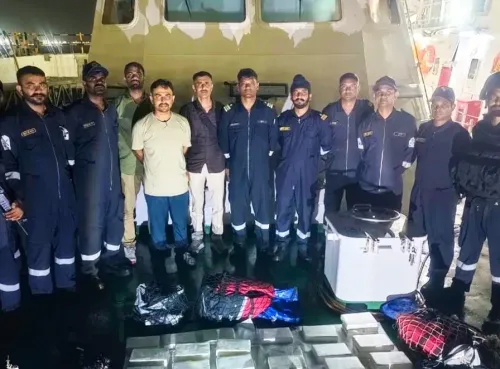
Mandapam (Tamil Nadu), March 5 (NationPress) The Indian Coast Guard (ICG) Station Mandapam conducted a swift and effective anti-smuggling operation in the coastal waters near Vedalai, resulting in the confiscation of approximately 280 kg of illegally collected sea cucumbers, as reported by an official.
The operation took place on March 3, following the receipt of credible intelligence, which allowed for the prompt deployment of an Air Cushion Vessel from the station.
The team successfully intercepted the shipment in the near-shore waters, averting what could have been a significant detriment to India’s marine biodiversity. Sea cucumbers, known scientifically as holothurians, are soft-bodied echinoderms that are among the most heavily protected marine species in India.
These organisms are categorized under “Schedule-I” of the Wildlife (Protection) Act, 1972, placing them in the same legal protection category as tigers and other critically endangered species. Their harvesting, possession, and trade are strictly forbidden unless under special scientific permits.
The rigorous protection of sea cucumbers is a response to years of over-exploitation fueled by increasing international demand, particularly from markets in China, Hong Kong, Japan, and other regions in East and Southeast Asia.
Dried sea cucumbers, referred to as beche-de-mer or trepang, command high prices as a luxury delicacy and component of traditional medicine, with some varieties being valued at lakhs of rupees per kilogram in illicit trade.
This demand has transformed areas like the Gulf of Mannar and Palk Bay into persistent hotspots for smuggling operations, often involving cross-border trafficking routes to Sri Lanka and beyond. Sea cucumbers serve a crucial ecological function as the “janitors” of the ocean floor.
They act as deposit feeders by consuming sediment, breaking down organic material, recycling nutrients, and excreting nutrient-rich waste that supports coral reefs, seagrass beds, and overall benthic health.
Their crucial “bioturbation activity” prevents the accumulation of organic matter, diminishes bacterial mats, and enhances productivity in nutrient-deficient tropical waters.
The removal of these species disrupts sediment dynamics, which can result in habitat degradation and diminished resilience in sensitive ecosystems like the Gulf of Mannar Biosphere Reserve.
Following the seizure, the entire 280 kg consignment was officially transferred to the “Forest Department” on March 4, 2026, for legal processing, documentation, and further action in accordance with wildlife regulations.
This incident emphasizes the ICG's increased vigilance in the Palk Strait–Gulf of Mannar corridor, where numerous sea cucumber seizures have occurred in recent years.
The force consistently conducts patrols with rapid interception vessels to combat poaching and trafficking syndicates that exploit marine resources.
While no immediate arrests were reported in the operation details, authorities are anticipated to investigate further to dismantle the supply chain behind such activities.
The ICG reaffirmed its commitment to enhanced coastal surveillance, anti-poaching initiatives, and collaboration with other agencies to safeguard endangered marine species and maintain India's coastal ecosystems for future generations.
Point of View
The recent interception by the Indian Coast Guard reflects a robust commitment to preserving marine biodiversity and enforcing wildlife protection laws. This operation underscores the importance of vigilance against illegal fishing practices, which pose a significant threat to ecological balance and conservation efforts.
NationPress
3 Oct 2026
Frequently Asked Questions
What are sea cucumbers?
Sea cucumbers are soft-bodied echinoderms, scientifically known as holothurians, that play a vital ecological role in marine environments.
Why are sea cucumbers protected?
They are protected under Schedule-I of the Wildlife (Protection) Act, 1972, due to over-exploitation and their ecological importance.
What is the demand for sea cucumbers?
Dried sea cucumbers are in high demand in international markets, particularly for use as luxury food items and traditional medicines.
How does the Indian Coast Guard address smuggling?
The ICG conducts regular patrols and uses fast interception vessels to combat poaching and trafficking syndicates exploiting marine resources.
What happens to seized sea cucumbers?
Seized sea cucumbers are handed over to the Forest Department for legal processing and further action under wildlife laws.