Operation Falcon: ANC and police hunt sea cucumber poachers in Andaman Islands

Synopsis
Three poachers are in custody and a gang hunt is active near Diglipur after the ANC intercepted an unauthorised boat on 9 August — the second major sea cucumber bust in two weeks. With some species fetching up to USD 35,000 per kg on illegal markets, and past arrestees routinely securing bail, India's enforcement machinery faces a test that goes well beyond the current search operation.
Key Takeaways
The Andaman and Nicobar Command (ANC) and local police launched Operation Falcon to dismantle a sea cucumber poaching gang near Diglipur .
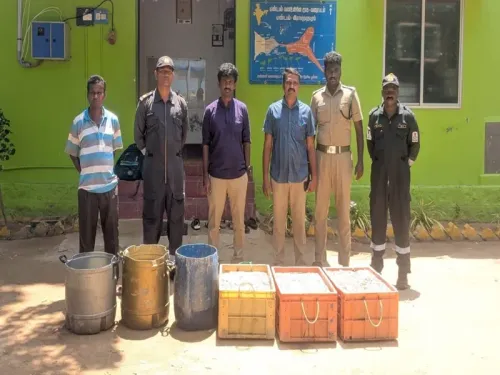
Three poachers were arrested on 9 August 2026 after an unauthorised boat was intercepted; additional gang members are suspected to be at large.
An earlier operation on 28–29 July 2026 resulted in one arrest and the seizure of over 300 kg of sea cucumber off Smith Island .
Sea cucumbers fetch between USD 300 and USD 3,500 per kg on illegal markets, with premium species reaching up to USD 35,000 per kg .
Sea cucumbers are listed under Schedule-I of the Wildlife Protection Act, 1972 — on par with tigers and elephants — making their possession entirely illegal in India.
Enforcement officials have flagged a pattern of arrested poachers obtaining bail and resuming the illegal trade.
The Andaman and Nicobar Command (ANC) and local police have launched a sustained search operation — dubbed Operation Falcon — to dismantle a gang involved in the large-scale poaching of sea cucumbers and other protected marine species in the waters around the Andaman and Nicobar Islands. The operation follows a series of interceptions that have already yielded arrests and significant seizures.
Key Developments
On Sunday, 9 August 2026, a joint ANC-police team intercepted an unauthorised boat and apprehended three poachers. The suspects were localised near Diglipur, and the search operation remains active as additional gang members are suspected to be in the area.
'On 09 Aug 26, while maintaining the security of national waters and safeguarding coastal integrity, ANC intercepted and apprehended an unauthorised boat. The intruders have been localised near Diglipur,' the ANC stated in a post on X. 'A coordinated search operation by ANC and AN Police led to the apprehension of three poachers. The presence of additional poachers in the area is suspected, and the search operation remains in progress,' it added.
Earlier Seizure Near Smith Island
This is not an isolated incident. On the intervening night of 28–29 July 2026, the ANC and police had already arrested a poacher from Diglipur after seizing a boat carrying over 300 kg of sea cucumber off Smith Island. The back-to-back operations indicate a sustained poaching presence in these waters, raising questions about the scale of the network operating in the region.
Why Sea Cucumbers Are Targeted
Despite their unassuming name, sea cucumbers are among the most sought-after commodities in the illegal marine trade. As detritivores, they perform a critical ecological function — breaking down organic matter and recycling nutrients, while their excretion of calcium carbonate actively supports coral reef health.
Their ecological value, however, is dwarfed in criminal markets by their commercial price. Sea cucumbers fetch between USD 300 and USD 3,500 per kg in the illegal international market, with certain premium species reportedly commanding up to USD 35,000 per kg. They are in high demand as a luxury food item and traditional medicine across East and South-East Asia, fuelling a thriving black market.
Legal Status and Enforcement Gaps
India has placed sea cucumbers under Schedule-I of the Wildlife Protection Act, 1972, affording them the same stringent protection as tigers, elephants, and one-horned rhinoceroses. Their possession is entirely prohibited. Yet enforcement remains a persistent challenge: poachers operate in the Andaman and Nicobar Islands and Lakshadweep, and similar incidents have been reported in Sri Lanka, which has since enacted stricter laws.
A recurring concern among enforcement officials is the weakness of prosecution. Many poachers arrested in past operations have reportedly secured bail and returned to the illegal trade — a pattern that critics argue undermines the deterrent value of arrests alone.
What Happens Next
The search operation is ongoing, with ANC and Andaman and Nicobar Police continuing to comb the area around Diglipur for suspected remaining gang members. The Indian Navy and Coast Guard maintain a standing watch for sea cucumber poaching activity across Indian waters. Whether the current operation leads to prosecution outcomes that break the bail-and-return cycle will be the real measure of its success.
Point of View
But the enforcement community's own admission — that past poachers routinely walk out on bail and return to the trade — exposes a structural failure that no number of interceptions can fix alone. India grants sea cucumbers the same legal protection as tigers, yet the prosecution machinery does not reflect that parity. The Andaman waters are remote, the seabed difficult to monitor, and the profit margins extraordinary; without mandatory minimum sentences and coordinated judicial follow-through, Operation Falcon risks becoming another data point in a long series of arrests that did not dent the network.
NationPress
25 Sept 2026
Frequently Asked Questions
What is Operation Falcon in the Andaman and Nicobar Islands?
Operation Falcon is an ongoing joint search operation by the Andaman and Nicobar Command (ANC) and Andaman and Nicobar Police to apprehend a gang involved in sea cucumber poaching. Three members were arrested on 9 August 2026 near Diglipur, and the hunt for additional suspects continues.
Why are sea cucumbers poached in Indian waters?
Sea cucumbers are in high demand as a luxury food and traditional medicine across East and South-East Asia, making them extremely valuable on illegal markets — fetching between USD 300 and USD 3,500 per kg, with some species reaching up to USD 35,000 per kg. India's remote island waters make enforcement difficult, attracting organised poaching gangs.
What is the legal status of sea cucumbers in India?
Sea cucumbers are listed under Schedule-I of the Wildlife Protection Act, 1972, which makes their possession, trade, and poaching entirely illegal. They enjoy the same protection level as tigers, elephants, and one-horned rhinoceroses.
What was seized in the earlier operation near Smith Island?
On the intervening night of 28–29 July 2026, ANC and police seized a boat carrying over 300 kg of sea cucumber off Smith Island near Diglipur and arrested one poacher. The latest operation on 9 August is a follow-up targeting the broader gang.
Why is prosecuting sea cucumber poachers difficult in India?
Enforcement officials have noted that many poachers arrested in past operations have obtained bail and returned to the illegal trade. The remote seabed locations where sea cucumbers are harvested also make surveillance and evidence-gathering challenging, weakening prosecution cases.