NTA report exposes 'grave incompetence': Congress after panel findings
Synopsis
A parliamentary panel chaired by Congress's Mukul Wasnik has found the NTA to be running on just 39 sanctioned posts — 41% vacant — entirely dependent on private contractors, sitting on a ₹590 crore surplus parked in FDs, and lacking even a full-time Director General during two successive paper leak crises. Congress's Jairam Ramesh says the report proves the government lied to Parliament when it claimed no NTA paper leak had ever occurred.
Key Takeaways
The Parliamentary Standing Committee on Education's 382nd report on the NTA was presented on 9 October , chaired by Congress MP Mukul Wasnik .
Congress leader Jairam Ramesh alleged the Ministry of Education made a "blatantly false" claim to the committee that no NTA paper leak had occurred between 2017 and 2025 ; he cited 9 documented irregularities .
The NTA has only 39 sanctioned posts , with just 23 officers in position — a vacancy of 41% — and all positions filled through short-term deputation.
The NTA accumulated a revenue surplus of ₹590 crore , reportedly invested in fixed deposits rather than used to upgrade examination infrastructure.
The panel recommended shifting NEET-UG entirely to Computer-Based Test (CBT) mode and setting up government-owned exam centres in every district.
Between the 2024 and 2026 NEET paper leaks, the post of NTA Director General reportedly remained vacant on a full-time basis.
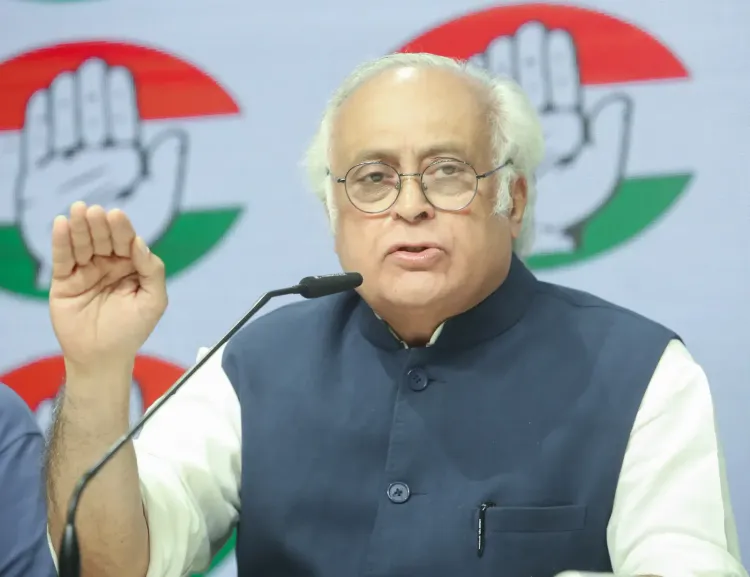
Senior Congress leader Jairam Ramesh on Sunday, 11 October mounted a sharp attack on the Central government after the Parliamentary Standing Committee on Education released its 382nd report on the National Testing Agency (NTA), alleging it lays bare "grave incompetence and malpractice" within the exam-conducting body and the Ministry of Education. The report, titled 'Reforms and Strengthening of the National Testing Agency (NTA)', was chaired by Congress Rajya Sabha member Mukul Wasnik and presented on 9 October.
Context: NEET-UG 2026 Cancellation
The report arrives in the aftermath of the cancellation of the NEET-UG 2026 examination following question paper leaks — the latest in a string of examination controversies surrounding the NTA. Among the committee's key recommendations are shifting medical entrance exams entirely to Computer-Based Test (CBT) mode, capping the maximum age and number of attempts for NEET-UG, and directing the NTA's financial surplus toward establishing government-owned examination centres in every district. The panel also called for stringent "quarantine" protocols for question-setters to curb paper leaks at source.
Ministry's Claim vs. Congress's Counter
Ramesh reserved particular criticism for what he described as a "blatantly false and audacious claim" by the Ministry of Education before the parliamentary committee — namely, that no paper leak had occurred in any NTA-conducted exam from its formation in 2017 until 2025. He alleged that at least 9 paper leaks and irregularities in NTA-conducted exams are documented. "What hope is there for a fair investigation or accountability when the Ministry even refuses to acknowledge what went wrong in the first place?" he said.
Ramesh also questioned the NTA's legal architecture, noting that the agency is registered as a society under the Societies Registration Act, 1860 rather than constituted as a statutory body through an Act of Parliament — a structure he said results in "limited accountability and parliamentary oversight." He described the NTA as a "khokhla body" that delegates all key responsibilities to private contractors.
Staffing Crisis and Contractor Dependence
According to Ramesh, the NTA has only 39 sanctioned positions, of which just 23 officers are currently in post — a vacancy rate of 41%. He noted that all permanent posts are filled through deputation, with officers serving tenures of only 2–3 years, preventing the development of institutional expertise. "This is despite the emphasis of the K Radhakrishnan Committee on building the NTA's staff strength," he added. The skeleton workforce, he argued, forces the agency into near-total reliance on private contractors for paper-setting, logistics, printing, and administration.
Transparency, Blacklists, and Results Publication
Ramesh pointed to a systemic gap: the absence of a nationwide blacklist of firms with poor track records in examination services. He alleged that firms blacklisted in one state routinely secure government contracts in others — a loophole that, in his view, creates recurring opportunities for malpractice. He also criticised the NTA for not publishing NEET-UG results in a publicly accessible format — unlike the Union Public Service Commission (UPSC) — arguing that the absence of test-centre-wise data prevents detection of anomalous performance patterns.
Leadership Vacuum and Surplus Funds
The Congress leader further alleged that between the NEET paper leak of 2024 and the NEET paper leak of 2026, the position of Director General of the NTA was held only on additional charge, leaving the agency without a full-time head during a period of acute institutional reform. He also claimed the NTA had accumulated a revenue surplus of ₹590 crore, which had reportedly been parked in fixed deposits to earn interest rather than deployed to upgrade examination infrastructure or support students. Taking aim at former Union Education Minister Dharmendra Pradhan, Ramesh recalled that Pradhan had dismissed a prior set of Standing Committee recommendations on NTA reform because the committee "had members of the Opposition in it." He concluded by urging the government to take the latest report seriously.
The Ministry of Education and the NTA had not issued a formal response to these allegations as of Sunday evening. How the government chooses to act on the parliamentary committee's recommendations — including the shift to CBT mode and the creation of district-level exam centres — will be closely watched in the weeks ahead.
Point of View
41% vacant, running entirely on private contractors, and sitting on ₹590 crore in idle surplus is not a governance oversight — it is a structural design failure. The Ministry's claim to Parliament that no NTA paper leak occurred between 2017 and 2025 is the most damaging detail in the report; if accurate as alleged, it suggests the institution tasked with holding students accountable has itself been less than accountable to lawmakers. The pattern of leaderless drift — a Director General post held on additional charge across two successive crises — points to a government that treated NTA reform as a political liability to be managed rather than a systemic problem to be fixed. With NEET-UG 2026 already cancelled, the next move belongs to the Centre: ignore the committee's CBT and staffing recommendations again, or finally treat the exam system as critical public infrastructure.
NationPress
11 Oct 2026
Frequently Asked Questions
What did the Parliamentary Standing Committee report on the NTA find?
The committee's 382nd report, presented on 9 October, recommended shifting NEET-UG entirely to Computer-Based Test mode, capping the age and number of attempts, establishing government-owned exam centres in every district, and introducing 'quarantine' protocols for question-setters. Congress leader Jairam Ramesh said the report exposes grave incompetence and malpractice within the NTA and the Ministry of Education.
Why has Congress attacked the Ministry of Education over this report?
Jairam Ramesh alleged that the Ministry made a 'blatantly false' claim to the committee that no paper leak had occurred in any NTA-conducted exam from 2017 to 2025, despite what he described as 9 documented paper leaks and irregularities. He argued that refusing to acknowledge past failures makes fair accountability impossible.
Why does the NTA rely so heavily on private contractors?
According to Ramesh, the NTA has only 39 sanctioned permanent posts — of which just 23 are filled, leaving a 41% vacancy — forcing the agency to depend on private contractors for paper-setting, logistics, printing, and administration. All permanent posts are filled through deputation with 2–3 year tenures, which he said prevents the build-up of institutional expertise.
What happened to the NTA's ₹590 crore revenue surplus?
According to Ramesh, the NTA accumulated a revenue surplus of ₹590 crore that was reportedly invested in fixed deposits to earn interest, rather than being deployed to upgrade examination infrastructure or support students — a point the parliamentary panel flagged in its recommendations.
What is the NEET-UG 2026 status following the paper leak?
The NEET-UG 2026 examination was cancelled following question paper leaks — the backdrop against which the parliamentary panel's report was released. A revised date for the examination has not been confirmed, and the committee's recommendations, including a full shift to CBT mode, are intended to prevent a recurrence.