Can the Right to Protest Disrupt Public Order?

Synopsis
The Delhi court's recent ruling on the Youth Congress protest underscores the delicate balance between the right to protest and maintaining public order. This landmark decision emphasizes that dissent must respect the rights of others, especially during significant international events. The implications of this ruling could resonate throughout future protests.
Key Takeaways
The right to protest is fundamental but not absolute.
Protests must respect public order and the rights of others.
Judicial rulings can shape the future of protests in India.
National events require heightened security measures.
Political discourse must balance dissent with civic responsibility.
New Delhi, Feb 22 (NationPress) A Delhi court remarked that even though the right to protest is a vital component of democracy, it must not be executed in a way that disturbs public order or infringes on the rights of others, especially during an international event with foreign delegates.
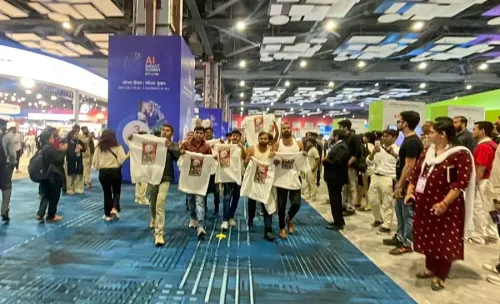
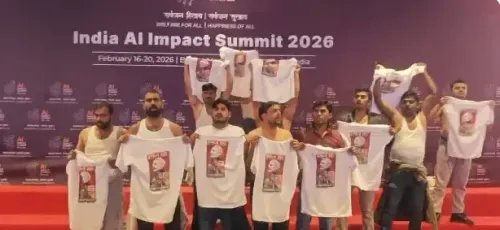
The Patiala House Court made this remark on Saturday while placing four Youth Congress members — Krishan Hari, Kundan, Ajay Kumar Singh, and Narsimha — in five days of police custody due to a shirtless protest at the AI Summit 2026 held at Bharat Mandapam.
According to the prosecution, the accused had engaged in a “pre-planned conspiracy” by gathering on February 20 at this high-security venue, donning T-shirts with the message “India US Trade Deal Compromised”, shouting provocative and anti-national slogans, creating chaos, and allegedly assaulting police officers, resulting in injuries to three personnel.
An FIR was lodged at the Tilak Marg police station under various sections of the Bharatiya Nyaya Sanhita (BNS), including Sections 61(2), 121(1), 132, 195(1), 221, 223(A), 190, 196, 197 and 3(5).
In its ruling, the court emphasized that the summit was “an international event attended by national and foreign delegates” and that the accused reportedly executed a “premeditated intrusion” into the high-security zones of Bharat Mandapam during this pivotal gathering.
Rejecting the argument that their actions constituted protected dissent under Articles 19(1)(a) and 19(1)(b) of the Constitution, Judicial Magistrate First Class Ravi stated: “The right to protest and dissent is fundamental to democracy, enshrined under Article 19(1)(a) and (b) of the Constitution. However, it is not absolute and subject to reasonable restrictions under Article 19(2) and (3) for sovereignty, public order and decency.”
Quoting the Supreme Court’s decision in Amit Sahni v. Commissioner of Police regarding the Shaheen Bagh protests, the court noted: “The right to protest is part of fundamental freedoms under Articles 19(1)(a) & (b), but cannot extend to causing grave inconvenience to commuters… public ways cannot be indefinitely occupied… rights of protesters must be balanced with rights of others under Article 21… protests must be at designated places even with permission.”
The ruling indicated that the conduct alleged in this case “palpably transcends the ambit of legitimate dissent, metamorphosing into a blatant assault on public order”.
It further stated that such actions “imperil not merely the event's sanctity but also the Republic's diplomatic image before foreign stakeholders, rendering it wholly unprotected by constitutional safeguards.”
On the matter of police custody, the court remarked that while “bail is the rule, jail is the exception”, discretion may be exercised when investigative needs are demonstrated.
The Investigating Officer asserted that custodial interrogation was essential to determine the identities and roles of other co-accused who allegedly fled the scene, uncover the larger conspiracy, including funding and organizational support, recover and analyze digital evidence such as mobile phones and social media communications, and trace the source of T-shirt production and associated financial transactions.
The court concluded that the investigation was at a pivotal stage and that the requirements outlined by the Delhi Police, including confrontation with electronic evidence and tracing financial and organizational connections, could not be effectively executed while in judicial custody.
While acknowledging the Supreme Court’s principle that “bail is the rule and jail the exception”, the court determined that the severity of the allegations, the presence of absconding associates, and the potential for evidence tampering warranted the denial of bail at this time.
Referring to the bail application as “premature and untenable at this nascent investigative juncture,” the order noted that the charges involved “grave threats to public order and state security at an international forum.”
“In light of the above, the application under Section 187 BNSS for police custody remand of all four accused persons is approved for five days,” the court ordered, directing that the accused be handed over to the Investigating Officer until February 25.
BJP leaders criticized the protest, calling it inappropriate and accusing the Congress of trying to derail a national event showcasing India’s technological advancements.
In a statement, the youth wing of the opposition Congress asserted that the demonstration aimed to raise concerns that “corporate interests are being prioritized over national interests” and alleged that the government’s foreign policy stance had weakened. The group also connected the protest to economic issues, such as rising prices and unemployment, claiming that young people were becoming increasingly frustrated.
Point of View
It is essential to recognize that while the right to protest is integral to democracy, it must be exercised responsibly. This ruling serves as a reminder that the exercise of rights should not infringe on public order or the rights of others. Striking a balance between dissent and public safety is crucial, particularly during significant national and international events.
NationPress
24 Sept 2026
Frequently Asked Questions
What was the reason for the protest?
The protest aimed to highlight concerns regarding the prioritization of corporate interests over national interests and included slogans about the 'India US Trade Deal.'
What were the consequences of the protest?
The protest led to injuries among police officers and resulted in the arrest of four Youth Congress members, who were remanded to police custody.
How did the court justify denying bail?
The court justified denying bail by highlighting the severity of the allegations and the potential risk of evidence tampering at this critical stage of the investigation.
What does this ruling mean for future protests?
This ruling sets a precedent that protests must not disrupt public order and emphasizes the need for designated places for protests, even when dissent is involved.
What impact did the protest have on public perception?
The protest sparked criticism from BJP leaders who claimed it was inappropriate, while the Congress youth wing framed it as a response to economic frustrations among young people.