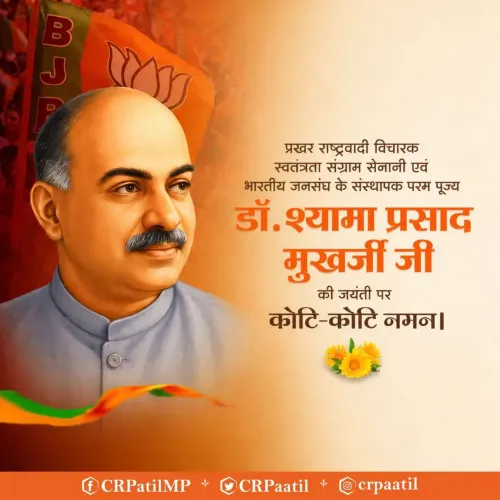
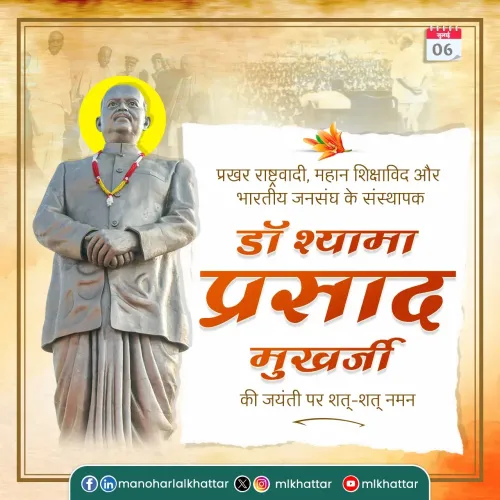
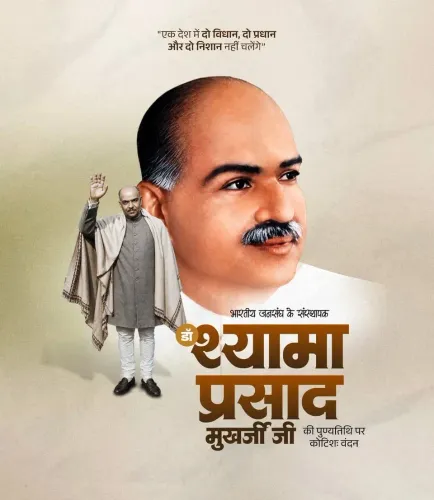
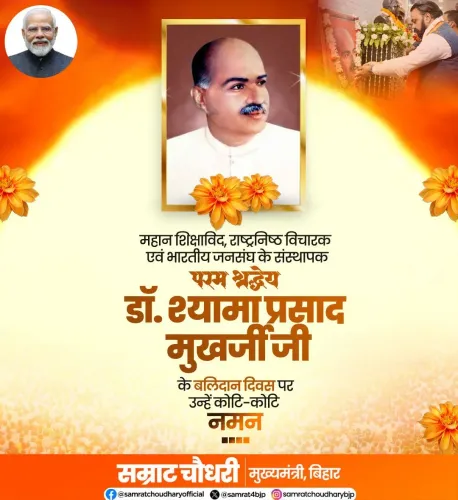
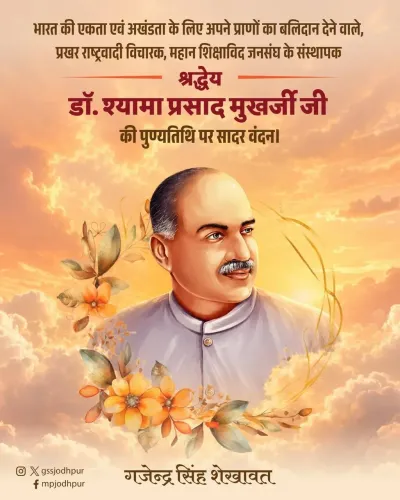
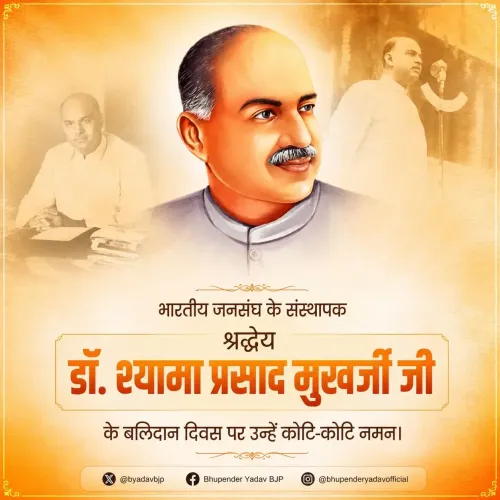
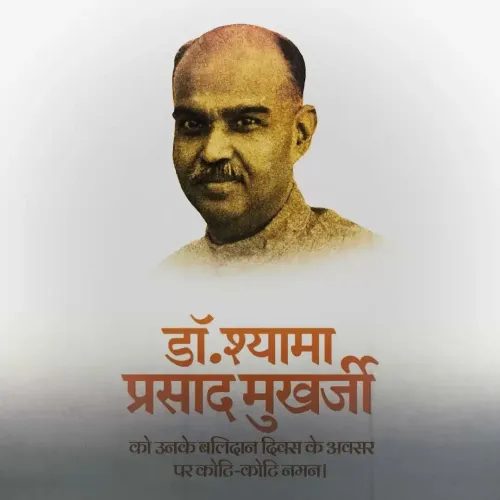
Jal Shakti Minister CR Paatil pays tribute to Dr. Shyama Prasad Mukherjee
Synopsis
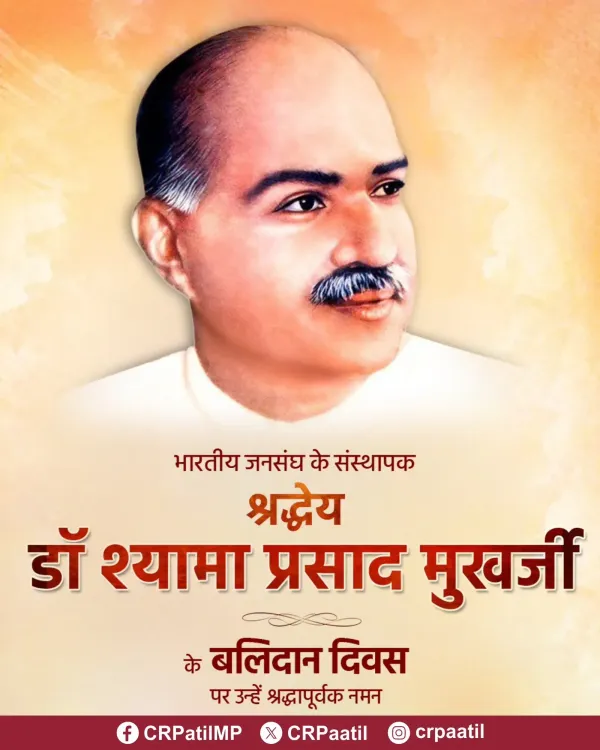
Union Jal Shakti Minister C. R. Paatil on 23 June 2026 paid tribute to Bharatiya Jana Sangh founder Dr. Shyama Prasad Mukherjee on Balidan Diwas, honouring his sacrifice for national unity, sovereignty, and cultural integrity as an enduring inspiration for public service.
Key Takeaways
Paatil , Union Minister of Jal Shakti, paid tribute to Dr.
Shyama Prasad Mukherjee on 23 June 2026 , his Balidan Diwas.
Mukherjee died on 23 June 1953 in custody in Jammu and Kashmir while protesting the special permit requirement for Indian citizens entering the state.
He founded the Bharatiya Jana Sangh in 1951 , the direct ideological predecessor of the BJP .
The BJP has observed 23 June as Balidan Diwas annually since at least the 1980s, with the day gaining renewed salience after Article 370 was revoked in 2019 .
Minister Paatil's tribute emphasised Dr.
Mukherjee's belief that India's sovereignty and national unity are paramount, and called his life an inspiration for 'Nation First' values.
Union Jal Shakti Minister C. R. Paatil on Tuesday, 23 June 2026 paid tribute to Dr. Shyama Prasad Mukherjee, founder of the Bharatiya Jana Sangh, on his Balidan Diwas (Martyrdom Day), honouring the leader's lifelong commitment to national unity, sovereignty, and cultural identity.
Context
Minister Paatil's post, written in Hindi, described Dr. Mukherjee as a 'प्रखर राष्ट्रचिंतक, शिक्षाविद् और दूरदर्शी नेता' — 'an ardent nationalist thinker, educationist, and visionary leader' — who dedicated his life to the nation's unity, integrity, and cultural identity. The tribute called Dr. Mukherjee's sacrifice an enduring inspiration for public service and the principle of 'Nation First'.
Dr. Shyama Prasad Mukherjee died on 23 June 1953 while in custody in Jammu and Kashmir, where he had gone to protest the requirement for a special permit for Indian citizens to enter the state — a restriction he linked to the region's special constitutional status under Article 370. His death in detention became a defining moment in the political history of Indian nationalism.
Policy Backdrop
Dr. Mukherjee founded the Bharatiya Jana Sangh in 1951 as a platform advocating integral nationalism and the full constitutional integration of Jammu and Kashmir with the rest of India. The Jana Sangh's ideological legacy was carried forward by the Bharatiya Janata Party (BJP), which formally succeeded it after the Janata Party experiment of the late 1970s.
The BJP has observed 23 June as Balidan Diwas annually since at least the 1980s. The commemoration gained renewed political salience after the Indian government revoked Article 370 in August 2019, an act the party framed as the fulfilment of Dr. Mukherjee's unfinished mission. Senior ministers and party functionaries routinely use the anniversary to connect the current government's agenda to the Jana Sangh's founding principles.
Stakeholders and Impact
Tributes on Balidan Diwas are directed primarily at BJP workers, RSS-affiliated organisations, and a broader constituency of voters who identify with cultural nationalism. For the party's rank and file, the day functions as an occasion to reaffirm ideological continuity between the Jana Sangh era and the present dispensation.
Dr. Mukherjee's legacy is also invoked in debates on federalism and internal security, where his opposition to differential treatment of any Indian territory remains a touchstone. Minister Paatil's post specifically emphasised that Dr. Mukherjee believed 'भारत की संप्रभुता और राष्ट्रीय एकता सर्वोपरि है' — 'India's sovereignty and national unity are paramount' — a framing consistent with the BJP's long-standing position on territorial integrity.
What's Next
Statements from other Union ministers and RSS-linked organisations are expected through the day, as Balidan Diwas typically sees coordinated commemorations across the BJP's organisational network. Any references to Dr. Mukherjee's vision in ongoing parliamentary or policy debates on federalism and internal security will be closely watched. The annual tribute cycle reinforces the BJP's effort to anchor its contemporary governance narrative in a lineage that predates independence-era political formations.
Point of View
Linking the current government's record — most visibly the 2019 revocation of Article 370 — to Dr. Shyama Prasad Mukherjee's founding vision of integral nationalism. Minister Paatil's post follows a well-established template that frames the Jana Sangh legacy as the moral foundation of BJP governance, reinforcing the party's self-image as the custodian of national unity. The consistency of this messaging across the ministerial hierarchy signals that Balidan Diwas functions as much as an internal mobilisation tool as a public commemoration. Over time, such tributes also serve to insulate the party's territorial-integrity positions from political contestation by grounding them in a revered historical sacrifice.
NationPress
21 Sept 2026
Frequently Asked Questions
Who was Dr. Shyama Prasad Mukherjee?
Dr. Shyama Prasad Mukherjee was an Indian politician, educationist, and the founder of the Bharatiya Jana Sangh in 1951. He championed national integration and opposed the special constitutional status of Jammu and Kashmir, dying in custody in the state on 23 June 1953.
What is Balidan Diwas?
Balidan Diwas, or Martyrdom Day, is observed on 23 June each year to mark the death of Dr. Shyama Prasad Mukherjee in 1953. The BJP and its affiliated organisations hold commemorations across the country on this day.
Why did Dr. Shyama Prasad Mukherjee go to Jammu and Kashmir?
Dr. Mukherjee travelled to Jammu and Kashmir in 1953 to protest the requirement that Indian citizens obtain a special permit to enter the state, a restriction he linked to its differential constitutional status under Article 370. He was detained and died in custody on 23 June 1953.
What is the connection between the Bharatiya Jana Sangh and the BJP?
The Bharatiya Jana Sangh, founded by Dr. Mukherjee in 1951, is the direct ideological predecessor of the Bharatiya Janata Party. After the Jana Sangh merged into the Janata Party in the late 1970s, its members reconstituted themselves as the BJP in 1980.
Who is C. R. Paatil?
C. R. Paatil is a senior BJP leader from Gujarat and currently serves as India's Union Minister of Jal Shakti. He previously served as the BJP's Gujarat state president and is a member of the Lok Sabha.