Shekhawat hails CRPF's 47-year first: zero operational casualties

Synopsis
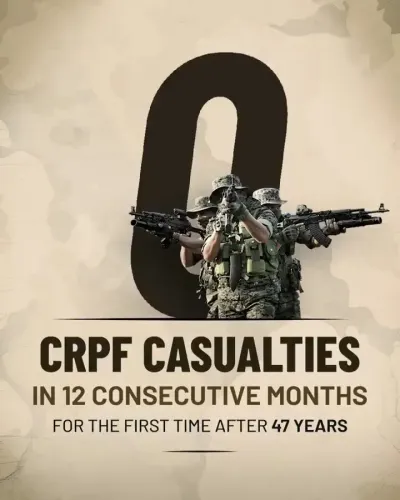
Union Minister Gajendra Singh Shekhawat has hailed a landmark CRPF achievement: 12 consecutive months of zero operational casualties in anti-Naxal operations — the first such record since 1979 — crediting PM Modi and Home Minister Amit Shah's strategy.
Key Takeaways
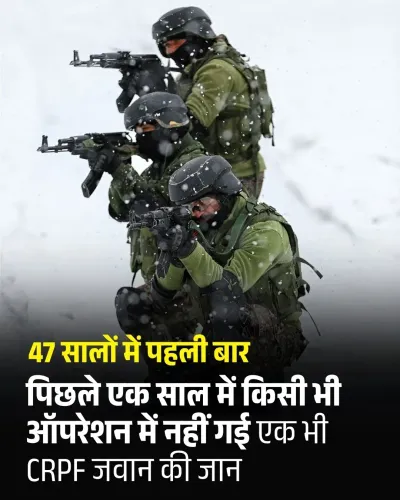
CRPF has completed 12 consecutive months of zero operational casualties in anti-Naxal operations, the first time since 1979 .
Union Minister Gajendra Singh Shekhawat announced the milestone on 4 November 2026 , saluting CRPF personnel.
The achievement is attributed to PM Narendra Modi's leadership and Home Minister Amit Shah's counter-Naxal strategy.
The SAMADHAN doctrine (2017) — combining security operations with development — underpins the government's LWE approach.
Official data has shown a progressive shrinkage of LWE-affected districts and declining violence incidents since 2014 .
The MHA's next annual LWE report will be a key indicator of whether this trend is sustained.
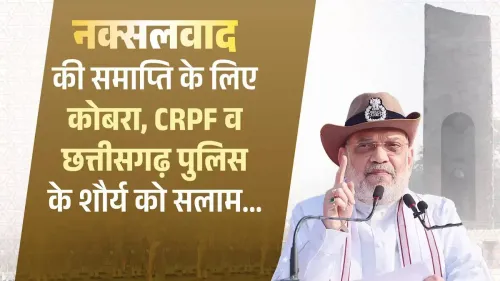
For the first time since 1979 — a gap of 47 years — the Central Reserve Police Force (CRPF) has completed 12 consecutive months without a single operational casualty in its anti-Naxal theatre. Union Culture and Tourism Minister Gajendra Singh Shekhawat marked the milestone on Wednesday, 4 November 2026, calling it a historic achievement for the force and a testament to the resolve of a 'new India.'
Posting in Hindi, Shekhawat wrote: '1979 ke baad pehli baar CRPF ne lagaatar 12 mahinon tak shunya operational casualty ka record banaya hai' — 'For the first time since 1979, CRPF has set a record of zero operational casualties for 12 consecutive months.' He credited Prime Minister Narendra Modi's 'decisive leadership' and Union Home Minister Amit Shah's 'precise strategy' for delivering what he described as an unprecedented success in the campaign against Naxalism.
Twelve months without a loss — what the number means
The CRPF is India's largest central armed police force and the primary instrument of the state in counter-insurgency operations across Left Wing Extremism (LWE)-affected districts in central and eastern India. For decades, the Naxal conflict extracted a steady toll in personnel lives — making a full calendar year of zero operational fatalities a figure that cuts through routine security-speak. The last time the force recorded a comparable stretch of uninterrupted operational safety was before most of its current recruits were born.
Shekhawat's post attributes the turnaround to three interlocking factors: 'better strategy, modern technology, and a robust security architecture' — a formulation that maps closely onto the SAMADHAN doctrine, the Ministry of Home Affairs' comprehensive LWE framework introduced in 2017. SAMADHAN blends area domination operations with roads, mobile connectivity, and financial inclusion in Naxal-affected zones, aiming to drain the insurgency's support base while simultaneously hardening security forces.
A shrinking red corridor — the policy arc behind the milestone
The milestone does not arrive without context. Since 2014, successive MHA annual assessments have documented a steady contraction in both the geographic spread of Naxal influence and the annual count of violence incidents. Districts once classified as 'most affected' have been progressively removed from that list; targeted operations have neutralised senior Maoist commanders. The government has repeatedly pointed to declining casualty data as measurable proof that its twin-track approach — force modernisation plus development spending — is working.
The CRPF itself has been the beneficiary of expanded intelligence-sharing networks, drone-assisted area reconnaissance, and better-equipped quick-reaction teams — all components of the modernisation push that Shekhawat's post gestures toward. The minister closed with a salute to the force's personnel: 'CRPF ke veer jawanon ko koti-koti naman!' — 'A million salutes to the brave soldiers of CRPF!'
What the government watches next
The benchmark now set, the pressure is on the security establishment to sustain it. The MHA's next annual LWE report will be closely read for district-wise data confirming whether the zero-casualty stretch holds and whether further districts earn 'Naxal-free' declarations. Any reversal would be politically significant given the scale of the claim being made today. For now, though, a 47-year record stands — and the government is making sure the country hears about it.
Point of View
A narrative that ties internal-security success directly to central leadership. The invocation of SAMADHAN's twin pillars — force and development — positions the milestone within a larger ideological argument that law-and-order gains and welfare delivery are inseparable. Sustaining the record, and translating it into lasting district-level stability, will determine whether the claim ages well.
NationPress
4 Nov 2026
Frequently Asked Questions
What is the CRPF zero casualty milestone announced in November 2026?
The CRPF has gone 12 consecutive months without a single operational casualty in its anti-Naxal operations — the first such record since 1979, a gap of 47 years.
What is the SAMADHAN doctrine for Naxal areas?
SAMADHAN is the Ministry of Home Affairs' comprehensive Left Wing Extremism strategy introduced in 2017, combining targeted security operations with development initiatives like roads, connectivity, and financial inclusion in affected districts.
Which districts are affected by Naxalism in India?
Left Wing Extremism has historically been concentrated in districts across Chhattisgarh, Jharkhand, Odisha, Maharashtra, and parts of Telangana and Andhra Pradesh — collectively called the 'red corridor,' which has shrunk significantly in recent years per government data.
What role does Amit Shah play in anti-Naxal operations?
As Union Home Minister, Amit Shah oversees India's internal security policy, including the counter-LWE strategy. He has been credited by the government with driving the operational and strategic coordination behind recent successes against Naxalism.
What is the CRPF's role in counter-Naxal operations?
The CRPF — India's largest central armed police force — is the primary instrument deployed in counter-insurgency operations in LWE-affected regions, working alongside state police forces and other central agencies.