CM Saini Hails Zero CRPF Casualties in Anti-Naxal Ops
Synopsis
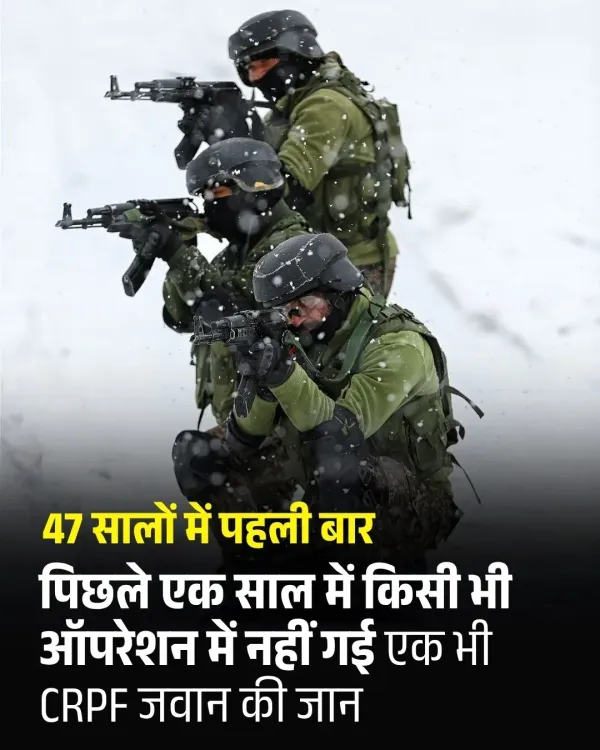
Haryana Chief Minister Nayab Singh Saini highlighted that no CRPF jawan suffered an operational casualty in anti-Naxal operations over the past 12 months — a feat not achieved since 1979 — crediting Prime Minister Modi's security policy and the bravery of security forces.
Key Takeaways
For the first time since 1979 , the CRPF recorded zero operational casualties in anti-Naxal operations over a 12-month period, according to CM Nayab Singh Saini .
At its peak, Left-Wing Extremism affected more than 100 districts across India; that number has fallen sharply over the past decade.
CM Saini credited Prime Minister Narendra Modi 's government for a coordinated strategy of security operations, development, and state-centre coordination.
The CRPF is the principal central paramilitary force responsible for anti-Naxal operations in central and eastern India.
CM Saini expressed heartfelt gratitude to all CRPF personnel, calling the life of every jawan 'priceless.'
For the first time since 1979, not a single CRPF jawan has lost their life in operational anti-Naxal duty over the preceding 12 months — a milestone that Haryana Chief Minister Nayab Singh Saini called a new chapter in India's internal security history on Tuesday, November 3, 2026.
A 47-Year Gap, Closed
In a post on X, CM Saini wrote: '1979 के बाद पहली बार हासिल हुई यह स्थिति' — 'this achievement realised for the first time after 1979' — attributing it to the security policy and sustained efforts of the central government under Prime Minister Narendra Modi. The Central Reserve Police Force is the primary paramilitary force that has shouldered the weight of anti-Naxal operations across central and eastern India for decades. Zero operational casualties in a full calendar year is not a statistical footnote. It is a rupture from a long, painful norm.
From 100-Plus Districts to a Shrinking Map
The scale of the reversal is striking. At its peak, Left-Wing Extremism gripped more than 100 districts across the country — a belt stretching through Chhattisgarh, Jharkhand, Odisha, Maharashtra, Andhra Pradesh and beyond. CM Saini noted that an effective strategy, a strengthened security apparatus, and relentless operations by security forces have brought about 'a sweeping change in circumstances.' Official data from the Ministry of Home Affairs over the last decade has tracked a consistent decline in both the number of affected districts and the frequency of violent incidents — a trend the government has repeatedly cited as evidence of a coordinated approach combining security operations, development programmes, and state-centre coordination that has been pursued since 2014.
The Human Ledger Behind the Numbers
Before closing with the statistic, Saini grounded it in human terms: 'देश के लिए अपना सर्वस्व समर्पित करने वाले प्रत्येक जवान का जीवन अनमोल है' — 'the life of every jawan who dedicates everything for the country is priceless.' The acknowledgement matters. The long war against Naxalism has claimed hundreds of CRPF lives over the years; every operational year without a fatality represents families that did not receive the knock they feared. Saini expressed his 'heartfelt gratitude to all the brave jawans.'
The benchmark now shifts to whether the winter session of Parliament and the next MHA annual report on Left-Wing Extremism will formalise and extend this milestone — and whether the security gains can be locked in with lasting development in the districts that are finally emerging from decades of conflict.
Point of View
Lending credibility to the directional argument even as the specific 12-month figure awaits official corroboration. The political subtext is clear: the government wants 'zero casualties' to become as recognisable a brand marker on internal security as surgical strikes became on external security.
NationPress
3 Nov 2026
Frequently Asked Questions
What is the significance of zero CRPF casualties in anti-Naxal operations?
It means no CRPF jawan died in operational anti-Naxal duty over the past 12 months — a situation not recorded since 1979, according to Haryana CM Nayab Singh Saini. It signals a major improvement in security conditions in formerly Naxal-affected regions.
How many districts in India were affected by Naxalism at its peak?
At its peak, Left-Wing Extremism affected more than 100 districts across India, spanning states like Chhattisgarh, Jharkhand, Odisha, Maharashtra, and Andhra Pradesh. That number has fallen significantly over the last decade.
What is CRPF's role in anti-Naxal operations?
The Central Reserve Police Force (CRPF) is the primary central paramilitary force deployed for anti-Naxal operations in central and eastern India, often operating in difficult terrain alongside state police.
What strategy has the Indian government used to reduce Naxal violence?
Since 2014, the central government has followed a coordinated approach combining security operations, development programmes, and closer state-centre coordination to reduce Left-Wing Extremism across affected districts.
Who is Nayab Singh Saini?
Nayab Singh Saini is the Chief Minister of Haryana and a senior BJP leader. He made the statement on X on November 3, 2026, highlighting the anti-Naxal security milestone under PM Modi's leadership.