CM Vijay launches Rs.3,000 cr SHG credit drive in Erode
Synopsis
Tamil Nadu CM C. Joseph Vijay launched a Rs.3,000 crore bank credit programme for 26,000 Women SHGs at Perundurai, Erode on 3 November 2026, handing over Rs.1,110 crore to 9,000 groups along with skill training and retail outlet approvals.
Key Takeaways
Rs.3,000 crore total credit linkage programme launched for 26,000 Women SHGs across Tamil Nadu.
Initial tranche of Rs.1,110 crore disbursed to 9,000 SHGs at Perundurai, Erode district on 3 November 2026 .
Remaining Rs.1,890 crore earmarked for the balance 17,000 SHGs in subsequent phases.
Sanction orders issued for youth skill training programmes and retail outlets for SHG products .
Programme executed by the Tamil Nadu Corporation for Development of Women under the Rural Development and Panchayat Raj Department.
Continues the decades-long Mahalir Thittam SHG policy lineage with an unprecedented single-event credit scale.
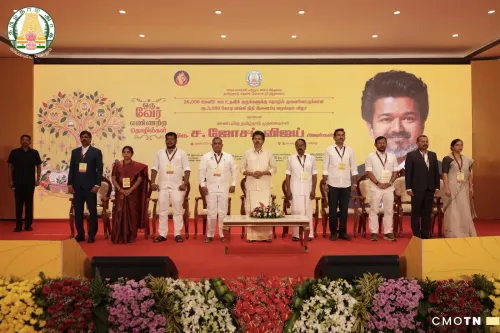
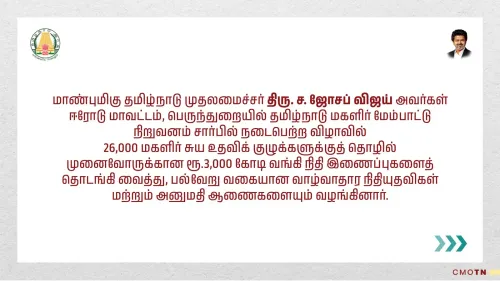
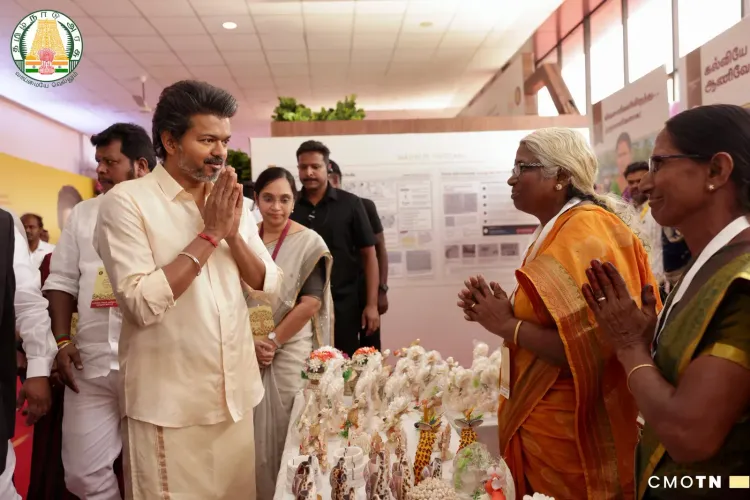
Twenty-six thousand women across Tamil Nadu woke up on 3 November 2026 with a direct line to bank credit — and the state's economy just got a measurable push from the ground up. The Chief Minister's Office of Tamil Nadu announced that Chief Minister C. Joseph Vijay personally handed over initial credit linkage orders worth Rs.1,110 crore to 9,000 Women Self-Help Groups (SHGs) at a function in Perundurai, Erode district, formally launching a statewide Rs.3,000 crore credit linkage programme for entrepreneurship that will ultimately reach 26,000 SHGs across Tamil Nadu.
What Rs.3,000 crore looks like on the ground in Perundurai
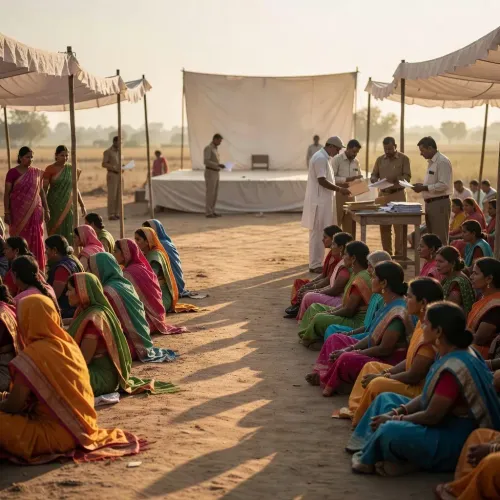
The event was organised by the Tamil Nadu Corporation for Development of Women (TNCDW), the state agency that operates under the Rural Development and Panchayat Raj Department and has been the institutional backbone of women's SHG policy in the state for decades. Beyond the headline credit figure, the occasion was packed with operational clearances: the Chief Minister distributed sanction orders for youth skill training programmes and — critically — approvals for setting up retail outlets dedicated to SHG products. Livelihood assistance funds were also distributed on the spot.
The choice of Erode — a western Tamil Nadu district where textiles, agriculture and small-scale industry converge — was deliberate. It is exactly the kind of economy where women's micro-enterprises find traction, and where a bank-credit injection can ripple quickly into household incomes.
The Rs.1,890 crore still in the pipeline — and why it matters
Tuesday's disbursement covered 9,000 SHGs worth Rs.1,110 crore. The balance — Rs.1,890 crore for the remaining 17,000 groups — is yet to be released, making the phased rollout the clearest near-term metric to watch. Market observers and SHG federations will be tracking whether the approved retail outlets actually get off the ground, since market linkage has historically been the weakest link in the SHG chain: groups can produce, but selling at scale requires infrastructure the state is now formally committing to provide.
Mahalir Thittam's long arc — and where today fits in it
Tamil Nadu's women SHG ecosystem didn't emerge overnight. Mahalir Thittam, the state's flagship SHG programme, has been running since the late 1990s, building the savings, group-discipline and credit-history foundation that makes today's Rs.3,000 crore commitment viable. Credit linkage has featured in state budgets and in the National Rural Livelihoods Mission framework since the early 2010s. What the present announcement adds is scale and bundling — credit, skills and markets in a single event — rather than a wholly new architecture.
Tamil Nadu governments of different political stripes have consistently returned to the SHG credit model as a rural women's economic tool. The pattern is familiar; the quantum is not.
Point of View
000 crore SHG credit launch is the largest single-event credit mobilisation in Tamil Nadu's women-empowerment policy record, signalling that the Vijay government is leaning on proven micro-enterprise architecture to deliver early economic optics. Bundling credit with retail outlet approvals and skill-training orders in one ceremony is a deliberate political choice — it frames the state not just as a lender but as a market-builder. The real test, however, is execution: Tamil Nadu's SHG history shows that bank credit reaches groups faster than markets do, and the operationalisation of the approved retail network will be the true measure of whether this programme breaks the usual pattern. Nationally, this scale of SHG credit linkage in a single state event also sets a benchmark in the National Rural Livelihoods Mission conversation.
NationPress
3 Nov 2026
Frequently Asked Questions
What is the Rs.3,000 crore SHG credit programme launched in Tamil Nadu?
It is a statewide bank credit linkage programme for entrepreneurship that will benefit 26,000 Women Self-Help Groups across Tamil Nadu. CM C. Joseph Vijay launched it on 3 November 2026 at Perundurai, Erode, with an initial disbursement of Rs.1,110 crore to 9,000 SHGs.
How many SHGs will benefit from the Tamil Nadu credit linkage programme?
26,000 Women SHGs will benefit in total. Of these, 9,000 groups received orders worth Rs.1,110 crore at the launch event; the remaining 17,000 groups will receive the balance Rs.1,890 crore in subsequent phases.
Which organisation is implementing the SHG programme in Tamil Nadu?
The Tamil Nadu Corporation for Development of Women (TNCDW) , a state agency under the Rural Development and Panchayat Raj Department , is the implementing body for this programme.
What else was announced at the Perundurai event beyond credit linkage?
CM Vijay also distributed livelihood assistance funds , issued sanction orders for youth skill training programmes , and granted approvals for setting up retail outlets dedicated to selling SHG products .
What is Mahalir Thittam and how does it relate to this programme?
Mahalir Thittam is Tamil Nadu's flagship women SHG scheme, running since the late 1990s . The new Rs.3,000 crore credit linkage initiative builds on its foundation of group savings, credit access and micro-enterprise promotion, continuing a policy arc that spans multiple governments.