Nadda Targets Akhilesh Over UP Violence Record
Synopsis
Union Health Minister J. P. Nadda invoked violence in seven Uttar Pradesh cities — including Muzaffarnagar — during Akhilesh Yadav's 2012–2017 Samajwadi Party government, signalling an early BJP offensive ahead of the 2027 UP assembly elections.
Key Takeaways
Nadda , Union Health Minister and BJP national president, posted on November 3, 2026 citing violence under Akhilesh Yadav's UP government.
Cities named include Muzaffarnagar, Bareilly, Mathura, Pratapgarh, Meerut, Prayagraj, and Lucknow .
The 2013 Muzaffarnagar communal riots , which occurred under SP rule, remain one of the most criticised law-and-order episodes of Akhilesh Yadav's tenure.
The post carries the hashtag #SaveDemocracyRemoveAnarchy , framing the attack as a broader democratic argument.
The BJP has consistently deployed the 2012–2017 SP governance record as an electoral attack line, dating back to the 2017 state election.
The post signals early national-level BJP engagement ahead of the 2027 Uttar Pradesh assembly elections .
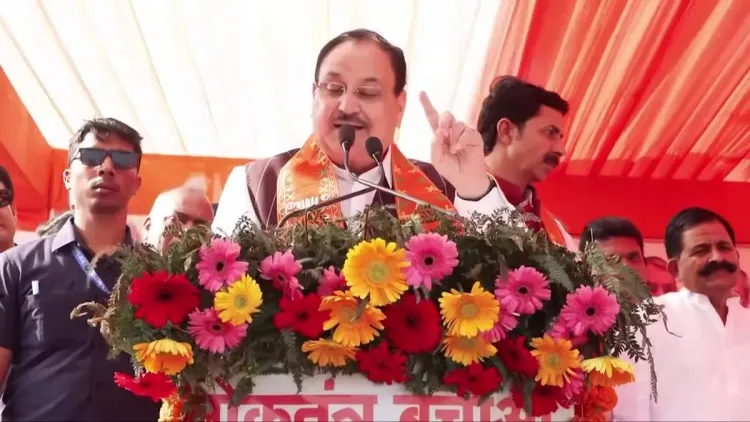
With Uttar Pradesh's 2027 assembly elections drawing closer, Union Health Minister J. P. Nadda fired a pointed salvo at Samajwadi Party chief Akhilesh Yadav on Tuesday, November 3, 2026, invoking a roll-call of cities scarred by violence during the 2012–2017 SP government — and tagging the broadside with the hashtag #SaveDemocracyRemoveAnarchy.
Nadda's post names Muzaffarnagar, Bareilly, Mathura, Pratapgarh, Meerut, Prayagraj, and Lucknow as sites of violence under Akhilesh Yadav's watch — a list that anchors an abstract law-and-order charge in specific, mappable places. The Muzaffarnagar reference carries the heaviest historical weight: the 2013 communal riots in the district, which erupted during Akhilesh Yadav's tenure, left dozens dead and drew national condemnation over the state government's handling of the crisis.
The 2013 Muzaffarnagar Riots and Their Political Afterlife
The Muzaffarnagar riots of August–September 2013 became one of the most consequential law-and-order episodes in recent UP history. The violence, which swept through western Uttar Pradesh, killed scores of people and displaced tens of thousands. Critics at the time accused the Samajwadi Party government of a delayed and inadequate response. The BJP has returned to that episode consistently in every subsequent electoral cycle as a benchmark of SP governance.
By pairing Muzaffarnagar with six other cities — Bareilly, Mathura, Pratapgarh, Meerut, Prayagraj, and Lucknow — Nadda's framing suggests a pattern rather than an isolated incident. Each city named has its own contested local memory from that period, lending the charge a geographic breadth that is hard to dismiss as cherry-picking.
BJP's Standard Pre-Electoral Playbook — And Why It Still Lands
This kind of messaging is a well-worn but durable instrument in Indian electoral politics. National parties routinely excavate state-level governance failures when they sense an opening. For the BJP, the 2012–2017 SP government record in Uttar Pradesh — especially on communal violence and crime — has been a dependable attack line since the 2017 state election that swept Yogi Adityanath to power.
What makes the November 2026 iteration notable is timing: with the next UP assembly contest on the horizon, and the SP positioning itself as the principal challenger, Nadda's intervention signals that the national party apparatus — not just the state unit — is already engaged in the narrative battle. A BJP national president directly amplifying a state-level law-and-order charge is a statement of electoral priority.
The Samajwadi Party has not yet publicly responded to this specific post. Watch for a counter-offensive that draws on the 2017–2027 BJP government's own law-and-order record in the state — the rhetorical exchange, once opened, rarely stays one-sided for long.
Point of View
Emotive memories for western UP voters in particular. By involving the national party president rather than just the state unit, the BJP is signalling that recapturing the UP narrative is a central priority at the apex level. The SP will almost certainly counter with present-tense law-and-order data from the Yogi Adityanath years, setting up a competing accountability frame that both parties will trade through the campaign season. The hashtag — framing anarchy as the antithesis of democracy — suggests a coordinated messaging architecture, not an improvised jab.
NationPress
4 Nov 2026
Frequently Asked Questions
What did J. P. Nadda say about Akhilesh Yadav?
Nadda posted on X citing violence in Muzaffarnagar, Bareilly, Mathura, Pratapgarh, Meerut, Prayagraj, and Lucknow during Akhilesh Yadav's Samajwadi Party government in Uttar Pradesh from 2012 to 2017 .
What were the Muzaffarnagar riots?
The Muzaffarnagar riots of 2013 were communal clashes in western Uttar Pradesh that killed dozens of people and displaced tens of thousands. They occurred during Akhilesh Yadav's chief ministership and drew widespread criticism over the state government's response.
Why is Nadda posting about UP violence in November 2026?
With Uttar Pradesh assembly elections due in 2027 , the BJP is building its electoral narrative early. Nadda's post, using the hashtag #SaveDemocracyRemoveAnarchy, signals national-level party engagement in framing the SP's past governance record.
When did Akhilesh Yadav serve as Uttar Pradesh Chief Minister?
Akhilesh Yadav served as Chief Minister of Uttar Pradesh from 2012 to 2017 , leading the Samajwadi Party government before the BJP won the state in the 2017 assembly elections.
Has the Samajwadi Party responded to Nadda's post?
As of the post on November 3, 2026 , the Samajwadi Party had not issued a formal public response. A counter-offensive drawing on the BJP-led government's own law-and-order record is widely expected.