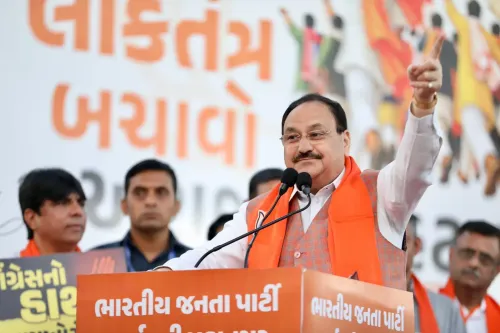
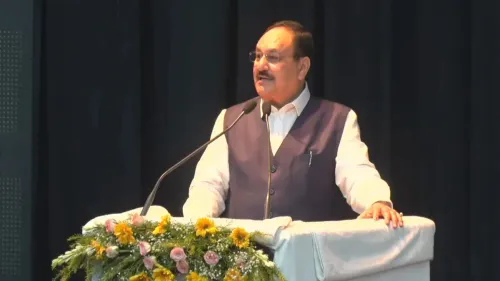
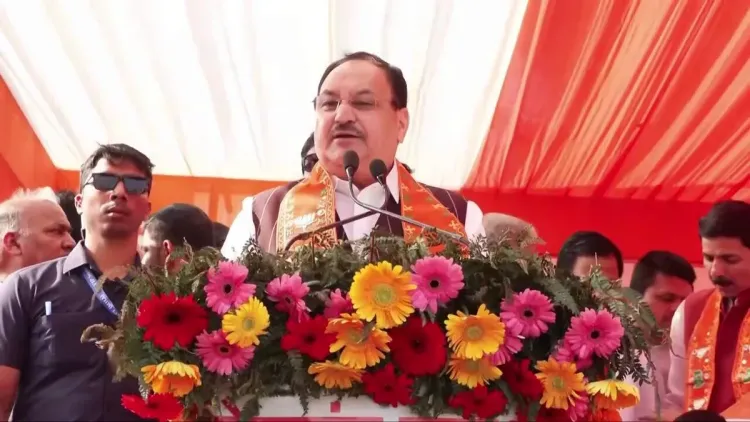
Nadda fires at Congress over Patel, Indira poll row
Synopsis
Union Health Minister and BJP president J. P. Nadda challenged Congress's right to question electoral integrity, invoking the 1947 Patel-Nehru leadership contest and the 1975 Allahabad High Court ruling on Indira Gandhi's election under the hashtag #SaveDemocracyRemoveAnarchy.
Key Takeaways
Nadda claimed that 12 of 15 PCC committee members voted for Sardar Patel as Prime Minister in 1947 , yet Nehru was chosen — a claim not corroborated in widely documented records.
He referenced the Allahabad High Court's 1975 ruling invalidating Indira Gandhi's 1971 Lok Sabha election victory.
The government's response to that ruling — the 39th Constitutional Amendment — shielded the PM's election from judicial review and was followed by the Emergency.
Nadda's post carries the hashtag #SaveDemocracyRemoveAnarchy , indicating a coordinated BJP messaging campaign.
BJP has a consistent strategy of countering Congress's democracy narrative with these two Congress-era historical episodes.
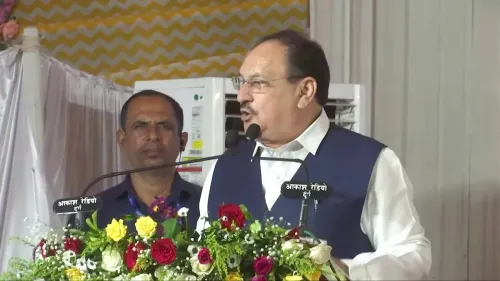
Two historical fault lines — who should have led India at its birth, and what happened when a court ruled against a sitting prime minister — have been dragged back into the present by Union Health Minister J. P. Nadda in a pointed post on Tuesday, 3 November 2026, challenging the Congress party's standing to question anyone on electoral integrity.
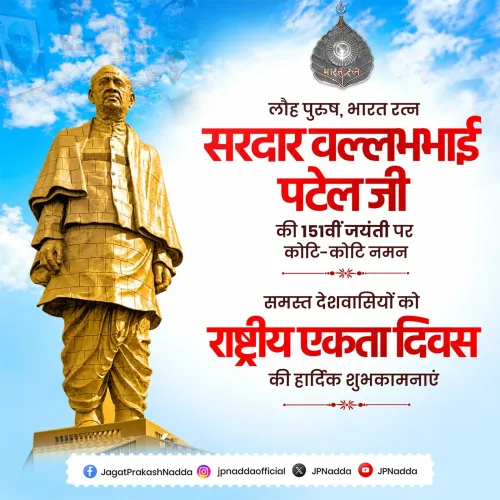
Nadda's post, in Hindi, opens with a stark assertion about the 1947 Congress leadership deliberations: 'कांग्रेस की 15 सदस्यीय PCC कमेटी में 12 सदस्यों ने सरदार पटेल जी को प्रधानमंत्री बनाने के पक्ष में वोट दिया, लेकिन प्रधानमंत्री नेहरू को बनाया गया.' ('In Congress's 15-member PCC committee, 12 members voted for Sardar Patel to be made Prime Minister, but Nehru was made Prime Minister instead.') The second charge follows quickly: that when Indira Gandhi's election was declared invalid, 'the law itself was changed.'
The two Congress-era episodes Nadda invokes
The first reference concerns the selection of Jawaharlal Nehru as India's first Prime Minister in 1947. Sardar Vallabhbhai Patel — the iron-willed Deputy Prime Minister who stitched together the princely states — was, by several historical accounts, the preferred choice of many within the Congress organisation. How votes were tallied and who weighed in has been debated by historians for decades; the research available to NationPress flags the specific claim of a 15-member committee with 12 Patel votes as not corroborated in widely documented public records.
The second episode is better documented. The Allahabad High Court ruled in June 1975 that Indira Gandhi's victory in the 1971 Lok Sabha election was invalid on grounds of electoral malpractice. Within months, the government responded with the 39th Constitutional Amendment, which placed the election of the President, Vice-President, Prime Minister and Speaker beyond the scrutiny of any court — a move widely seen as shielding Gandhi's seat. The Emergency followed shortly after, a period that still anchors BJP attacks on Congress's democratic credentials.
A rhetorical challenge beneath the hashtag
Nadda closes with a rhetorical broadside that is the political point of the entire post: 'जिनकी नींव ही वोट चोरी पर टिकी हो, वे आज किस मुंह से सवाल उठाते हैं?' — 'Those whose very foundation rests on the theft of votes, how dare they raise questions today?' The hashtag #SaveDemocracyRemoveAnarchy signals this is part of a coordinated BJP messaging push rather than an isolated comment.
This pattern is well-worn terrain for BJP leaders: when Congress attacks the ruling party on electoral fairness, the counter-move is to loop back to 1947 and 1975 — eras when, the argument goes, Congress bent its own rules to keep power. Whether those historical analogies hold in contemporary electoral disputes is precisely the debate both sides want voters to form a view on.
Point of View
The BJP reaches for two iconic Congress-era wounds — the 1947 leadership succession and the 1975 Emergency precedents — to flip the framing entirely. The rhetorical move is effective precisely because it changes the subject from present-day allegations to foundational historical grievances that are harder for Congress to dismiss outright. That said, the specific 15-member PCC committee vote count Nadda cites lacks corroboration in documented public records, which gives Congress room to challenge the premise. The hashtag signals this is a top-down coordinated campaign, suggesting the party is girding for a sustained electoral-integrity battle heading into the parliamentary session.
NationPress
4 Nov 2026
Frequently Asked Questions
Why does JP Nadda say Congress stole votes in 1947?
Nadda claims that 12 of 15 members in a Congress PCC committee voted for Sardar Patel as Prime Minister but Nehru was chosen instead, framing this as an internal overriding of a democratic vote. Historians have long debated the leadership selection process of 1947, and this specific vote count is not corroborated in widely documented public records.
What happened when Indira Gandhi's election was declared invalid?
The Allahabad High Court ruled in June 1975 that Indira Gandhi's 1971 Lok Sabha election victory was invalid due to electoral malpractice. The government then passed the 39th Constitutional Amendment, placing the PM's election beyond court scrutiny, followed by the declaration of the Emergency.
What does #SaveDemocracyRemoveAnarchy mean?
#SaveDemocracyRemoveAnarchy is a BJP campaign hashtag used in Nadda's post, signalling a coordinated party message attacking the Congress on democracy and electoral integrity issues.
Why does BJP keep bringing up Sardar Patel versus Nehru?
BJP frequently invokes the Patel-Nehru leadership contest to argue that Congress suppressed democratic choice within its own organisation from the very founding of the Republic — using it as historical ammunition whenever Congress challenges the BJP on democratic values.
What is the 39th Constitutional Amendment?
The 39th Constitutional Amendment, passed in 1975, barred courts from examining disputes over the elections of the President, Vice-President, Prime Minister and Speaker. Critics saw it as designed to protect Indira Gandhi's contested parliamentary seat after the Allahabad High Court ruling.