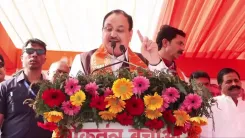
CM Vijay launches Rs 3,000 cr bank linkage for 26,000 SHGs in Erode
Synopsis
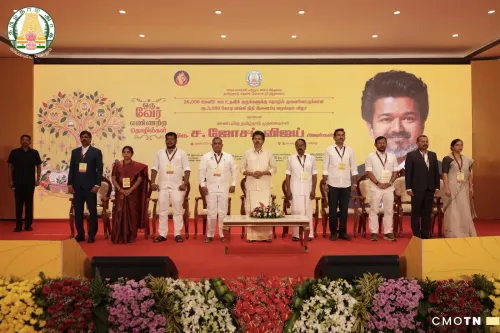
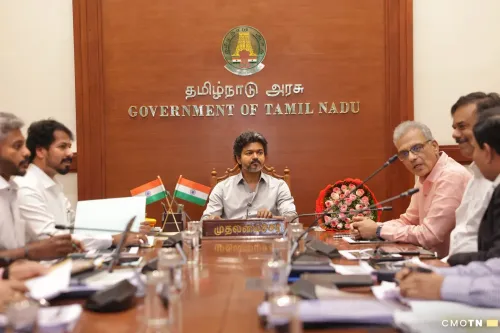
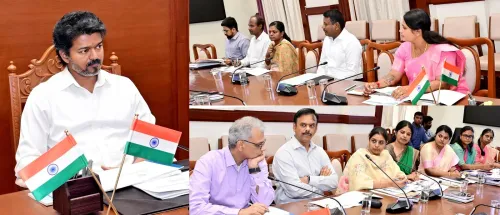
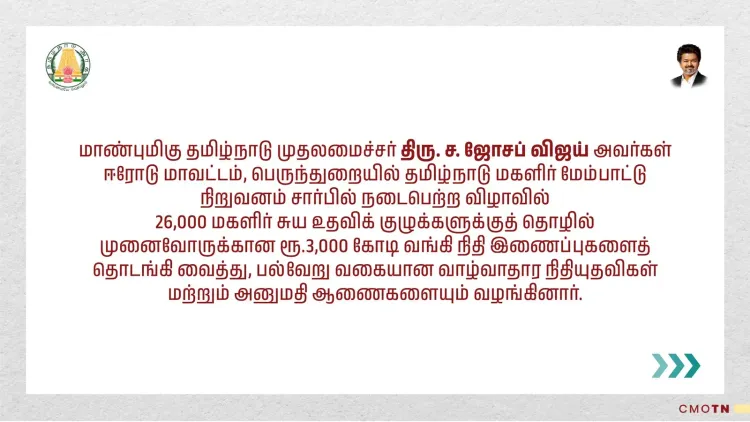
Chief Minister Joseph Vijay launched Rs 3,000 crore in bank credit linkages for 26,000 women's self-help groups at a Tamil Nadu Women's Development Corporation event in Perundurai, Erode, also distributing livelihood grants and sanction orders on November 3, 2026.
Key Takeaways
Rs 3,000 crore in entrepreneurship bank credit linkages were launched for women's self-help groups in Tamil Nadu on November 3, 2026 .
26,000 women's self-help groups were covered under this single disbursement event in Perundurai, Erode district .
The event was organised by the Tamil Nadu Women's Development Corporation under the state government.
CM Joseph Vijay also distributed livelihood assistance grants and multiple sanction orders at the ceremony.
Tamil Nadu's SHG bank-linkage infrastructure traces back to the Mahalir Thittam scheme launched in 1997 .
Further district-level credit linkage events are expected across Tamil Nadu in the coming months.
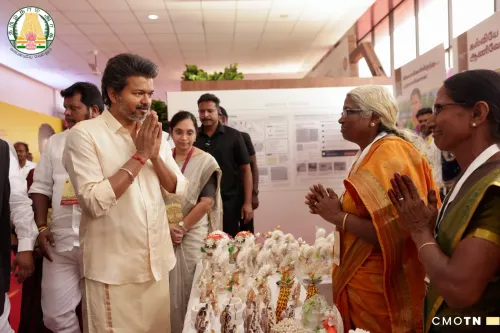
A Rs 3,000 crore bank credit lifeline reached 26,000 women's self-help groups in Tamil Nadu on Tuesday, November 3, 2026 — as the Chief Minister's Office of Tamil Nadu announced that Chief Minister Joseph Vijay flagged off the landmark disbursement at a ceremony organised by the Tamil Nadu Women's Development Corporation in Perundurai, Erode district. Alongside the credit linkages, the CM handed over livelihood assistance grants and sanction orders spanning multiple welfare categories.
What Rs 3,000 crore means for women entrepreneurs in Erode
The scale of Tuesday's event is hard to miss. Reaching 26,000 self-help groups in a single ceremony, the bank linkage exercise funnels entrepreneurship finance directly to grassroots women's collectives across Erode district — a region already known for its textile trade and small-enterprise culture. For each group, the credit access translates into working capital, equipment loans, and the institutional credibility that comes with a formal bank relationship.
The Tamil Nadu Women's Development Corporation, the state undertaking that anchored the event, has for decades been the primary channel for organising women into SHGs and connecting them to scheduled banks for micro-credit. That institutional backbone is precisely what allows a single district-level event to process finance at this volume.
Three decades of Mahalir Thittam — and why this moment matters
Tamil Nadu's SHG infrastructure stretches back to 1997, when the state launched the Mahalir Thittam scheme — one of India's earliest and most sustained state-run women's micro-credit programmes. The scheme systematically organised rural and semi-urban women into savings-linked groups, trained them in livelihood skills, and brokered the bank relationships that successive governments have expanded ever since.
That three-decade foundation is what makes a Rs 3,000 crore single-event disbursement operationally feasible today. The groups receiving finance on Tuesday are not new formations — they are mature collectives with savings histories, repayment records, and ready business plans waiting on capital.
Livelihood grants and sanction orders widen the safety net
Beyond the headline credit figure, CM Vijay also distributed livelihood assistance grants and sanction orders covering multiple welfare categories — widening Tuesday's event from a pure credit exercise into a broader social-security intervention. The Tamil Nadu Women's Development Corporation framed the occasion as part of its ongoing mandate to improve the socio-economic status of women through coordinated financial inclusion.
Erode, with its mix of weaving cooperatives, agro-processing units, and trade networks, provides fertile ground for entrepreneurship finance to convert quickly into visible economic activity — making it a strategically chosen host for a programme this size.
With district-level rollouts of similar scale expected in the months ahead, Tuesday's Perundurai ceremony sets a visible benchmark: when the state puts institutional infrastructure first, women's entrepreneurship finance can move at scale — and it just did.
Point of View
000 crore disbursement is less a standalone welfare gesture and more a statement of institutional confidence — Tamil Nadu is betting that a mature SHG ecosystem, built over nearly three decades, can now absorb large-scale entrepreneurship capital efficiently. For CM Vijay, anchoring such an event in Erode — a commercially active western district — signals an intent to convert the state's micro-credit infrastructure into a visible economic growth story, not merely a welfare line item. The Mahalir Thittam lineage gives this programme credibility that newer SHG schemes in other states lack. The real test will be whether district-level rollouts in less commercially dense regions produce comparable repayment and enterprise outcomes.
NationPress
3 Nov 2026
Frequently Asked Questions
What is the Rs 3,000 crore SHG bank linkage scheme announced in Tamil Nadu?
Chief Minister Joseph Vijay launched Rs 3,000 crore in entrepreneurship bank credit linkages for 26,000 women's self-help groups at a Tamil Nadu Women's Development Corporation event in Perundurai, Erode on November 3, 2026. The disbursement provides working capital and enterprise finance to SHGs through scheduled banks.
What is the Tamil Nadu Women's Development Corporation?
The Tamil Nadu Women's Development Corporation is a state government undertaking that implements socio-economic development schemes for women, primarily by organising them into self-help groups and facilitating bank credit linkages for livelihood and enterprise activities.
What is the Mahalir Thittam scheme?
Mahalir Thittam is Tamil Nadu's flagship women's self-help group programme launched in 1997. It organises women into savings-linked groups, provides skill training, and brokers formal bank relationships for micro-credit — forming the backbone of the state's SHG ecosystem.
Why was the event held in Erode district?
Erode district in western Tamil Nadu is known for its textile industry, agricultural processing, and small-enterprise activity, making it a commercially active base where entrepreneurship finance for SHGs can convert quickly into measurable economic activity.
What else did CM Joseph Vijay distribute at the Perundurai event?
In addition to the Rs 3,000 crore bank credit linkages, CM Vijay distributed livelihood assistance grants and sanction orders across multiple welfare categories to beneficiaries at the TNWDC ceremony in Perundurai.