A Pivotal Moment in India's Quest for Freedom: VP Radhakrishnan and PM Modi Reflect on the Dandi Satyagraha
Synopsis
On March 12, Vice President C.P. Radhakrishnan and Prime Minister Modi commemorated the Dandi Satyagraha, highlighting its significance in India's freedom struggle. This historical march, led by Mahatma Gandhi, ignited a spirit of self-reliance and civil disobedience against British rule.
Key Takeaways
Dandi Satyagraha was a key event in India's freedom struggle.
It was led by Mahatma Gandhi against the oppressive salt tax.
The march inspired a spirit of self-reliance among Indians.
It attracted over 50,000 participants during its course.
Gandhi's principles of Satya and Ahimsa were central to the movement.
New Delhi, March 12 (NationPress) Vice President C.P. Radhakrishnan and Prime Minister Narendra Modi commemorated the legacy of Mahatma Gandhi and the courageous freedom fighters involved in the pivotal 'Dandi Satyagraha' on Thursday.
PM Modi shared on social media platform 'X': "The Dandi March commenced on this day in 1930. We honor all the significant figures who participated."
Vice President C.P. Radhakrishnan also expressed on 'X': "The remarkable Dandi Satyagraha, initiated on this day in 1930 under Mahatma Gandhiji’s guidance, represented a pivotal moment in India’s struggle for freedom, igniting a nationwide ethos of self-sufficiency through the principles of Satya and Ahimsa. I pay my respects to Bapu and all the valiant freedom fighters who joined this momentous march. As we strive towards an Atmanirbhar Bharat, the spirit of self-reliance that it inspired continues to steer our nation forward."
The Salt March, often called the Salt Satyagraha, Dandi March, or Dandi Satyagraha, was a significant act of nonviolent civil disobedience orchestrated by Mahatma Gandhi against colonial rule in India.
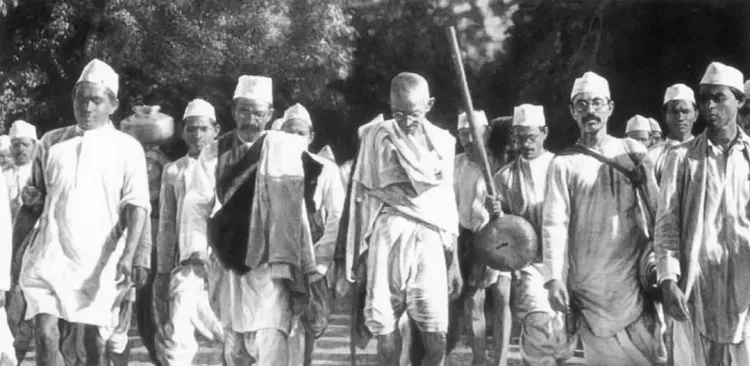
On March 12, 1930, Mahatma Gandhi began the historic Salt March from the Sabarmati Ashram in Ahmedabad, Gujarat, heading towards Dandi on the coast to protest the high salt tax imposed by the British. This notable march, known as the Dandi March or Salt March, lasted for 24 days and is historically important as it catalyzed the mass Civil Disobedience Movement.
At that time, the British had banned Indians from harvesting or trading salt. Indians were compelled to purchase this essential food item exclusively from the British, who monopolized its production and imposed hefty taxes on it. The Salt March marked the inception of a widespread resistance against British oppression.
Upon arriving at the coast in Dandi, Mahatma Gandhi openly defied the law by producing illegal salt. This act sparked a nationwide civil disobedience movement, with millions of Indians either producing salt or purchasing it illegally.
Starting with approximately 80 participants, the march swelled to over 50,000 as more individuals joined the 390 km journey.
The Dandi March gained both national and international attention, impressing the British with its peaceful approach. It received extensive media coverage, drawing global focus to the Indian Independence Movement.
Point of View
The Dandi Satyagraha stands out as a quintessential example of nonviolent resistance that galvanized the Indian populace against colonial rule. The reflections by national leaders today reinforce the importance of self-reliance and unity in the ongoing narrative of India's development.
NationPress
20 Sept 2026
Frequently Asked Questions
What was the Dandi Satyagraha?
The Dandi Satyagraha, also known as the Salt March, was a nonviolent protest led by Mahatma Gandhi in 1930 against the British salt tax, symbolizing India's fight for independence.
Why is the Dandi March significant?
The Dandi March is significant as it marked a turning point in India's independence movement by mobilizing masses against British oppression through civil disobedience.
Who participated in the Dandi Satyagraha?
The Dandi Satyagraha began with around 80 participants, but eventually grew to over 50,000 as people joined Gandhi on his 390 km journey.
What principles did Gandhi emphasize during the Dandi March?
Gandhi emphasized the principles of Satya (truth) and Ahimsa (non-violence) during the Dandi March, which inspired a nationwide ethos of self-reliance.
What impact did the Dandi Satyagraha have?
The Dandi Satyagraha sparked widespread civil disobedience across India, leading to significant resistance against British rule and highlighting the quest for independence.