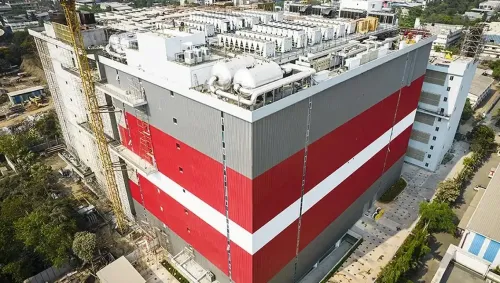
Dr. Jitendra Singh flags data centres to create 1 lakh engineer jobs
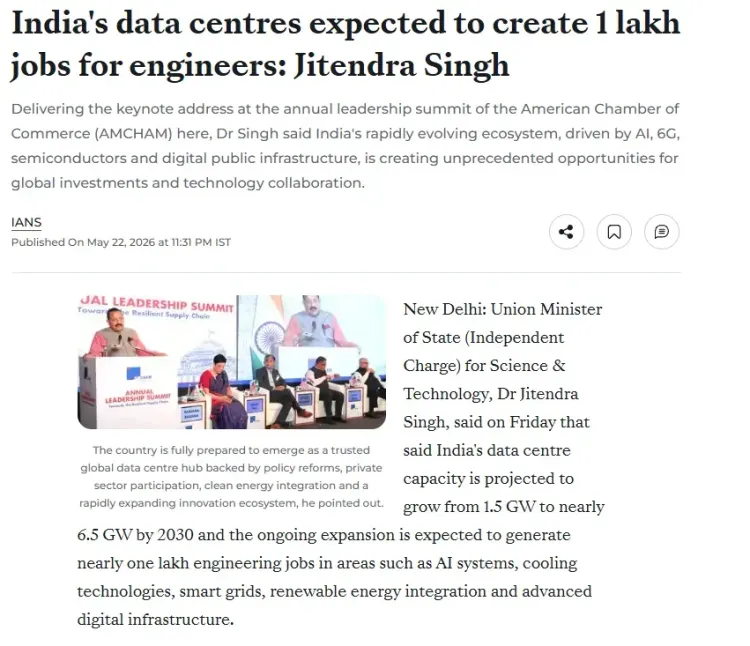
Synopsis
Union Science and Technology Minister Dr. Jitendra Singh on 23 May 2026 shared a report projecting India's data centre sector will create 1 lakh engineering jobs, underscoring the government's push to build domestic digital infrastructure and high-skill employment under the Digital India and Atmanirbhar Bharat frameworks.
Key Takeaways
Union Science and Technology Minister Dr.
Jitendra Singh shared on 23 May 2026 a report projecting 1 lakh engineering jobs from India's data centre expansion.
The data centre sector's growth is underpinned by the Digital India programme (2015), MeitY's Draft Data Centre Policy (2020), and the India Semiconductor Mission (Rs 76,000 crore, 2021).
The PLI scheme for IT Hardware (2021) incentivises domestic manufacturing of servers and networking gear critical to data centres.
RBI data localisation mandates since 2018 have accelerated domestic data centre investment by compelling companies to store data within India.
Finalisation of rules under the Digital Personal Data Protection Act 2023 is the key near-term policy event that will shape further data centre demand and investment.
States including Maharashtra, Telangana, Tamil Nadu , and Uttar Pradesh are competing for data centre investments through land, power, and clearance incentives.
Union Science and Technology Minister Dr. Jitendra Singh on Saturday, 23 May 2026, shared a report projecting that India's expanding data centre sector is set to generate 1 lakh engineering jobs, amplifying the finding to his official social media following.
Context
The minister shared a report highlighting that India's data centre expansion is expected to create 1 lakh jobs for engineers. The post signals the government's continued interest in positioning data infrastructure as a high-skill employment driver, even as the data centre sector has traditionally been discussed under the ambit of the Ministry of Electronics and Information Technology (MeitY).
India's data centre capacity has grown sharply over the past five years, driven by cloud adoption, digital payments, streaming platforms, and regulatory mandates requiring domestic data storage.
Policy Backdrop
The data centre push sits within a broader policy architecture assembled since 2015. The Digital India programme, launched in July 2015, established digital infrastructure as a core national utility, spurring demand for domestic data storage and processing capacity.
MeitY's Draft Data Centre Policy, released in November 2020, sought to position India as a global data centre hub by offering fiscal and land-use incentives to investors. The India Semiconductor Mission, approved in December 2021 with an outlay of Rs 76,000 crore, further strengthened the hardware ecosystem on which data centres depend. The Production Linked Incentive (PLI) scheme for IT Hardware, notified in February 2021, added incentives for domestic manufacturing of servers and networking gear — the backbone of any data centre facility.
Data localisation requirements from regulators such as the Reserve Bank of India, in place since 2018, have also compelled companies to build or lease domestic server capacity, accelerating investment in the sector.
Stakeholders and Impact
The projected 1 lakh engineering jobs would primarily benefit IT engineers, network specialists, and data infrastructure professionals across the country. Cloud service providers, hyperscale operators, and domestic data centre firms are the principal employers in this space.
State governments — particularly Maharashtra, Telangana, Tamil Nadu, and Uttar Pradesh — have competed actively to attract data centre investments through land allotments, power guarantees, and single-window clearances. Employment generation at this scale would have multiplier effects on ancillary services including facilities management, cybersecurity, and hardware maintenance.
The Atmanirbhar Bharat objective of building domestic technology infrastructure aligns closely with this trajectory, as high-skill data centre roles reduce dependence on offshore cloud capacity and keep data-economy value within Indian borders.
What's Next
The finalisation of rules under the Digital Personal Data Protection Act 2023 is the most consequential near-term policy event for the sector. Clearer data localisation norms under the Act are expected to further sharpen investment decisions by global cloud and data centre operators.
Fresh investment announcements in tier-2 cities and state-level policy updates are also being watched closely, as land and power costs push operators beyond the traditional metros. If the 1 lakh job projection materialises, it would mark a significant milestone in India's ambition to become a global data infrastructure hub — and add political weight to the government's technology employment narrative ahead of future electoral cycles.
Point of View
The Science and Technology Ministry's visible interest signals a whole-of-government approach to digital infrastructure. The 1 lakh jobs figure, if it materialises, would give the ruling dispensation a concrete data point to cite in its Atmanirbhar Bharat and Digital India narratives. The timing — well ahead of potential electoral cycles — suggests the government is beginning to consolidate its technology-employment story for public consumption.
NationPress
7 Oct 2026
Frequently Asked Questions
How many jobs will India's data centres create?
A report shared by Union Minister Dr. Jitendra Singh projects that India's data centre expansion will create 1 lakh engineering jobs .
What is India's data centre policy?
MeitY's Draft Data Centre Policy , released in November 2020, aims to make India a global data centre hub by offering fiscal incentives, land support, and streamlined approvals to investors.
Why is India's data centre sector growing?
Growth is driven by rising cloud adoption, digital payments, streaming services, and data localisation mandates from regulators like the RBI since 2018, which require companies to store data within India.
What is the India Semiconductor Mission?
The India Semiconductor Mission was approved in December 2021 with an outlay of Rs 76,000 crore to develop a domestic semiconductor and display manufacturing ecosystem, supporting the hardware needs of data centres.
How does the Digital Personal Data Protection Act affect data centres?
The Digital Personal Data Protection Act 2023 is expected to introduce clearer data localisation rules; once its implementing regulations are finalised, they will significantly influence investment decisions by Indian and global data centre operators.