India data centres to hit 6.5 GW by 2030, create 1 lakh engineering jobs: Jitendra Singh

Synopsis
India's data centre sector is no longer a back-end utility story — it is a geopolitical and economic bet. With capacity set to quadruple to 6.5 GW by 2030 and one lakh engineering jobs in the pipeline, Minister Jitendra Singh's AMCHAM address signals that New Delhi is positioning data infrastructure as the new commanding heights of the economy.
Key Takeaways
India's data centre capacity is projected to grow from 1.5 GW to nearly 6.5 GW by 2030 .
The expansion is expected to create close to one lakh engineering jobs in AI, cooling tech, smart grids and renewable energy integration.
Union Minister Dr Jitendra Singh made the announcement at the AMCHAM annual leadership summit in New Delhi on 22 May 2025 .
India has already crossed 1,000 km of quantum communication infrastructure in three years against an eight-year target of 2,000 km .
Key policy enablers cited include the Semiconductor Mission , National Research Foundation , and tax incentives for foreign cloud providers.
Dr Singh described data centres as the 'next oil economy', calling for an integrated national approach across government, industry and research.
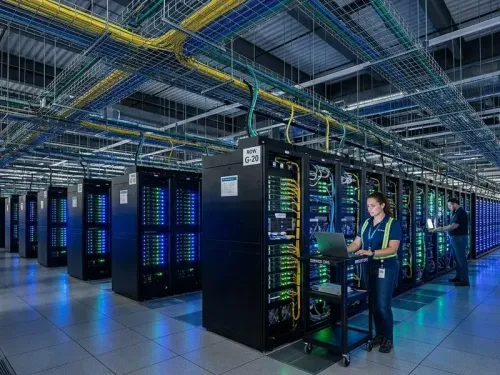
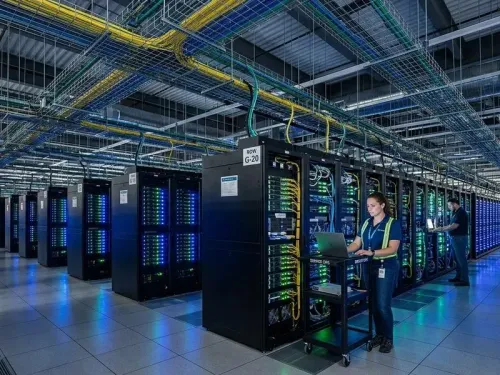
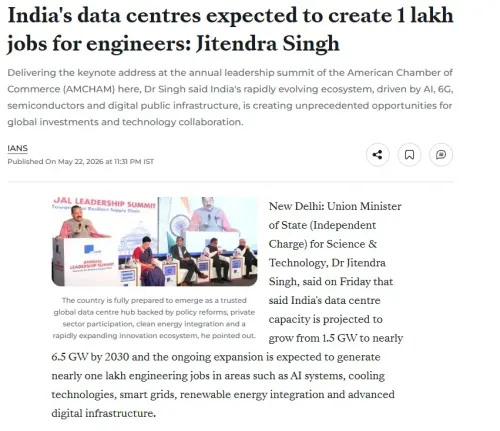
India's data centre capacity is on course to expand from 1.5 GW to nearly 6.5 GW by 2030, a trajectory that is expected to generate close to one lakh engineering jobs in disciplines spanning AI systems, cooling technologies, smart grids, renewable energy integration and advanced digital infrastructure, Union Minister of State (Independent Charge) for Science and Technology Dr Jitendra Singh said on Friday, 22 May. He was delivering the keynote address at the annual leadership summit of the American Chamber of Commerce (AMCHAM) in New Delhi.
Data Centres as Strategic National Assets
Dr Singh framed the data centre boom not as a routine technological upgrade but as a defining strategic opportunity. He described data centres as the 'next oil economy', arguing that future global power will increasingly revolve around data control, digital infrastructure and secure technology ecosystems. India, he said, can no longer treat the data economy as merely a technological transition — it must be approached as a national priority influencing investments, employment, energy systems and geopolitical competitiveness for decades ahead.
The minister said India is fully prepared to emerge as a trusted global data centre hub, backed by policy reforms, private sector participation, clean energy integration and a rapidly expanding innovation ecosystem. He stressed the need for an integrated national approach involving government, private industry, infrastructure providers, telecom networks, renewable energy stakeholders and research institutions to fully leverage opportunities in hyperscale data centres and co-location markets.
AI, 6G and Quantum: India's Frontier Push
Dr Singh said India's rapidly evolving technology ecosystem — driven by AI, 6G, semiconductors and digital public infrastructure — is creating unprecedented openings for global investment and technology collaboration. He asserted that the world now increasingly looks to India for technology partnerships, rather than India waiting for breakthroughs from elsewhere.
Citing the National Quantum Mission as a flagship example, he noted that India has already crossed 1,000 kilometres of secure quantum communication infrastructure within just three years — more than half the target of 2,000 kilometres set over an eight-year horizon. This pace, he said, reflects India's ability to move decisively in frontier sectors.
Policy Reforms Enabling the Shift
The minister highlighted several transformative policy decisions under Prime Minister Narendra Modi's government that have laid the groundwork for India's digital infrastructure ambitions. These include long-term tax incentives for foreign cloud service providers, the establishment of the National Research Foundation, the Semiconductor Mission, and the opening of the space and nuclear energy sectors to private participation. Dr Singh acknowledged that many of these reforms were considered unlikely just a few years ago, but said India has demonstrated the political will to act rapidly in areas critical to future economic leadership.
What Will Drive Future Growth
Looking ahead, Dr Singh outlined the pillars on which India's data centre expansion will depend: resilient supply chains, sustainable energy systems, advanced telecom connectivity, subsea cable infrastructure, smart cooling solutions and coordinated cross-sectoral policy support. He said the growing alignment between policy intent and private sector participation has positioned India as one of the world's most dependable digital infrastructure destinations.
With global technology investment increasingly seeking stable, policy-backed environments, India's data centre ambitions place it at the centre of a multi-trillion-dollar infrastructure race over the next decade.
Point of View
But the harder question is whether India's power grid and land acquisition frameworks can keep pace with hyperscale demand — two structural bottlenecks the minister did not address. India's data centre ambitions also sit in a competitive field: Singapore, Malaysia and the UAE are all aggressively courting the same hyperscale tenants with faster permitting and cheaper green power. The Quantum Mission milestone is genuinely impressive, but quantum communication and commercial data centre growth are largely separate investment tracks. Conflating them risks overstating readiness. The real signal to watch is whether the foreign cloud tax incentives translate into committed capacity announcements from the hyperscalers in the next 12 months.
NationPress
19 Sept 2026
Frequently Asked Questions
What is India's data centre capacity target by 2030?
India's data centre capacity is projected to grow from 1.5 GW to nearly 6.5 GW by 2030, according to Union Minister Dr Jitendra Singh. This represents more than a fourfold increase driven by AI, cloud adoption and digital public infrastructure expansion.
How many jobs will India's data centre expansion create?
The ongoing expansion is expected to generate close to one lakh engineering jobs in areas including AI systems, cooling technologies, smart grids, renewable energy integration and advanced digital infrastructure, according to Dr Singh's address at AMCHAM on 22 May 2025.
What did Jitendra Singh say about India's Quantum Mission progress?
Dr Singh said India has already crossed 1,000 kilometres of secure quantum communication infrastructure within three years — more than half of the 2,000-kilometre target set over an eight-year period under the National Quantum Mission. He cited this as evidence of India's capacity to move rapidly in frontier technology sectors.
Which policy reforms is India using to attract data centre investment?
Key reforms include long-term tax incentives for foreign cloud service providers, the Semiconductor Mission, the National Research Foundation, and the opening of space and nuclear energy sectors to private participation. Dr Singh said these measures have created a policy environment conducive to global digital infrastructure investment.
Why did Jitendra Singh call data centres the 'next oil economy'?
Dr Singh used the phrase to argue that future global economic and geopolitical power will revolve around data control, digital infrastructure and secure technology ecosystems — much as oil shaped the 20th century. He called on India to treat data centre growth as a strategic national priority, not merely a technological transition.