What Did Day 7 of Nagaland’s Hornbill Festival Reveal About the Rich Traditions of 8 Northeastern States?
Click to start listening
Synopsis
On the seventh day of the Hornbill Festival, a kaleidoscope of culture unfolded, showcasing the unique traditions of eight Northeastern states. This vibrant celebration not only highlighted the rich heritage of the region but also emphasized the spirit of unity and cultural exchange that defines the Northeast. Join us as we explore this remarkable festival!
Key Takeaways
- Rich cultural diversity showcased through traditional performances.
- Unity and harmony among the eight Northeastern states emphasized.
- Performances included unique dances and songs that reflect the region's heritage.
- The event promotes cultural exchange at national and international levels.
- NEZCC plays a key role in preserving and promoting Northeastern culture.
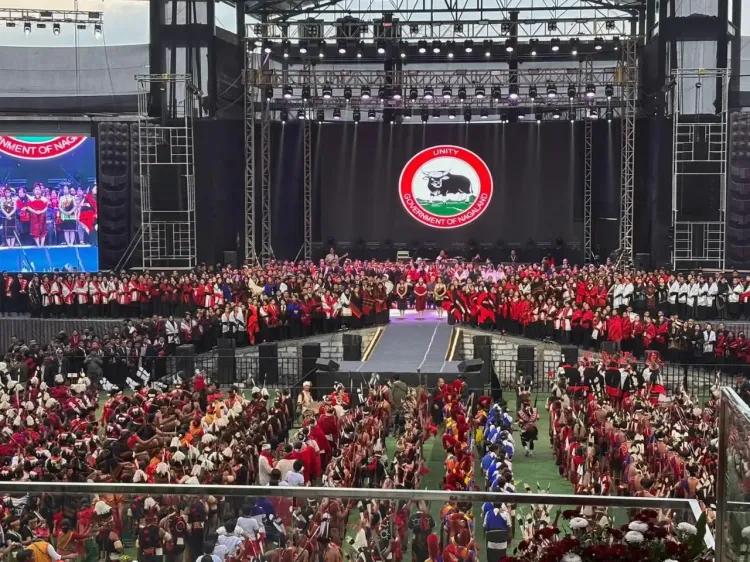
Kohima, Dec 7 (NationPress) The seventh day of the 26th edition of the Hornbill Festival on Sunday showcased a vibrant display of traditional performances by cultural troupes from all eight Northeastern states at the Naga Heritage Village in Kisama, near Kohima.
The cultural exhibitions represented the rich cultural diversity and a celebration of unity among the eight Northeastern states, stretching from the magnificent hills of Nagaland and Meghalaya to the stunning valleys of Manipur and Mizoram, from the powerful Brahmaputra of Assam to the distinctive heritage of Arunachal Pradesh, Tripura, and Sikkim.
Day 7 of the Cultural Connect event held at Unity Plaza in Naga Heritage Village, Kisama, was graced by Deputy Chief Minister Yanthungo Patton as the host and Kekhrielhoulie Yhome, Advisor, School Education, SCERT, as the co-host. Highlights of the day included Mizoram’s Cheraw (Bamboo) Dance, celebrated for its rhythmic utilization of bamboo staves, and Sarlamkai, a warrior dance symbolizing victory.
The Nyishi community from Arunachal Pradesh presented Juju Jaja Jaminja, performed during harvest to invoke the Deity of Wealth, along with Rikhampada, featuring devotional songs and love ballads traditionally sung by women. The Kabui Rongmei community from Manipur showcased Duisha Laam, or the Waterfall Dance, reflecting the graceful flow of water, and Kit Laam, inspired by the lively movement and gaiety of crickets post-monsoon.
Tripura’s Chakma community performed the well-known Bizu Dance, recognized for its sudden pauses, and the Jhum Dance, representing different stages of jhum cultivation through circular and linear formations. Meghalaya’s Khasi community presented the Mastieh Dance, a thanksgiving performance to express gratitude to the Creator for good health and prosperity, alongside a Harvest Dance, joyfully performed by both men and women after the harvest.
From Nagaland, the Lotha women showcased Nzanta, a post-harvest thanksgiving dance, and Mungyanta, performed during the Tokhu Emong festival to celebrate their labor’s fruits. Sikkim’s Bhutia community performed the Snow Lion Dance (Singhi Chham), which honors Mt. Khangchendzonga, believed to resemble the sacred snow lion symbolizing fortune and prosperity.
The Karbi community of Assam presented Chong Kedam, a martial dance usually performed during Chomangkan to protect the spirits of the deceased from evil forces. This cultural event was curated by the North East Zone Cultural Centre, Dimapur (NEZCC).
With its motto ‘Unity through Culture,’ the NEZCC serves as a guardian of the rich artistic heritage of the eight Northeastern states, acting as a channel for cultural exchange and facilitating representation of the Northeast at both national and international levels.
Point of View
It's crucial to highlight the Hornbill Festival as a significant cultural event that not only showcases the artistic expressions of the Northeastern states but also fosters a sense of unity. The rich traditions displayed reflect the diverse heritage of India, encouraging national integration and appreciation of regional cultures.
NationPress
08/12/2025
Frequently Asked Questions
What is the Hornbill Festival?
The Hornbill Festival is an annual cultural festival in Nagaland, India, celebrating the rich traditions and cultural heritage of the state and its neighboring Northeastern states.
When does the Hornbill Festival take place?
The Hornbill Festival typically takes place in the first week of December each year.
What activities are featured in the Hornbill Festival?
The festival features traditional dance performances, music, food, crafts, and various cultural exhibitions from different tribes and communities.
Where is the Hornbill Festival held?
The festival is held at the Naga Heritage Village in Kisama, near Kohima, Nagaland.
Who can participate in the Hornbill Festival?
The festival is open to everyone, including locals and tourists, and encourages participation from various cultural groups.