Delhi CM Rekha Gupta Pays Tribute to Ex-PM Chandrashekhar
Synopsis
Delhi Chief Minister Rekha Gupta on 8 July 2026 paid tribute to former Prime Minister Chandrashekhar on his death anniversary, honouring his legacy of simplicity, courage, and dedication to national interest — continuing a cross-party commemoration pattern observed since his passing in 2007.
Key Takeaways
Delhi CM Rekha Gupta posted a tribute to former PM Chandrashekhar on 8 July 2026 , his death anniversary.
Chandrashekhar served as Prime Minister from November 1990 to June 1991 , heading a minority government.
He resigned from Congress in 1975 in protest against the Emergency, cementing his image as a politician of principle.
Gupta praised his 'simplicity, courage, and principled politics' as an enduring inspiration for future generations.
The tribute follows a BJP pattern of acknowledging former prime ministers across ideological lines to project national unity.
Leaders from other parties are expected to issue their own statements marking the anniversary on 8 July .
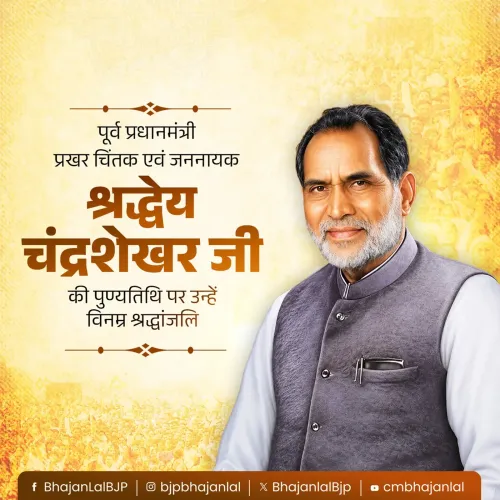
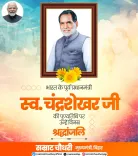
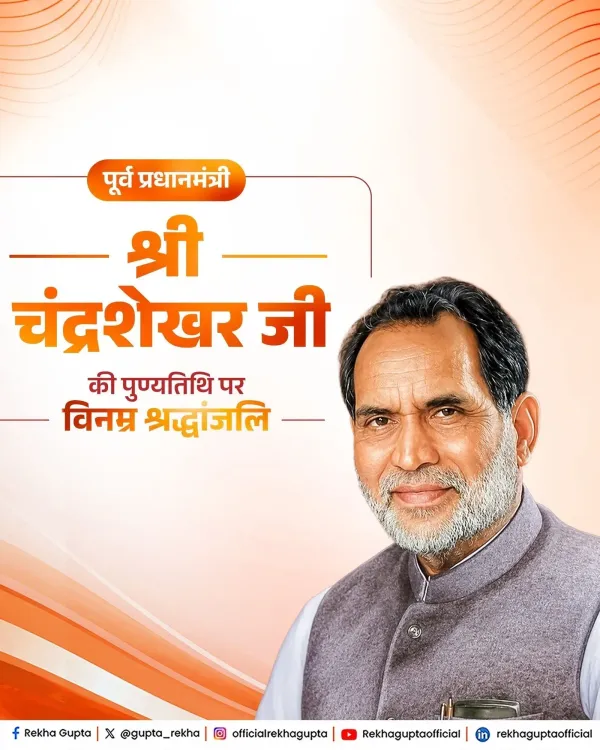
Delhi Chief Minister Rekha Gupta on Wednesday, 8 July 2026, paid tribute to former Prime Minister Chandrashekhar on his death anniversary, honouring his legacy of simplicity, courage, and principled politics.
Posting on X in Hindi, Gupta wrote: 'पूर्व प्रधानमंत्री चंद्रशेखर जी की पुण्यतिथि पर उन्हें विनम्र श्रद्धांजलि' — 'Humble tribute to former Prime Minister Chandrashekhar Ji on his death anniversary.' She added that his contribution to simplicity, courage, and principled politics 'will always be remembered,' and that his dedication to national interest 'will continue to inspire future generations.'
Context
Chandrashekhar served as Prime Minister of India from November 1990 to June 1991, heading a minority government after the collapse of the V.P. Singh administration. He led the Janata Dal (S) and was widely respected across party lines for his socialist convictions, personal austerity, and willingness to take principled stands even at political cost.
He resigned from the Indian National Congress in 1975 in protest against the Emergency imposed by then Prime Minister Indira Gandhi — a decision that defined his image as a politician of conscience. He passed away on 8 July 2007, and leaders across the political spectrum have since marked the date with annual tributes.
Policy Backdrop
The BJP, both at the Centre and in states it governs, has maintained a consistent practice of issuing cross-party tributes to former prime ministers and national figures from other ideological traditions. The gesture is seen as a way of projecting respect for India's institutional and constitutional history over narrow partisan lines.
Chandrashekhar's tenure, though brief, coincided with a period of acute economic stress — the 1991 balance-of-payments crisis was already building during his watch — and his government's caretaker decisions helped bridge the transition to the reforms era that followed. Political historians credit him with keeping democratic processes intact during a period of coalition fragility.
Stakeholders and Impact
The tribute carries significance for BJP workers and political historians who track the party's relationship with India's non-Congress, non-BJP political legacy. Chandrashekhar represented a strand of socialist nationalism that predates the current two-dominant-party framework, and acknowledging him allows ruling-party leaders to claim a broader national inheritance.
For Delhi's political landscape, the statement from Chief Minister Gupta also signals the state government's intent to position itself as a custodian of all-India political memory, not merely a vehicle for party interests.
What's Next
Observers will watch whether other national and state leaders — particularly from the Samajwadi Party and Congress, which have historically claimed closer ideological kinship with Chandrashekhar — issue comparable statements on 8 July 2026. Any official Delhi government commemorative events honouring former prime ministers could signal a more institutionalised approach to such anniversaries under CM Gupta's administration.
As India's coalition era recedes in memory, tributes like this one serve a dual purpose: keeping the legacy of consensus-era leaders alive while reinforcing the current government's claim to a unifying, national-interest-first political identity.
Point of View
Congress-dissident former prime minister, the party signals institutional maturity and broad national stewardship — particularly useful optics for a state government still consolidating its mandate in Delhi. The tribute also subtly reclaims Chandrashekhar's anti-Emergency stand, a narrative the BJP has long used to draw a moral contrast with the Congress. In the longer arc, such commemorations help normalise BJP rule in Delhi as a continuation of India's democratic tradition rather than a rupture from it.
NationPress
8 Jul 2026
Frequently Asked Questions
Who was Chandrashekhar and why is he remembered?
Chandrashekhar was the 10th Prime Minister of India , serving from November 1990 to June 1991 . He is remembered for his personal simplicity, socialist convictions, and his principled resignation from Congress in 1975 to protest the Emergency.
When did Chandrashekhar pass away?
Former Prime Minister Chandrashekhar passed away on 8 July 2007 . His death anniversary has since been marked annually by leaders across party lines.
Why did Delhi CM Rekha Gupta pay tribute to Chandrashekhar?
Delhi CM Rekha Gupta paid tribute on his death anniversary, 8 July 2026 , praising his simplicity, courage, and dedication to national interest — in keeping with the BJP's practice of honouring former prime ministers from all political backgrounds.
What is Rekha Gupta's position in Delhi politics?
Rekha Gupta is a BJP leader serving as the Chief Minister of Delhi . She posted the tribute on her official X account on 8 July 2026 .
Did the BJP government have any connection to Chandrashekhar?
Chandrashekhar was not a BJP leader — he led the Janata Dal (S) — but the BJP has consistently honoured former prime ministers across ideological lines as part of a broader practice of respecting India's national political heritage.