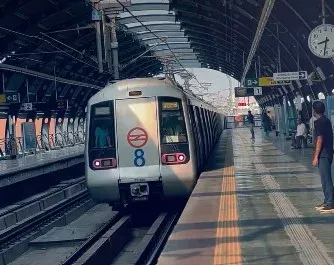
Delhi Metro launches Har Ghar Tiranga train on Yellow Line for 80th Independence Day
Synopsis
Delhi Metro's tricolour-wrapped Yellow Line train is more than a patriotic gesture — it arrives alongside a disclosure that DMRC has outpaced the Hong Kong, Paris, and New York metro systems on punctuality, clocking 99.95% in 2026 under a 59-second delay threshold stricter than most global peers. After 23 years and 416.5 km of network, that is a quietly remarkable infrastructure story.
Key Takeaways
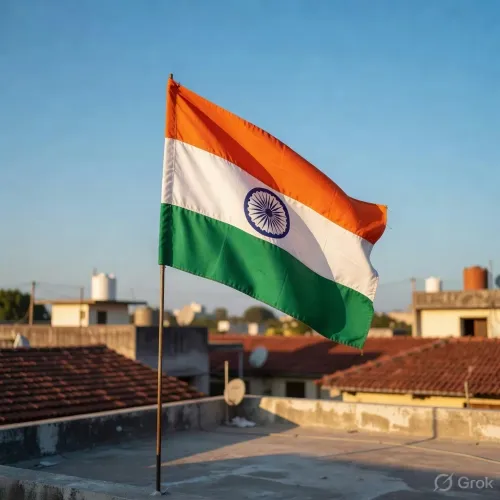
Delhi Metro unveiled a tricolour-themed train on the Yellow Line on 9 August 2026 as part of the 'Har Ghar Tiranga' campaign for India's 80th Independence Day .
The campaign also marks the 150th anniversary of India's national song 'Vande Mataram' .
DMRC has achieved 99.95% train punctuality in 2026 , outranking the Hong Kong Metro , Paris Metro , and New York Subway .
DMRC records a delay if a train arrives more than 59 seconds late — stricter than most international metro systems.
The Pink Line , at 71.55 km with 45 stations , is the world's longest driverless metro line .
Delhi Metro has grown from an 8.4 km , 6-station network in 2002 to 416.5 km across 303 stations , with daily ridership exceeding 81 lakh journeys .
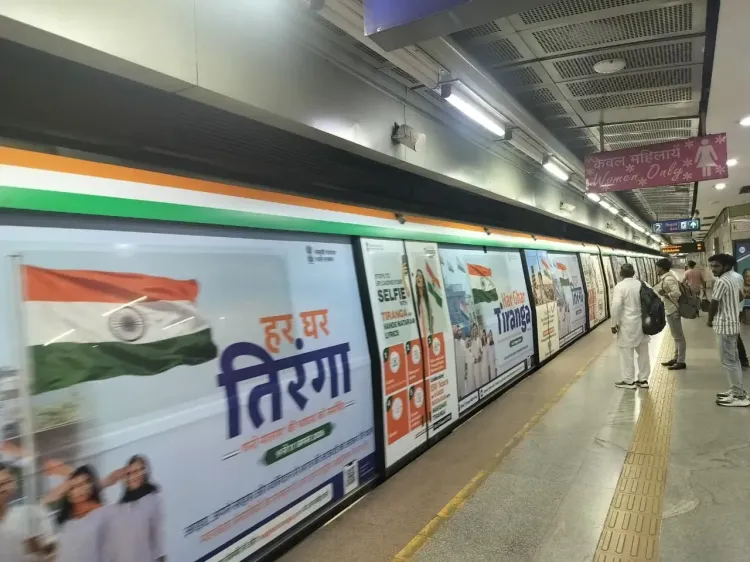
The Delhi Metro on Sunday, 9 August 2026, unveiled a special train wrapped in the tricolour theme on the Yellow Line as part of the week-long 'Har Ghar Tiranga' campaign, marking India's 80th Independence Day. An official of the Union Ministry of Culture confirmed the launch, which coincides with the 150th anniversary of India's national song 'Vande Mataram'.
The Har Ghar Tiranga Campaign
The Ministry of Culture, in a post on social media platform X, described the initiative as part of week-long activities celebrating the spirit of independence. 'All citizens are being encouraged to proudly hoist the National Flag and participate in the digital events,' the post noted. The campaign this year carries added symbolic weight, commemorating the 150th year of 'Vande Mataram'.
Delhi Metro's Global Punctuality Ranking
Separately, the Delhi Metro Rail Corporation (DMRC) disclosed that it has outperformed some of the world's most established urban rail systems — including the Hong Kong Metro, Paris Metro, and New York Subway — on train punctuality and reliability. Anuj Dayal, Principal Executive Director of DMRC's Corporate Communications, noted that this achievement is especially significant given the network's stringent benchmark: a train is recorded as delayed if it arrives at its destination station more than 59 seconds behind schedule, a threshold far stricter than many international counterparts.
Train punctuality stood at 98.27% in 2003, climbing to 99.64% by 2005 — placing DMRC among the elite group of metro systems worldwide to cross the 99% mark within just two years of inception. As of 2026, punctuality has reached 99.95%, defying the typical pattern where reliability declines as networks age and expand.
Reliability Benchmarks and Driverless Operations
Through international benchmarking by the Community of Metros (COMET) — a consortium of 45 leading metro systems worldwide — DMRC has consistently ranked among the top five globally on reliability, measured using the two-minute delay criterion. The network has also achieved a Mean Distance Between Failures (MDBF) of 2.72 million car-kilometres, a key indicator of operational resilience.
DMRC operates India's largest driverless metro network, with approximately 29% of the network running under Unattended Train Operation (UTO). Notably, the Pink Line (Line 7), spanning 71.55 km across 45 stations, is the world's longest driverless metro line and one of the longest circular metro lines globally. It interchanges with every Delhi Metro corridor except a small portion of the Grey Line.
From 8.4 km to 416.5 km: DMRC's Growth Story
Delhi Metro began operations on 25 December 2002 with an 8.4 km corridor between Shahdara and Tis Hazari covering just six stations. Today, it spans 416.5 km across 303 stations on 12 lines, with 31 interchange stations connecting Delhi and the National Capital Region. Daily ridership has grown from approximately 82,000 passengers in its first year to a record single-day peak of over 81 lakh passenger journeys. Train headway on the busiest corridors has been reduced from 7 minutes in the early years to just 2 minutes 18 seconds.
As Independence Day approaches, the tricolour-wrapped train on the Yellow Line stands as both a patriotic gesture and a showcase of an urban transit system that has quietly become one of the world's most reliable.
Point of View
But the more substantive story buried alongside it is DMRC's punctuality data. A 59-second delay threshold that is stricter than Hong Kong or Paris, combined with a 99.95% punctuality rate across a 416.5 km network, is a genuine operational achievement — not just a press release number. Indian urban infrastructure rarely gets to make that claim credibly. The question now is whether DMRC's reliability standards can be replicated as Phase IV expansion adds new corridors and complexity, or whether 2026 marks the high-water mark before network sprawl tests the system's discipline.
NationPress
24 Sept 2026
Frequently Asked Questions
What is the 'Har Ghar Tiranga' Delhi Metro train?
It is a special Delhi Metro train on the Yellow Line wrapped in the tricolour theme, unveiled on 9 August 2026 as part of the week-long 'Har Ghar Tiranga' campaign ahead of India's 80th Independence Day. The campaign also commemorates the 150th year of India's national song 'Vande Mataram'.
How punctual is Delhi Metro compared to global metro systems?
Delhi Metro achieved 99.95% train punctuality in 2026, ranking among the top five metro systems globally according to Community of Metros (COMET) benchmarking. It has outperformed the Hong Kong Metro, Paris Metro, and New York Subway under a stricter-than-average 59-second delay threshold.
What is the world's longest driverless metro line?
Delhi Metro's Pink Line (Line 7), spanning 71.55 km with 45 stations, is the world's longest driverless metro line and one of the longest circular metro lines globally. It operates under Unattended Train Operation (UTO) and interchanges with every Delhi Metro corridor except a small portion of the Grey Line.
How large is the Delhi Metro network in 2026?
Delhi Metro operates 416.5 km across 303 stations on 12 lines, with 31 interchange stations connecting Delhi and the National Capital Region. It began in 2002 with just 8.4 km and six stations, and daily ridership has grown from around 82,000 to over 81 lakh passenger journeys.
What is DMRC's Mean Distance Between Failures (MDBF)?
DMRC has recorded a Mean Distance Between Failures (MDBF) of 2.72 million car-kilometres, measuring the average distance travelled before a service-affecting failure occurs. This is a key reliability indicator and contributes to DMRC's consistent top-five global ranking in the COMET benchmarking exercise.