Madina Mosque demolition in Shalimar Bagh: Cong's Udit Raj alleges unequal law

Synopsis
A late-night bulldozer operation against portions of the 30-year-old Madina Mosque in Delhi's Shalimar Bagh has drawn sharp political fire from Congress leader Udit Raj, who alleges that authorities pick and choose which illegal constructions to demolish along religious lines — reigniting the national debate over equal application of anti-encroachment law.
Key Takeaways
Congress leader Udit Raj criticised the late-night demolition of parts of Madina Mosque in Shalimar Bagh, Delhi on 23 September 2026 .
Raj alleged selective enforcement, saying the action was taken because the structure 'belongs to Muslims' and that a temple would not have been treated the same way.
The demolition on Max Hospital Road was described by civic authorities as part of an anti-encroachment and road-widening exercise.
The targeted mosque is approximately 30 years old and is located in Shalimar village .
Heavy deployment of police and paramilitary personnel was in place during the operation.
The administration maintains that all structures removed were illegal encroachments on public land.
Congress leader Udit Raj on Wednesday, 23 September sharply criticised the late-night demolition of portions of the Madina Mosque and adjoining structures in Shalimar Bagh, New Delhi, alleging that civic authorities selectively enforce anti-encroachment laws based on religious identity. His remarks follow a bulldozer operation on Max Hospital Road in Shalimar Bagh that civic bodies described as part of an anti-encroachment and road-widening exercise.
What Udit Raj Said
Addressing the demolition action against illegal extensions of the mosque, Raj said, 'Illegal construction in Delhi is continuous; it's a regular affair. Right now, thousands of illegal constructions must be going on, which happen through coordination between the police and the corporation. No one can stop it. But they can choose who to stop and who not to stop.'
He went further, arguing that religious identity determined the outcome: 'Yes, that (illegal construction) happens, but what's important here is that because it's a mosque and belongs to Muslims, it was stopped. Had it been a temple, it wouldn't have been stopped. There would be no one to stop it; they would say it's a matter of faith. Then it becomes a matter of faith, and nobody stops it.'
Raj concluded: 'In the eyes of the law, everyone should be equal, but that is simply not the case anymore.'
The Demolition Operation
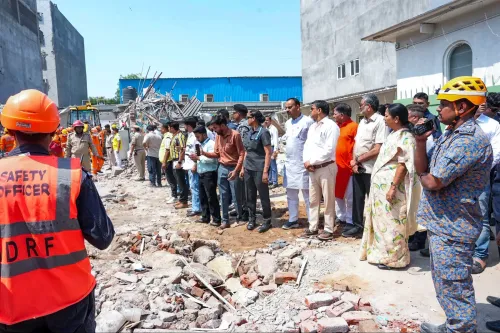
The operation was conducted late at night along Max Hospital Road in Shalimar Bagh, with bulldozers and dumpers deployed alongside several municipal officials. A heavy security presence — comprising police and paramilitary personnel — was stationed at the site and on surrounding roads as the demolition work proceeded.
According to local residents, the action targeted portions of the approximately 30-year-old Madina Masjid, located in Shalimar village. Structures adjoining the mosque were also brought down during the operation.
Administration's Position
Authorities have maintained that the structures removed were illegal encroachments on public land. Officials stated the drive was part of an approved road-widening project aimed at eliminating structural bottlenecks and improving traffic flow along the stretch — framing it as routine civic enforcement rather than a targeted action.
Broader Context
The demolition draws attention to a pattern of contentious bulldozer actions that have repeatedly sparked political and legal debate across Indian cities in recent years. Critics argue, as Raj did, that such drives disproportionately target minority-community properties, while authorities consistently maintain they are applying standard encroachment rules. Courts, including the Supreme Court, have previously issued guidelines cautioning against demolitions without due process. This incident is likely to add fresh fuel to that ongoing national conversation about equal application of law.
Point of View
Publicly auditable database of encroachment notices issued and acted upon, making it impossible to independently verify whether enforcement is consistent across communities. The administration's 'road-widening' justification is the standard shield in such operations — and without disclosure of which other structures on the same stretch received notices, it is impossible to assess. Courts have already flagged demolition due-process concerns nationally; the absence of a uniform compliance record is what gives these political charges their traction, regardless of the specific facts in Shalimar Bagh.
NationPress
23 Sept 2026
Frequently Asked Questions
What happened at Madina Mosque in Shalimar Bagh, Delhi?
Civic authorities conducted a late-night demolition drive on 23 September, bringing down portions of the Madina Mosque and adjoining structures on Max Hospital Road in Shalimar Bagh as part of an anti-encroachment and road-widening project.
What did Congress leader Udit Raj allege about the demolition?
Udit Raj alleged that authorities selectively enforce anti-encroachment laws based on religion, claiming that had the structure been a temple, the demolition would not have taken place. He said: 'In the eyes of the law, everyone should be equal, but that is simply not the case anymore.'
What is the administration's justification for the demolition?
Officials stated that the structures removed were illegal encroachments on public land, and that the action was part of an approved road-widening project to remove structural bottlenecks and improve traffic movement along the stretch.
How old is the Madina Mosque in Shalimar Bagh?
According to local residents, the Madina Masjid in Shalimar village is approximately 30 years old. Portions of the mosque and structures adjoining it were demolished during the operation.
Was security deployed during the demolition?
Yes, a heavy security deployment was put in place, with police and paramilitary personnel stationed at the site and on surrounding roads throughout the operation.