Has Delhi-NCR's air quality seen a slight improvement to 'very poor'?
Click to start listening
Synopsis
In a welcome development, the air quality in Delhi-NCR has improved slightly, moving to the 'very poor' category. With an AQI of 349, this change offers a glimmer of hope amidst ongoing pollution challenges. However, the situation remains serious, prompting continued monitoring and awareness.
Key Takeaways
- Air quality in Delhi-NCR is currently 'very poor'.
- AQI reported at 349 by the CPCB.
- Notable areas of concern include Noida and Greater Noida.
- Weather conditions are expected to impact air quality further.
- Public health remains a priority amidst ongoing pollution.
New Delhi, Dec 24 (NationPress) The National Capital Region experienced a slight alleviation from severe pollution on Wednesday, as air quality shifted to the 'very poor' category with the Air Quality Index (AQI) reported at 349, as per data from the Central Pollution Control Board (CPCB).
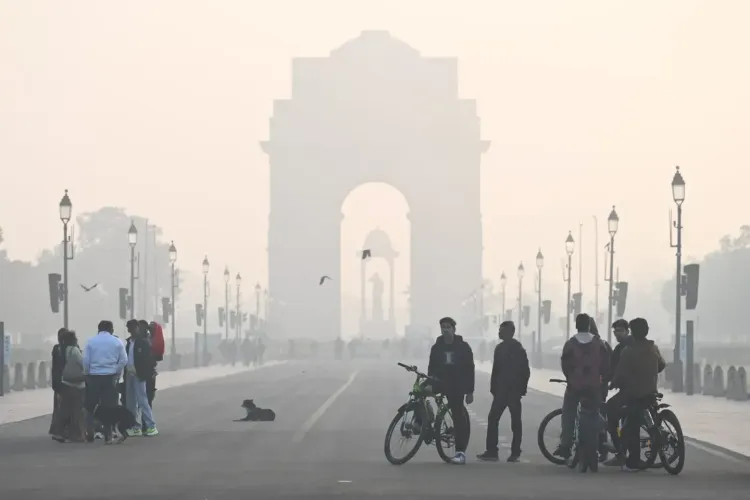
The thick smog that had enveloped the area seemed to have lifted somewhat, though numerous monitoring stations throughout the national capital still indicated AQI levels nearing the severe zone.
At 6:58 a.m., Noida was identified as the second most polluted city in India, with an AQI of 355.
Greater Noida followed with an AQI reading of 344, while Gurugram recorded 316 and Ghaziabad 309, all categorized as 'very poor'.
Additionally, the India Meteorological Department noted that Delhi registered a maximum temperature of 23.2 degrees Celsius, which is 2.5 degrees above the seasonal average, and a minimum of 8.8 degrees Celsius, 1.3 degrees higher than usual.
The department forecasted a minimum temperature of around 9 degrees Celsius and a maximum of approximately 19 degrees Celsius for Wednesday, alongside potential moderate fog throughout the day.
It also predicted a gradual decline in minimum temperatures by 2 to 4 degrees Celsius over the next 24 hours across northwest and central India, with no significant changes anticipated thereafter.
A similar pattern is expected for Delhi, with the minimum temperature potentially dropping to about 7 degrees Celsius starting Thursday.
This modest improvement follows a day where the capital was shrouded in a dense grey fog, with the 24-hour average AQI measuring 412 in the severe category as of 4:00 p.m. on Tuesday.
This represented a significant decline from an AQI of 373 recorded in the 'very poor' category at the same time the previous day.
Among the 40 operational air quality monitoring stations in Delhi, five reported severe-plus AQI levels exceeding 450.
Locations such as Nehru Nagar at 465, Mundka at 457, Chandni Chowk at 453, Okhla at 452, and Jahangirpuri were among them. A total of 26 stations remained in the severe category.
The other monitoring stations across the city indicated very poor air quality, according to data from the CPCB's SAMEER application.
On Tuesday, Delhi recorded the second-worst air quality in India with an AQI of 412, only behind Noida, which led the list with an AQI of 426.
Point of View
It is our responsibility to ensure that we present the facts objectively. The marginal improvement in Delhi-NCR's air quality is a positive development, yet it is essential to recognize that the region still faces severe pollution challenges. Continuous monitoring and proactive measures are vital in addressing this ongoing environmental issue that affects the health and well-being of millions.
NationPress
24/12/2025
Frequently Asked Questions
What is the current air quality status in Delhi-NCR?
As of December 24, the air quality in Delhi-NCR is categorized as 'very poor' with an AQI of 349.
Which areas in Delhi-NCR are most affected by pollution?
Noida, Greater Noida, Gurugram, and Ghaziabad are among the most polluted areas, with AQI readings indicating 'very poor' conditions.
What precautions should be taken during poor air quality?
During periods of poor air quality, it is advisable to limit outdoor activities, wear masks, and use air purifiers indoors.
How does the weather affect air quality?
Weather conditions, such as temperature and humidity, can significantly influence air quality by affecting pollution dispersion and concentration.
What are the health implications of poor air quality?
Poor air quality can lead to respiratory issues, cardiovascular problems, and other health complications, especially for vulnerable populations.