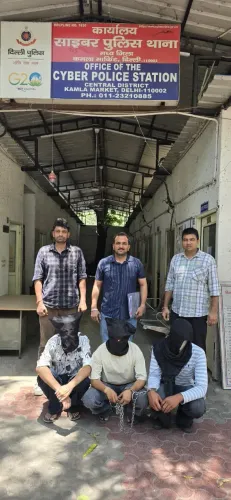
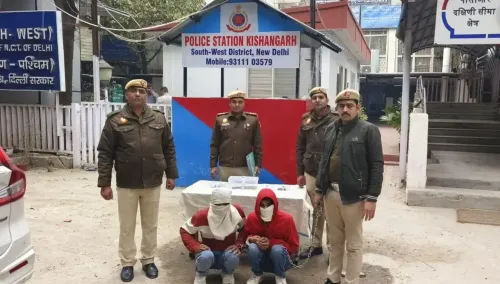
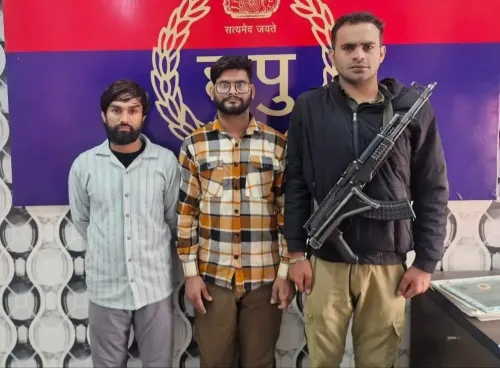
Delhi Police arrest 2 ex-Hitachi custodians for ATM cash-trap fraud

Synopsis
Two former Hitachi ATM custodians turned their insider knowledge into a calculated fraud scheme — inserting rubber rings to trap cash inside Axis Bank and ICICI Bank ATMs, then returning to collect it after genuine customers walked away empty-handed. Their arrest, along with illegal firearms, exposes how privileged access to financial infrastructure can be weaponised.
Key Takeaways
Delhi Police arrested Aman and Suraj — both former Hitachi ATM custodians — on 15 September 2026 for ATM cash-trap fraud.
The accused allegedly inserted rubber rings into ATM cash-dispensing mechanisms to trap cash, then retrieved it using stolen keys.
Targeted ATMs included Axis Bank branches in Sector 4–5, Gurugram and ICICI Bank ATMs in Kapashera, Delhi .
Police recovered one illegal country-made pistol and five live cartridges from the two accused.
288/2026 was registered on 16 September 2026 under the Arms Act at PS Kamla Market, Central District, Delhi.
Investigators are contacting police stations in Gurugram and Kapashera to trace additional cases linked to the same modus operandi.
Delhi Police have arrested two men — Aman and Suraj, both in their twenties and originally from Uttar Pradesh — for allegedly tampering with the cash-dispensing mechanisms of Axis Bank and ICICI Bank ATMs in Delhi and Gurugram. The arrests were made on 15 September 2026 following a tip-off acted upon by the Special Staff, Central District. Both accused were former custodians at Hitachi, where they reportedly acquired detailed knowledge of ATM operations and their vulnerabilities.
How the Arrests Were Made
On the evening of 15 September 2026, a dedicated police team — constituted under the leadership of Inspector Sandeep Yadav, In-Charge Special Staff, Central District, and operating under the overall supervision of ACP Operations Padam Singh Rana — received specific intelligence that the two accused would arrive near Mirdard Wali Gali, Tagore Road, behind Civic Centre, Delhi, on a Bajaj Pulsar motorcycle.
The team laid a trap near the rear side of the MCD Building, in front of Reliance Building, Tagore Road, Kamla Market. At approximately 11:20 pm, the two suspects approached from the Gandhi Market side on their motorcycle. When signalled to stop, they attempted to flee, but were apprehended after a brief chase.
Police recovered one illegal country-made pistol and two live cartridges from Suraj, and three live cartridges from Aman. An FIR — No. 288/2026 dated 16 September 2026 — was subsequently registered under Sections 25/54/59 of the Arms Act at Police Station Kamla Market, Central District, Delhi.
The Modus Operandi: Exploiting Insider Knowledge
According to investigators, the accused used insider knowledge gained during their tenure at Hitachi, where they were employed as custodians responsible for depositing and withdrawing cash from Axis Bank ATMs. They allegedly obtained keys to targeted ATM machines through an earlier associate, enabling them to open the machines without triggering alarms.
The accused would reportedly insert rubber rings inside the cash-dispensing mechanism to create a physical obstruction, then close the machine and leave. When an unsuspecting customer subsequently performed a valid cash withdrawal transaction — entering their card details and PIN — the cash would be processed by the system but would remain trapped in the ATM's internal dispensing tray rather than being ejected through the normal outlet.
The customer, assuming the transaction had failed, would leave the booth. The accused would then return, unlock the machine using their keys, and retrieve the trapped cash. Investigators describe this as a calculated exploitation of the gap between a successful digital transaction and the physical dispensing of notes.
Scale of the Fraud: Multiple ATMs Targeted
During sustained interrogation, the accused disclosed that they carried out this scheme at multiple ATMs — primarily during off-peak hours and on Saturdays and Sundays, when security guards were less likely to be present. Targeted locations included Axis Bank ATMs in Sector 4–5, Gurugram, and ICICI Bank ATMs in Kapashera and nearby areas of Delhi.
Notably, the accused specifically timed their operations to exploit the reduced vigilance on weekends — a pattern that investigators say reflects a deliberate and pre-meditated approach, not opportunistic crime.
Investigation Status and Next Steps
Further investigation is underway. Delhi Police officials said they are coordinating with concerned police stations in Gurugram and Kapashera to determine whether any FIRs relating to similar ATM fraud incidents have been filed in those jurisdictions. Authorities are also working to establish the full extent of the financial losses caused by the accused and to identify whether any additional associates were involved in supplying the keys or facilitating the operation.
The case underscores a broader concern about the risks posed by insiders with privileged access to critical financial infrastructure — and the need for banks and ATM service providers to conduct more rigorous background checks and post-employment access audits.
Point of View
Several similar schemes likely go undetected, because the victims — customers who see a 'transaction failed' message — rarely file police complaints, leaving the fraud invisible in crime data.
NationPress
18 Sept 2026
Frequently Asked Questions
How did the accused tamper with ATMs to steal cash?
The accused allegedly inserted rubber rings inside ATM cash-dispensing mechanisms to physically block notes from being ejected. When a legitimate customer made a withdrawal, the cash was processed by the system but remained trapped inside the machine; the accused would then return, unlock the ATM using keys obtained through an associate, and remove the cash.
Who are the arrested accused and what is their background?
The accused are identified as Aman and Suraj, both in their twenties and originally from Uttar Pradesh. They were previously employed by Hitachi as ATM custodians, responsible for depositing and withdrawing cash from Axis Bank ATMs, which gave them detailed knowledge of ATM operations and vulnerabilities.
Which banks and locations were targeted?
According to investigators, the accused targeted Axis Bank ATMs in Sector 4–5, Gurugram, and ICICI Bank ATMs in Kapashera and nearby areas of Delhi. They reportedly operated during off-peak hours and on weekends when security guards were less likely to be present.
What charges have been filed against the accused?
An FIR — No. 288/2026 — was registered on 16 September 2026 under Sections 25/54/59 of the Arms Act at Police Station Kamla Market, Central District, Delhi, following the recovery of an illegal country-made pistol and five live cartridges. Charges related to the ATM fraud are being established through ongoing investigation.
What is the current status of the investigation?
Further investigation is underway. Delhi Police are coordinating with police stations in Gurugram and Kapashera to determine whether any additional FIRs relating to similar ATM fraud incidents have been registered, and to establish the full financial scale of the accused's operations.