Is Delhi Battling Smog as AQI Reaches 333? IMD Cold Wave Alert Issued!
Click to start listening
Synopsis
As New Delhi grapples with a thick layer of smog, the city's Air Quality Index has surged to an alarming 333, raising health concerns. The India Meteorological Department has also issued a cold wave alert, with temperatures set to drop significantly. Stay informed on the pollution crisis and its impact on winter conditions in the capital.
Key Takeaways
- Delhi's AQI has reached 333, indicating very poor air quality.
- 35 out of 39 monitoring stations reported very poor air quality.
- The IMD has issued a cold wave alert due to dropping temperatures.
- Pollution levels have fluctuated significantly over the week.
- Humidity peaked at 100%, affecting visibility and health.
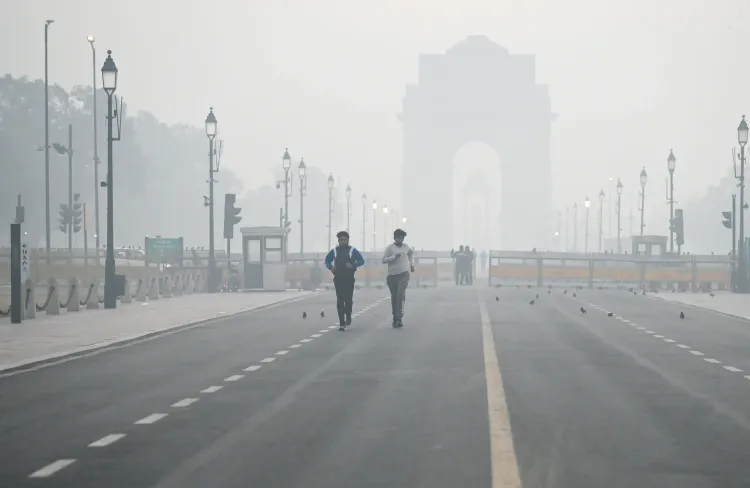
New Delhi, Dec 6 (NationPress) A dense layer of smog enveloped the national capital on Saturday, causing the overall Air Quality Index (AQI) in Delhi to reach 333, firmly placing it in the ‘very poor’ category and slightly higher than the previous day. This escalation in pollution coincided with a significant drop in temperatures, exacerbating winter conditions throughout the city.
The India Meteorological Department (IMD) has issued a cold wave alert for December 6, indicating that minimum temperatures are expected to remain around 8–9 degrees Celsius until December 10, accompanied by shallow fog. The department noted that Friday was the coldest December morning recorded this season, with temperatures plummeting to 5.6 degrees Celsius—almost four degrees below average.
Data from the Central Pollution Control Board (CPCB) recorded at 7 am showed that Mundka had the worst air quality, with an AQI of 381. Out of the 39 monitoring stations in Delhi, 35 reported air quality in the ‘very poor’ category, while four stations indicated ‘poor’ air quality. The IGI Airport recorded an AQI of 263.
Stations registering ‘very poor’ air quality included RK Puram (364), Punjabi Bagh (348), Chandni Chowk (348), Rohini (374), Vivek Vihar (309), Bawana (375), Siri Fort (343), Wazirpur (359), Anand Vihar (366), Ashok Vihar (348), and Sonia Vihar (352).
Locations with ‘poor’ air quality included NSIT Dwarka (260), Mandir Marg (256), IGI Airport (263), and Aya Nagar (289).
According to CPCB standards, an AQI of 0–50 is classified as ‘good’, 51–100 as ‘satisfactory’, 101–200 as ‘moderate’, 201–300 as ‘poor’, 301–400 as ‘very poor’, and 401–500 as ‘severe’.
Air quality in Delhi has fluctuated considerably over the past week. The AQI was recorded at 279 on Sunday, increased to 304 on Monday, and soared to 372 on Tuesday—approaching the ‘severe’ category. It eased to 342 on Wednesday, remained at 304 on Thursday, and slightly improved to 327 on Friday.
Humidity levels peaked at 100 percent on Friday morning before settling at 68 percent by the evening. The IMD mentioned that shallow fog is likely to persist, with temperatures on Saturday anticipated to range between 8 degrees Celsius and 23 degrees Celsius.
Point of View
The ongoing air quality issues in New Delhi represent a significant public health crisis. It is imperative that government agencies and citizens alike address these environmental challenges collaboratively to ensure the well-being of all residents. As the air quality deteriorates, proactive measures and community awareness are essential for navigating these pressing concerns.
NationPress
06/12/2025
Frequently Asked Questions
What does AQI stand for?
AQI stands for Air Quality Index, which measures the level of air pollution.
What are the health effects of very poor air quality?
Very poor air quality can lead to respiratory issues, cardiovascular problems, and other health complications.
How can I protect myself during high AQI levels?
Limit outdoor activities, wear masks, and use air purifiers indoors.
What causes the air quality to worsen in Delhi?
Factors include vehicular emissions, industrial pollution, and seasonal crop burning.
What is a cold wave alert?
A cold wave alert indicates that temperatures are expected to drop significantly, posing health risks.