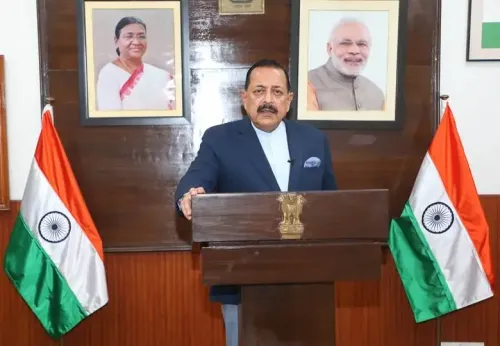
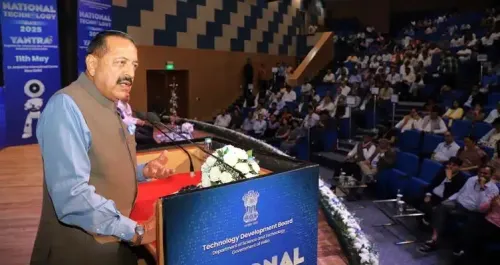
Dr. Jitendra Singh Addresses NDC on Tech and National Security
Synopsis
Union Science and Technology Minister Dr. Jitendra Singh delivered a Special Address at the National Defence College on 25 June 2026, engaging senior officers on emerging technologies, innovation-led warfare and geo-political challenges, and paid tribute to the armed forces' peacetime contributions in disaster relief and humanitarian service.
Key Takeaways
Jitendra Singh delivered a Special Address at the National Defence College on 25 June 2026 .
The session covered emerging technologies, innovation-led warfare strategies and evolving geo-political and national security challenges.
The minister acknowledged the nation's 'eternal indebtedness' to soldiers for both combat and non-combat service including disaster relief and humanitarian crises.
The engagement reflects growing civil-military collaboration on science, technology and defence R&D under frameworks such as iDEX (launched 2018 ).
The National Policy on Disaster Management (2009) formally recognises the Armed Forces as first responders alongside the NDRF .
Follow-up policy moves on defence R&D funding and NDC curriculum updates remain areas to watch ahead of the next Union Budget .
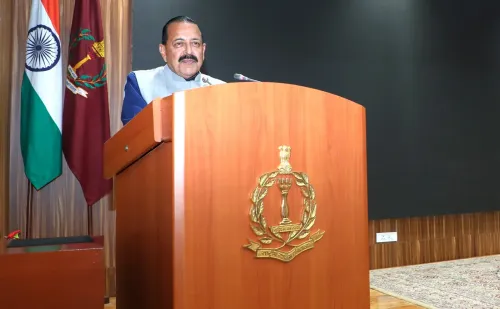
Union Minister of State (Independent Charge) for Science and Technology Dr. Jitendra Singh delivered a Special Address at the National Defence College (NDC), New Delhi, on 25 June 2026, engaging senior military officers and course participants in a candid discussion on emerging technologies, innovation-led warfare and the evolving geo-political challenges confronting national security in the 21st century.
Context
In a post shared on X, Dr. Singh described the session as an interactive exchange covering 'emerging technologies, innovation-led warfare strategies and the evolving challenges confronting geo-political scenario and national security.' The address concluded on a reflective note, with the minister acknowledging that 'the nation remains eternally indebted to its soldiers not only for safeguarding the country during times of conflict but also for their invaluable service during disaster situations, emergencies and humanitarian crises.'
Dr. Singh specifically underscored the 'unseen peace-time contributions of the Armed Forces,' calling them an exemplar of 'the true spirit of service and sacrifice' — a framing that broadens the public conversation on military value beyond battlefield roles.
Policy Backdrop
The National Defence College, established as India's premier institution for senior officers and civil servants, regularly hosts high-level forums where the intersection of technology, geopolitics and security doctrine is debated. Dr. Singh's participation as the science and technology minister signals the government's intent to deepen civil-military collaboration on indigenous research and development.
India's defence innovation architecture has evolved considerably since the launch of Innovations for Defence Excellence (iDEX) in 2018, which opened defence technology development to start-ups and private sector entities. Simultaneously, the National Policy on Disaster Management (2009) formally recognised the Armed Forces as first responders alongside the National Disaster Response Force (NDRF) — a mandate Dr. Singh's remarks explicitly honoured.
Since the mid-2010s, India has accelerated efforts to integrate technologies such as artificial intelligence, drones and cyber tools into military operations, even as the forces' role in humanitarian assistance and disaster relief (HADR) has expanded. NDC sessions serve as a recurring crucible for these discussions at the highest levels of the officer corps.
Stakeholders and Impact
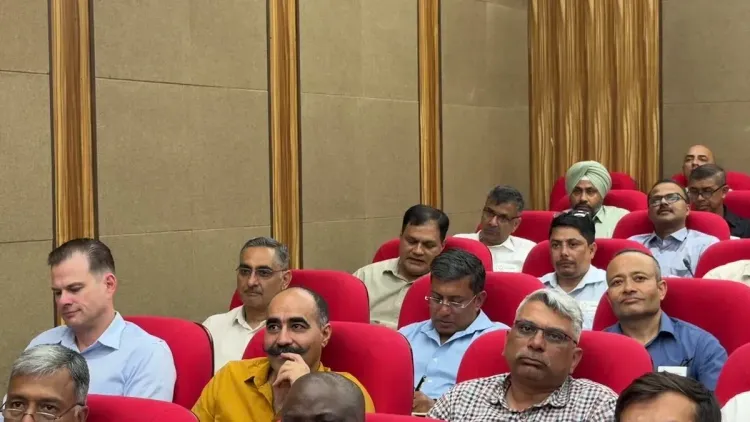
Senior officers and course participants at the NDC — drawn from across the three services as well as civil services — form the primary audience for such ministerial engagements. The dialogue between a science ministry head and defence leadership carries direct relevance for procurement priorities, R&D funding allocations and joint civil-military technology roadmaps.
The minister's tribute to the armed forces' disaster-relief and humanitarian contributions also resonates with a broader public that has witnessed the forces' deployment in floods, earthquakes and other emergencies across the country. Recognising these 'unseen' contributions at a formal defence forum lends institutional weight to an often under-acknowledged dimension of military service.
What's Next
Observers will watch for follow-up announcements on defence R&D funding or new iDEX challenges in the forthcoming Union Budget, as well as any joint civil-military technology initiatives that may emerge from the NDC engagement. Dr. Singh's address reinforces a pattern of science ministry outreach to the defence establishment — a convergence that is likely to intensify as India pursues greater self-reliance in critical and dual-use technologies.
Point of View
Signalling that the government views technology integration — from AI to drones — as inseparable from defence preparedness. By publicly honouring the forces' peacetime and humanitarian roles alongside their combat mandate, the minister adds a softer, nation-building dimension to what is otherwise a hard-security forum. This dual emphasis — innovation on one hand, gratitude for service on the other — is consistent with the ruling dispensation's broader effort to project both technological ambition and civilisational respect for the military. The address may presage concrete policy announcements linking the science ministry's R&D mandate more formally with defence innovation pipelines.
NationPress
25 Jun 2026
Frequently Asked Questions
What did Dr. Jitendra Singh speak about at the National Defence College?
Dr. Jitendra Singh delivered a Special Address at the National Defence College covering emerging technologies, innovation-led warfare strategies and the evolving geo-political and national security challenges of the 21st century, followed by an interactive discussion with senior officers and course participants.
What is the National Defence College India?
The National Defence College (NDC) is India's premier institution for training senior military officers and civil servants on national security strategy, geo-politics and higher defence management. It regularly hosts ministerial and expert addresses as part of its course curriculum.
What is iDEX in Indian defence?
Innovations for Defence Excellence (iDEX) is a Ministry of Defence initiative launched in 2018 to accelerate indigenous technology development by enabling start-ups and private sector firms to participate in creating defence systems and solutions.
What role do Indian Armed Forces play in disaster relief?
The National Policy on Disaster Management (2009) formally recognises the Indian Armed Forces as first responders for natural calamities and humanitarian crises, working alongside the National Disaster Response Force (NDRF). Dr. Singh's address highlighted this often under-acknowledged peacetime role.
Why is the science minister engaging with the defence establishment?
As Minister for Science and Technology, Dr. Singh's engagement with the NDC reflects the government's push to integrate emerging technologies such as AI, drones and cyber tools into military doctrine, and to align civilian R&D pipelines with defence innovation needs.