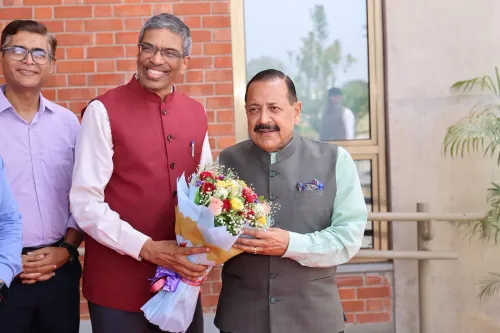
Dr. Jitendra Singh Visits ICTP Trieste, Meets Indian Scholars

Synopsis
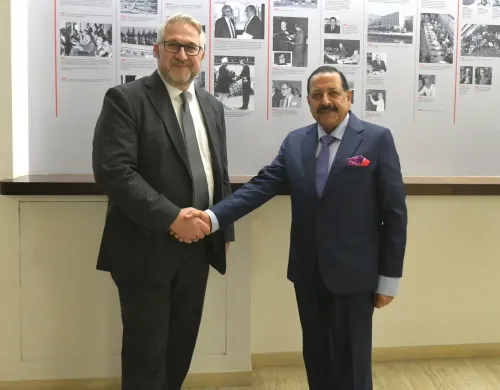
Union Science Minister Dr. Jitendra Singh visited the ICTP in Trieste on 15 November 2026, engaging with Indian scholars at the renowned physics research hub and reinforcing India's decades-long participation in its programmes.
Key Takeaways
Union Science Minister Dr.
Jitendra Singh visited the ICTP in Trieste, Italy on 15 November 2026 .
The ICTP was founded in 1964 by Nobel laureate Abdus Salam as a global physics research and education hub for scientists from developing nations.
The minister held a direct interaction with Indian students and scholars currently enrolled in courses at the centre.
India has participated in ICTP programmes continuously since the 1960s , making it one of the institution's long-standing partner nations.
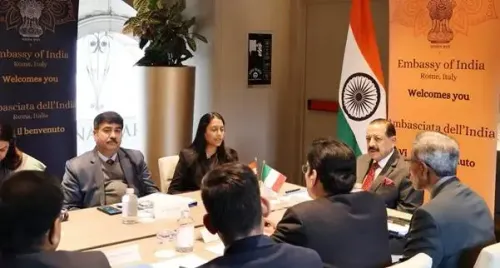
The visit is part of India's broader strategy of scientific diplomacy , leveraging global institutions for advanced capacity-building in theoretical sciences.
Possible follow-up outcomes — including expanded fellowship seats or joint ICTP-India programmes — could emerge from future bilateral India-Italy science talks .
India's scientific diplomacy touched down in northern Italy on Sunday, 15 November 2026, as Union Science and Technology Minister Dr. Jitendra Singh visited the International Centre for Theoretical Physics (ICTP) in Trieste — one of the world's foremost hubs for advanced physics research and a decades-long bridge between global academia and scientists from the developing world.
A Centre Built for the World's Underrepresented Scientists
Founded in 1964 by Nobel laureate Abdus Salam, the ICTP was conceived with an explicit mission: to ensure that physicists from developing nations could access the same frontier research as their counterparts in the global north. More than six decades on, that mission holds. The Trieste campus draws students and scholars from across Africa, Asia and Latin America — with India among its most consistent contributor nations, sending physicists and researchers to its schools, workshops and fellowship programmes since the institute's earliest years.
Minister Singh's Interaction with Indian Scholars at ICTP
The highlight of Dr. Singh's visit was what he described as a 'mutually enriching interaction' with Indian students and scholars currently pursuing courses at the centre. Such direct engagement — a minister sitting across from young Indian physicists training at a world-class international institution — carries a signal beyond the ceremonial: it places the government's stamp of attention on scientific careers that unfold far from home. The minister shared his impressions on X, calling the ICTP 'a leading global hub for advanced research, higher education and capacity-building in physics, attracting students and scholars from across the world including India.'
India's Long Relationship with ICTP and What May Follow
India has maintained continuous engagement with ICTP programmes for over half a century, making the visit a reinforcement of an established partnership rather than a fresh start. Indian Science Ministry visits to leading international research centres are part of a broader strategy of scientific diplomacy — leveraging global institutions to expand advanced training pathways for Indian scholars in theoretical and applied sciences. The visit also comes against the backdrop of active India-Italy bilateral science and technology ties, which have grown steadily in recent years. Whether this engagement produces tangible follow-ups — expanded Indian participation quotas, joint ICTP-India programmes, or new fellowship seats — will likely surface in future ministry statements or bilateral science talks.
Point of View
So this is a renewal of an old partnership rather than a new one. The more consequential question is whether the visit seeds specific, verifiable outcomes — additional fellowship seats, joint research programmes, or a formal ICTP-India collaboration framework — that would distinguish it from a symbolic stopover. India's expanding STEM ambitions and the ICTP's mandate for developing-country scientists make a deeper institutional arrangement both logical and overdue.
NationPress
15 Nov 2026
Frequently Asked Questions
What is the ICTP in Trieste?
The International Centre for Theoretical Physics (ICTP), based in Trieste, Italy, is a leading global research and education institute founded in 1964 by Nobel laureate Abdus Salam, with a special focus on enabling scientists from developing countries to access world-class physics training.
Why did Dr. Jitendra Singh visit the ICTP?
Union Science and Technology Minister Dr. Jitendra Singh visited the ICTP on 15 November 2026 to engage with the institution as part of India's scientific diplomacy efforts and to interact with Indian students and scholars currently pursuing courses there.
How long has India been associated with the ICTP?
India has maintained a continuous relationship with ICTP programmes since the 1960s, with Indian physicists, researchers and students regularly attending its schools, workshops and fellowship programmes over more than six decades.
What could follow from Dr. Jitendra Singh's ICTP visit?
Possible outcomes include expanded Indian participation quotas at ICTP, new joint ICTP-India research programmes, or additional fellowship seats for Indian scholars — though no specific agreements have been confirmed from this visit.
Where is the ICTP located?
The ICTP is headquartered in Trieste, a city in northeastern Italy, where it has operated since its founding in 1964.