Should ECI Stop Electoral Registration Officers from Writing Notes on Voter Documents?
Synopsis
In a recent directive, the Election Commission of India has mandated that Electoral Registration Officers in West Bengal avoid writing explanatory notes on voter documents during hearings. This decision aims to enhance accountability and maintain the integrity of the electoral process.
Key Takeaways
The ECI has instructed EROs to avoid writing notes on voter documents.
Only signatures of EROs and voters should be present on these documents.
A three-phase verification process will be implemented for the documents.
The final voters' list will be published on February 14 next year.
This directive aims to uphold the integrity of the electoral process.
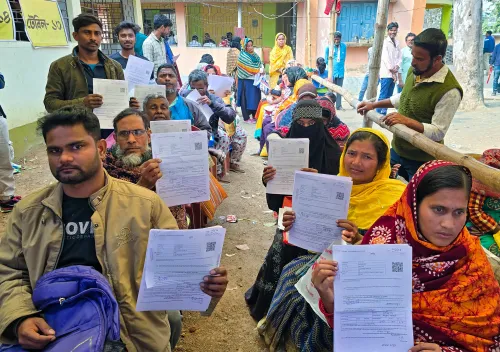
Kolkata, Dec 28 (NationPress) The Election Commission of India (ECI) has instructed Electoral Registration Officers (EROs) to avoid making any explanatory notes on identity documents submitted by voters during the hearing sessions concerning claims and objections to the draft voters' list in West Bengal.
As per directives from the commission, EROs are specifically prohibited from marking the term "verified" on any documents provided by voters, as informed by sources within the office of the Chief Electoral Officer (CEO) of West Bengal.
Moreover, the commission has directed the appointed micro-observers to ensure that no explanatory annotations are inscribed on the documents received during these sessions, except for the signatures of both EROs and voters on them. EROs are also encouraged to place their signatures or that of the voter on the reverse side of the document papers, according to the CEO's office sources.
The reasoning behind the prohibition on writing explanatory notes, particularly the term "verified", is that simply receiving these documents during the hearing does not equate to their verification or authentication.
Upon receipt, these documents will undergo a three-phase verification process: first by the concerned EROs, then by the relevant District Magistrates, and lastly, a technical assessment by the commission's expert team.
This measure aims to establish accountability among all electoral officers involved in the hearing process, as stated by the sources.
The hearing sessions will be conducted in two phases. Currently, hearings are focused on "unmapped" voters, meaning those without connections to the 2002 voters' list, either through "self-mapping" or "progeny mapping". The last time the SIR was conducted in West Bengal was back in 2002.
The second phase will address voters with logical discrepancies, where unusual family tree data has been identified during progeny mapping, including instances of voters becoming fathers at ages as young as 15 or grandfathers at 40 or younger, as well as cases where voters have parents with identical names.
The final voters' list is scheduled to be published on February 14 next year, following the conclusion of the hearing sessions and subsequent verifications. Shortly thereafter, the ECI will announce the polling dates for the crucial assembly elections in the state.
Point of View
I recognize the importance of maintaining the integrity of the electoral process. The ECI's directive to EROs is a significant step towards ensuring accountability and transparency in the voter verification process. This decision aligns with the principle of safeguarding democracy in our nation.
NationPress
29 Sept 2026
Frequently Asked Questions
Why has the ECI prohibited notes on voter documents?
The ECI aims to ensure that merely receiving documents does not imply their verification or authentication, thus maintaining the integrity of the electoral process.
What is the verification process for voter documents?
The documents will undergo a three-stage verification, first by EROs, then by District Magistrates, and finally by the commission's technical team.
What are 'unmapped' voters?
'Unmapped' voters are those who do not have links to the 2002 voters' list through self-mapping or progeny mapping.
When will the final voters' list be published?
The final voters' list is set to be published on February 14 next year.
What are the implications of this directive for the electoral process?
This directive is aimed at enhancing accountability and maintaining the integrity of the electoral process in West Bengal.