ED Raids 6 Locations: ₹95 Crore Funnelled via Foreign Debit Cards
Synopsis
The ED has uncovered a covert network that allegedly channelled ₹95 crore into India via foreign Truist Bank debit cards, bypassing FCRA regulations. Cash worth ₹6.5 crore was withdrawn in Naxal-hit Chhattisgarh. A man carrying 24 foreign debit cards was intercepted at Bengaluru airport. The case links foreign funds to Left Wing Extremism zones — a serious national security red flag.
Key Takeaways
The Enforcement Directorate (ED) conducted raids at 6 locations across multiple states on April 18–19, 2025 in connection with illegal foreign fund flows via debit cards.
Micah Mark was intercepted at Bengaluru International Airport carrying 24 foreign bank debit cards linked to Truist Bank, USA .
Approximately ₹6.5 crore was withdrawn from ATMs in LWE-affected areas including Dhamtari and Bastar, Chhattisgarh , raising serious security concerns.
A total of ₹95 crore was allegedly channelled into India through foreign debit cards between November 2025 and April 2026 .
The organisation at the centre of the probe, The Timothy Initiative (TTI) , is not registered under FCRA , making its foreign fund usage illegal under Indian law.
Seizures include 25 foreign debit cards , ₹40 lakh cash , and multiple digital devices; further arrests and asset attachments are expected.
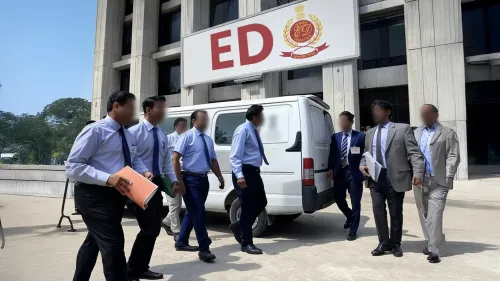
The Directorate of Enforcement (ED) conducted sweeping search operations across six locations in multiple states on April 18 and 19, 2025, targeting a suspected network that allegedly funnelled foreign funds into India through foreign bank debit cards, deliberately circumventing regulatory and compliance frameworks. The agency confirmed the raids in an official release on Friday, April 24. At the centre of the probe is an organisation called The Timothy Initiative (TTI), which operates in India without registration under the Foreign Contribution (Regulation) Act (FCRA).
The Timothy Initiative and the FCRA Violation Angle
The ED's investigation zeroed in on activities linked to The Timothy Initiative (TTI), a movement whose Indian operations allegedly relied on cash generated through repeated ATM withdrawals using foreign bank debit cards issued by Truist Bank, USA. Since TTI is not registered under FCRA, receiving and utilising foreign funds through any channel — let alone covert cash withdrawals — constitutes a serious violation of Indian law.
FCRA governs how foreign contributions can be received by individuals and organisations in India, and non-compliance can attract prosecution, cancellation of registration, and freezing of assets. The ED's intervention signals that this case is being treated not merely as a financial irregularity but as a potential national security threat.
Key Seizures and the Bengaluru Airport Interception
A critical breakthrough in the investigation came when Micah Mark was intercepted by the Bureau of Immigration at Bengaluru International Airport pursuant to a Look Out Circular (LOC) issued by the ED. Authorities found 24 foreign debit cards in his possession at the time of interception — a discovery that significantly widened the scope of the probe.
The searches conducted across multiple states resulted in the seizure of 25 foreign bank debit cards, cash worth ₹40 lakh, and a range of digital devices, documents, and other incriminating evidence. The agency noted that multiple individuals spread across different parts of India are now under scrutiny.
Naxal Regions, ₹6.5 Crore Withdrawals, and Security Concerns
Among the most alarming findings is the pattern of cash withdrawals in Left Wing Extremism (LWE)-affected regions. Investigators found that these foreign debit cards were used to withdraw approximately ₹6.5 crore in cash from ATMs in Dhamtari and the Bastar region of Chhattisgarh over the past few years — areas that have long been flashpoints for Naxalite insurgency.
The ED stated that the withdrawals were executed in a systematic and pre-planned manner, pointing to the possible involvement of organised financial networks. The agency warned that the emergence of a parallel cash-based economy in Naxal-affected zones poses a grave threat to India's security architecture and financial integrity, and could potentially serve as a conduit for funding unlawful activities.
This is not the first time foreign funding has been suspected of flowing into conflict-prone regions of central India. Security analysts have previously flagged the vulnerability of LWE-affected districts to external financial influence, making the ED's findings particularly significant in a broader counter-insurgency context.
₹95 Crore Channelled Through Foreign Cards: Scale of the Operation
The full scale of the alleged operation is staggering. The ED revealed that approximately ₹95 crore was channelled into India using foreign bank-issued debit cards during the period from November 2025 to April 2026. This volume of funds, routed outside formal banking and regulatory systems, underscores the sophistication and reach of the network under investigation.
The agency also found that a billing and accounting online platform — reportedly controlled by entities operating from outside India — was used to maintain meticulous records of ATM withdrawals and their end-use. This digital trail, now in the ED's possession, is expected to be central to building the prosecution's case.
Broader Implications: FCRA, Foreign Funding, and India's Regulatory Gaps
This case arrives in the context of India's increasingly strict enforcement of FCRA provisions. In recent years, the government has cancelled FCRA registrations of hundreds of NGOs, citing concerns over foreign funding being used to influence domestic affairs. The TTI case, however, goes a step further — the alleged use of foreign debit cards to bypass the formal banking system entirely represents a new and more covert method of circumventing India's foreign contribution laws.
Critics and security experts argue that this case exposes a significant regulatory gap: while FCRA monitors wire transfers and formal donations, cash-based ATM withdrawals using foreign cards remain harder to track in real time. The ED's use of financial intelligence and airport surveillance to crack this network may prompt calls for tighter monitoring of foreign card usage at Indian ATMs, particularly in sensitive regions.
As the investigation progresses, authorities are expected to identify additional individuals and entities involved in the network, with possible arrests and asset attachment orders likely to follow in the coming weeks.
Point of View
But this network exploited a blind spot by using foreign debit cards for cash withdrawals, effectively making the money invisible to conventional financial surveillance. The geographic targeting of Naxal-affected Bastar and Dhamtari is not incidental; it is a deliberate operational choice that transforms a financial crime into a national security crisis. What is equally troubling is the scale — ₹95 crore in under six months — suggesting this is not a fringe operation but a well-resourced, organised network with external backing. India must now urgently close the ATM-cash withdrawal loophole before it becomes a standard playbook for foreign interference.
NationPress
2 Oct 2026
Frequently Asked Questions
What is the ED foreign debit card case about?
The ED is investigating a network that allegedly used foreign bank debit cards issued by Truist Bank, USA, to withdraw large amounts of cash from Indian ATMs, bypassing FCRA regulations. The funds were reportedly used to finance activities of The Timothy Initiative (TTI), an unregistered foreign-linked organisation operating in India.
Who is Micah Mark and why was he arrested?
Micah Mark was intercepted by the Bureau of Immigration at Bengaluru International Airport based on a Look Out Circular issued by the ED. He was found carrying 24 foreign bank debit cards at the time of interception, making him a key figure in the ongoing investigation.
How much money was allegedly channelled into India through foreign debit cards?
According to the ED, approximately ₹95 crore was channelled into India using foreign bank-issued debit cards between November 2025 and April 2026. Of this, around ₹6.5 crore was withdrawn specifically in Naxal-affected regions of Chhattisgarh.
What is The Timothy Initiative and why is it under scrutiny?
The Timothy Initiative (TTI) is an organisation operating in India that is not registered under the Foreign Contribution (Regulation) Act (FCRA). Receiving or utilising foreign funds without FCRA registration is a legal violation in India, and the ED suspects TTI's activities were financed through the covert debit card cash withdrawal network.
What was seized during the ED raids?
The ED's searches across six locations resulted in the seizure of 25 foreign bank debit cards, cash amounting to ₹40 lakh, and various digital devices, documents, and other incriminating evidence. Further investigation is currently under way.