Did the SC Reject the Probe into the Alleged CLAT 2026 Paper Leak?
Click to start listening
Synopsis
The Supreme Court's recent dismissal of a plea for an investigation into the alleged CLAT 2026 paper leak raises questions about the integrity of one of the nation's key law entrance exams. With over 92,000 candidates affected, this decision marks a significant moment in the ongoing discourse surrounding examination fairness.
Key Takeaways
- The Supreme Court dismissed the plea for the CLAT 2026 investigation.
- The court cited the completion of the examination process as a primary reason.
- There are serious allegations regarding the leak of the question paper.
- The petitioners expressed concerns about the integrity of the examination.
- Over 92,000 candidates were impacted by the exam results.
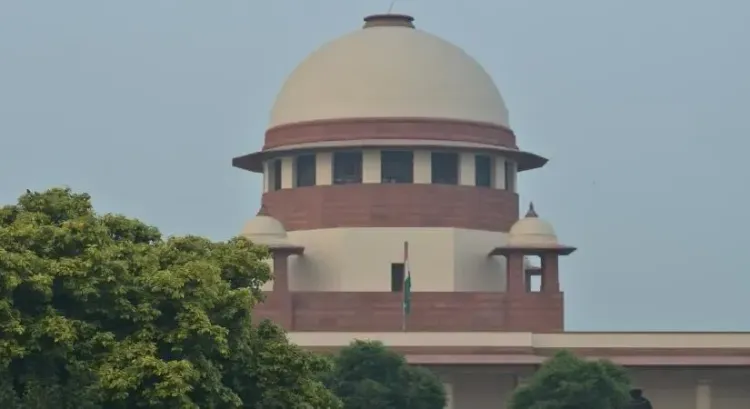
New Delhi, Jan 7 (NationPress) The Supreme Court on Wednesday rejected a request for a court-supervised, independent, and timely investigation into the purported leak of the Common Law Admission Test (CLAT) 2026 question paper and answer key, which was supposed to take place before the examination on December 7.
Refusing to entertain the writ petition, a panel of Justices P.S. Narasimha and Alok Aradhe noted that the examination process had already concluded and the petition was submitted too late.
In questioning the need to pursue this issue at such a delayed stage—after the announcement of results and completion of crucial admission processes—the Justice Narasimha-led panel remarked that the examination had already been conducted and that “everything was over.”
The court highlighted the delay in approaching them, pointing out that while the petitioners claimed the leak occurred on December 6, they did not file the writ petition until December 16.
“You knew on December 6 that the paper was leaked. Why did you wait until December 16 to file?” the Justice Narasimha-led panel questioned, adding that the Supreme Court would have “appreciated” the issue being raised before the results were declared.
The plea, submitted through advocate Malvika Kapila, requested an investigation under the court's supervision into the alleged dissemination of videos, screenshots, and other digital content on WhatsApp, Telegram, and other social media platforms that “prima facie demonstrated that the CLAT 2026 question paper and answer key were illegally accessed, leaked and disseminated prior to the examination conducted on December 7, 2025.”
The petition mentioned that images with date and time stamps of around 10:15 p.m. on December 6—almost 15 hours before the exam—began circulating online. These allegedly included admissions from individuals claiming to have accessed the paper ahead of time, alongside messages from a person offering the question paper for a fee.
“While the Telegram application offers a feature for media editing that typically triggers an automatic ‘edited’ label, no such indicators of subsequent modifications are present on these images, which prima facie validates their authenticity and supports the alleged timeline of the organized leak,” the plea asserted.
The petitioners, identifying as bona fide candidates from Scheduled Caste, OBC, and economically weaker section categories, argued that a “level playing field is essential for any public competitive examination” and claimed that the scale and speed of material circulation had “irreparably compromised” the integrity of CLAT 2026, thus disadvantaging genuine and deserving candidates.
The plea further alleged inaction from the exam conducting body, stating that despite the establishment of a grievance redressal mechanism led by a retired Supreme Court judge on December 17, no reasoned order, inquiry report, or clarification addressing the paper leak allegations had been communicated to candidates.
Claiming that national-level examinations constitute a public function, the petition asserted that proceeding with counseling and seat allocation based on a “prima facie compromised examination” would lead to irreversible repercussions, including the permanent displacement of deserving candidates.
According to the petition, over 92,000 candidates applied for CLAT 2026 for approximately 3,500 undergraduate and 1,500 postgraduate seats, with the examination being conducted in offline mode across 156 centers in 25 states and four Union Territories (UTs).
CLAT is a national-level entrance examination for admission to undergraduate and postgraduate law programs offered by 25 National Law Universities (NLUs) throughout the country and is conducted by the Consortium of National Law Universities.
Point of View
While the Supreme Court's dismissal of the CLAT 2026 paper leak investigation plea may seem justifiable given the timing, it highlights a critical lapse in accountability for examination integrity. The concerns raised by the petitioners underscore the need for prompt action and transparent processes to maintain public trust in competitive examinations.
NationPress
08/01/2026
Frequently Asked Questions
What is the Supreme Court's ruling regarding the CLAT 2026 paper leak?
The Supreme Court rejected a plea for a court-monitored investigation into the alleged leak of the CLAT 2026 question paper, citing the completion of the examination process.
Why was the plea dismissed by the Supreme Court?
The plea was dismissed because it was filed after the examination had been conducted and the results declared, indicating a delay in addressing the issue.
What do the petitioners claim regarding the CLAT 2026 exam?
The petitioners claim that there was a significant leak of the question paper and answer key, which compromised the integrity of the exam and affected deserving candidates.
How many candidates applied for CLAT 2026?
Over 92,000 candidates applied for CLAT 2026 for approximately 3,500 undergraduate and 1,500 postgraduate seats.
What is CLAT?
CLAT, or the Common Law Admission Test, is a national-level entrance examination for admission to law programs at various National Law Universities in India.