CM Fadnavis Hails BJP-NDA Wins Across Recent Bypolls, Civic Polls
Synopsis
Maharashtra CM Devendra Fadnavis hails BJP-NDA victories across bypolls in West Bengal, Assam and Puducherry and civic elections in Rajasthan and Tripura, crediting PM Modi's leadership and dismissing opposition politics as negative and untrustworthy.
Key Takeaways
CM Devendra Fadnavis declared BJP-NDA's 'victory march' unbroken after wins across five electoral contests.
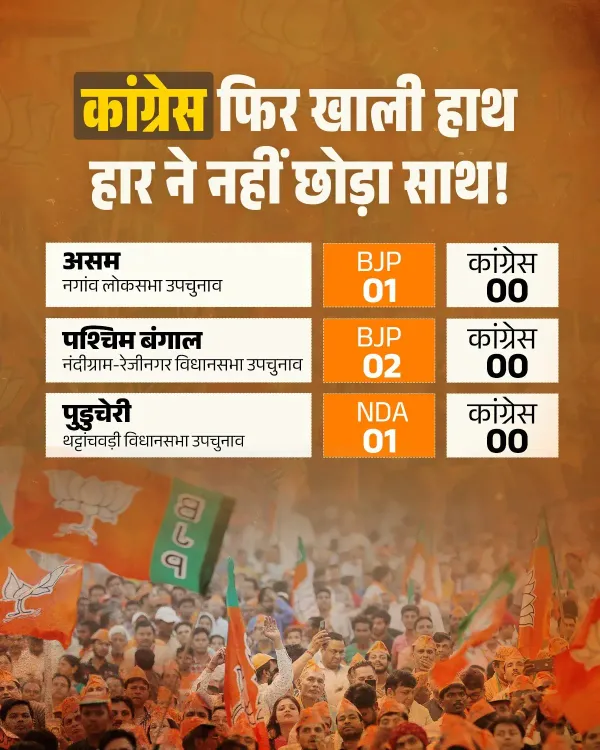
Bypolls in West Bengal, Assam, and Puducherry and civic body polls in Rajasthan and Tripura are the specific wins cited.
Fadnavis credited PM Narendra Modi's leadership and BJP National President Nitin Nabin's guidance for the results.
He directly tagged state leaders including Himanta Biswa Sarma, Suvendu Adhikari, Bhajan Lal Sharma, and Dr Manik Saha .
Fadnavis accused the opposition of habitually questioning institutions and rejecting public mandates after every defeat.
A string of victories — from bypolls in West Bengal, Assam, and Puducherry to the recent civic body elections in Rajasthan and Tripura — has prompted Maharashtra Chief Minister Devendra Fadnavis to declare that the BJP-NDA's winning momentum is unbroken and accelerating. On Friday, October 9, 2026, Fadnavis posted on X, framing each result as the public's direct answer to what he called the opposition's 'negative politics.'
In his post, Fadnavis wrote — 'जनता का अटूट विश्वास, भाजपा की लगातार जीत!' ('The people's unshakeable trust, BJP's unending victories!') — crediting Prime Minister Narendra Modi's leadership and BJP National President Nitin Nabin's guidance for the alliance's forward march. He specifically called out a pattern: 'After every defeat, questioning institutions and rejecting public mandates has become the opposition's habit.'
Which elections triggered the celebration
The sweep Fadnavis referenced spans two distinct formats. The bypolls in West Bengal, Assam, and Puducherry are state legislative or parliamentary constituency contests — tightly watched because they often signal a ruling party's mid-term standing. The civic body elections in Rajasthan and Tripura are a different but equally important theatre: local government wins build the party's ground machinery and signal grassroots loyalty ahead of assembly cycles.
Together, they represent geography from eastern India to the union territory of the south coast — making Fadnavis's framing of a 'continuous victory march' more than just a ceremonial flourish. It is a multi-front claim.
Fadnavis's shout-outs and the leaders he named
Fadnavis addressed his congratulations directly to BJP-NDA-ruled state Chief Ministers, senior leaders, state presidents, and ground-level workers. He tagged several senior figures including Suvendu Adhikari (West Bengal), Himanta Biswa Sarma (Assam Chief Minister), Bhajan Lal Sharma (Rajasthan Chief Minister), and Dr Manik Saha (Tripura Chief Minister) — each name anchoring the win in the specific state it came from.
The explicit name-checks serve a political function beyond courtesy: they tie each regional leader's effort to the national narrative the party is building, and they reinforce the idea of coordinated, top-to-bottom party machinery rather than isolated, personality-driven wins.
The counter-narrative Fadnavis is building
The sharper political edge in the post is aimed squarely at the opposition. Fadnavis argues that the public has 'now clearly recognised the lies and negativity' of the opposition — a line designed to pre-empt any post-result contest of legitimacy. In Indian electoral politics, allegations of institutional compromise after defeats have become a recurring friction point, and Fadnavis is explicitly naming and dismissing that playbook before it unfolds.
For BJP, a party that has staked its identity on development politics and decisive mandates, a sequence of wins across five distinct electoral events — different states, different formats, different demographics — is the kind of data point that feeds the internal morale machine as much as the external messaging operation. These victories signal that the coalition's ground game is holding.
The votes are in. The scoreboard reads the same across five contests. The NDA's next test will tell whether this momentum is structural or cyclical — but for now, the numbers are talking.
Point of View
Unified story of national momentum ahead of future electoral cycles. By crediting both Modi's leadership and the new national party president Nitin Nabin in the same breath, the post signals alignment at the top of the party hierarchy. The pre-emptive swipe at opposition 'institution-questioning' suggests BJP is preparing the communications battlefield for any results that may not go its way in upcoming contests. Across India's fragmented electoral calendar, the ability to frame a sequence of local and sub-state results as a coherent mandate is itself a form of political power.
NationPress
10 Oct 2026
Frequently Asked Questions
Which elections did Devendra Fadnavis refer to in his BJP victory post?
Fadnavis referenced bypolls in West Bengal, Assam, and Puducherry, as well as recent civic body elections in Rajasthan and Tripura as part of BJP-NDA's victory streak.
Who is Nitin Nabin and why did Fadnavis mention him?
Nitin Nabin is the BJP National President and Member of Parliament. Fadnavis credited his guidance alongside PM Modi's leadership for the party's continued electoral wins.
What did Fadnavis say about the opposition in his post?
Fadnavis accused the opposition of negative politics, false allegations, and propaganda, and said that questioning institutions after every defeat has become the opposition's habit.
Which BJP and NDA state leaders did Fadnavis congratulate?
He specifically tagged Suvendu Adhikari from West Bengal, Himanta Biswa Sarma of Assam, Bhajan Lal Sharma of Rajasthan, and Dr Manik Saha of Tripura, along with all BJP-NDA Chief Ministers and workers.
What is the significance of BJP winning both bypolls and civic elections together?
Winning across both state legislative bypolls and local civic body elections simultaneously demonstrates strength at multiple levels of governance and suggests the party's ground machinery is performing consistently across states.