Maharashtra quantum technology mission: Fadnavis eyes national leadership
Synopsis
Maharashtra isn't content to ride the Centre's ₹6,000 crore National Quantum Mission — it's building its own. CM Fadnavis has laid out a two-phase talent pipeline: 500 trained faculty first, then 5,000 quantum professionals, backed by five premier institutions and AI chatbots 'Chandra' and 'Surya'. The state is betting that training the trainers is the fastest route to quantum leadership.
Key Takeaways
CM Devendra Fadnavis announced the Maharashtra Quantum Technology Mission on 17 July , aligned with but independent of the National Quantum Mission.
The Centre has allocated approximately ₹6,000 crore for the National Quantum Mission ; Maharashtra is running a parallel state-level initiative.
Phase 1 targets training 500 expert faculty members ; Phase 2 aims to produce over 5,000 quantum-trained professionals .
Key institutions involved include IIT Bombay , IISER , C-DAC , COEP , and VNIT .
AI chatbots 'Chandra' and 'Surya' have been developed to simplify quantum concepts for students and faculty.
Fadnavis identified AI , semiconductors , and quantum technology as the three pillars of future global competitiveness.
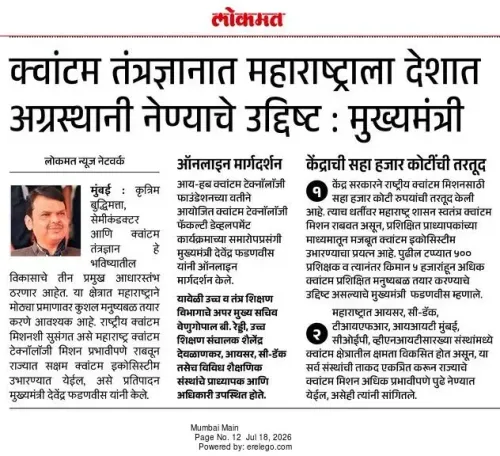
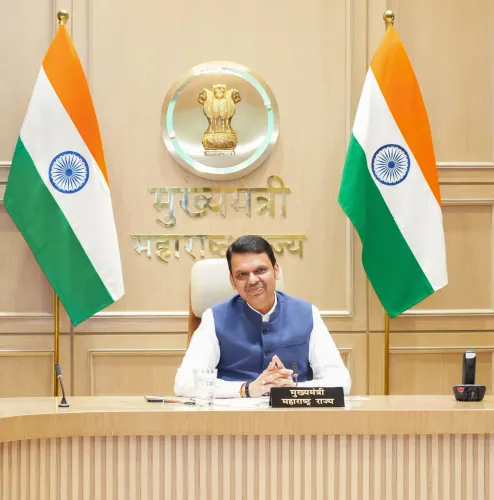
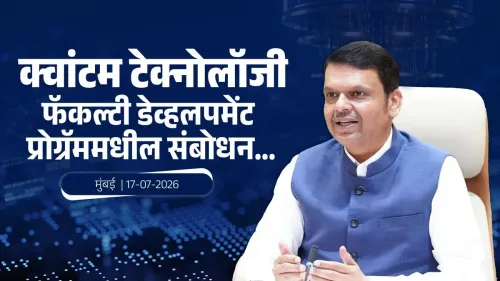
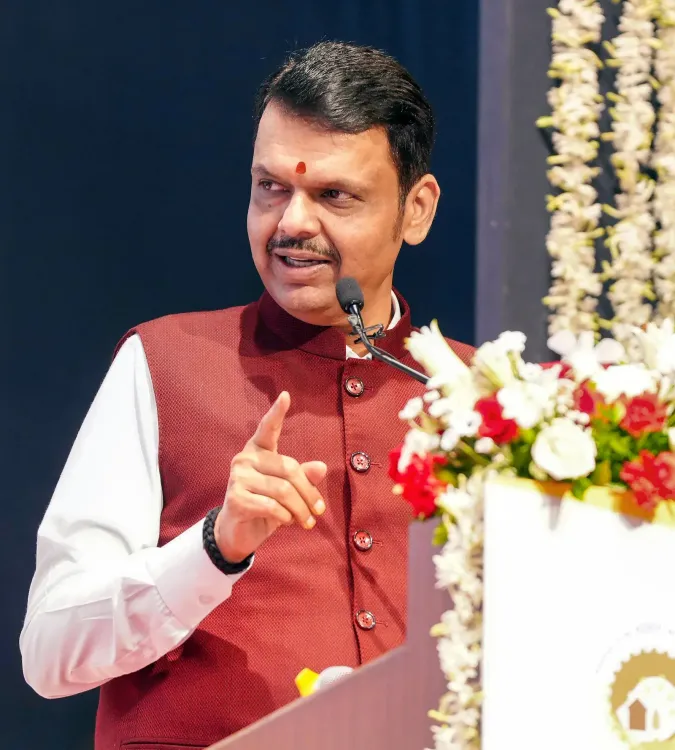
Maharashtra Chief Minister Devendra Fadnavis on 17 July declared that the state is committed to positioning itself at the forefront of India's quantum technology ambitions, announcing a structured talent pipeline and a dedicated state-level mission to build a world-class quantum ecosystem. The announcement came during the valedictory session of the Quantum Technology Faculty Development Programme, organised by the I-Hub Quantum Technology Foundation, which Fadnavis addressed virtually.
Three Pillars of Future Development
Chief Minister Fadnavis identified Artificial Intelligence (AI), semiconductors, and quantum technology as the three decisive pillars that will shape global economic competition in the coming decades. He stressed that the world is rapidly transitioning from a data-based economy to an era of high-speed data processing, and that nations which build skilled workforces in these domains will secure outsized advantages.
'Just like in the Information Technology (IT) sector, India must capitalise on its skilled workforce to secure global leadership in the quantum domain,' Fadnavis said.
Maharashtra Quantum Technology Mission
The Chief Minister confirmed that the state will implement the Maharashtra Quantum Technology Mission, aligned with the National Quantum Mission for which the Centre has allocated approximately ₹6,000 crore. Maharashtra, however, is running its own independent state-level mission — a signal that the state intends to move beyond merely complementing federal efforts and establish a distinct quantum identity.
The talent roadmap is structured in two phases: Phase 1 targets the training of 500 expert instructors and faculty members, while Phase 2 aims to develop a workforce of over 5,000 quantum-trained professionals. This sequenced approach — training the trainers first — reflects a scalable model that could accelerate adoption across institutions.
Institutions Driving the Push
Fadnavis highlighted the collective strength of premier institutions already building capabilities in quantum technology within the state, including IISER (Indian Institute of Science Education and Research), C-DAC (Centre for Development of Advanced Computing), IIT Bombay, COEP (College of Engineering Pune), and VNIT (Visvesvaraya National Institute of Technology). The convergence of these institutions under a single mission framework is intended to prevent fragmentation of research and talent.
Impact Across Sectors
The Chief Minister underscored that quantum technology is poised to revolutionise engineering, medicine, space exploration, industry, and defence. He emphasised that the employment landscape is expected to transform radically over the next few years, making it vital to equip both students and faculty with next-generation skills today rather than waiting for the technology to mature.
Fadnavis also lauded the newly developed training curricula, Learning Management Systems (LMS), and the dedicated AI chatbots 'Chandra' and 'Surya', which have been designed to simplify core quantum concepts for learners at various levels.
What Comes Next
With the faculty development programme now concluded, the focus shifts to scaling Phase 2 — deploying the trained instructors to build the broader 5,000-strong professional cohort. How effectively Maharashtra integrates its state mission with the Centre's ₹6,000 crore National Quantum Mission framework will determine whether the state can translate ambition into measurable outcomes in a technology race that is already intensifying globally.
Point of View
000 crore National Quantum Mission is strategically shrewd — but the real question is whether state-level execution can avoid the coordination failures that have plagued India's previous deep-tech initiatives. Training 500 faculty before scaling to 5,000 professionals is a sensible sequenced model, yet the timeline and accountability metrics remain unspecified. India's IT dominance was built on decades of institutional investment and a fortuitous global moment; quantum technology demands far more capital-intensive, long-cycle research. Without hard targets, independent audits, and industry linkages that convert trained professionals into employed ones, Maharashtra's quantum ambition risks becoming another well-intentioned announcement that stalls at Phase 1.
NationPress
16 Oct 2026
Frequently Asked Questions
What is the Maharashtra Quantum Technology Mission?
The Maharashtra Quantum Technology Mission is a state-level initiative announced by Chief Minister Devendra Fadnavis to build a quantum ecosystem in the state, running parallel to the Centre's National Quantum Mission. It focuses on workforce creation, institutional collaboration, and curriculum development to position Maharashtra as India's quantum technology leader.
How much has the Centre allocated for the National Quantum Mission?
The Central Government has allocated approximately ₹6,000 crore for the National Quantum Mission. Maharashtra is implementing its own independent state-level mission in alignment with this national framework.
What is the talent development roadmap under the Maharashtra quantum plan?
The plan is structured in two phases: Phase 1 involves training 500 expert instructors and faculty members, and Phase 2 targets the creation of a workforce of over 5,000 quantum-trained professionals. The approach trains educators first to enable faster, scalable rollout.
Which institutions are involved in Maharashtra's quantum technology push?
Five premier institutions are driving the initiative: IISER, C-DAC, IIT Bombay, COEP (College of Engineering Pune), and VNIT (Visvesvaraya National Institute of Technology). Together, they form the institutional backbone of the state's quantum ecosystem.
What are the AI chatbots 'Chandra' and 'Surya' mentioned by CM Fadnavis?
'Chandra' and 'Surya' are dedicated AI chatbots developed as part of the Quantum Technology Faculty Development Programme. They are designed to simplify core quantum concepts for students and faculty, supporting the Learning Management Systems (LMS) built for the programme.