Trump Blames Canada for 'Filthy' Air Invading the US
Synopsis
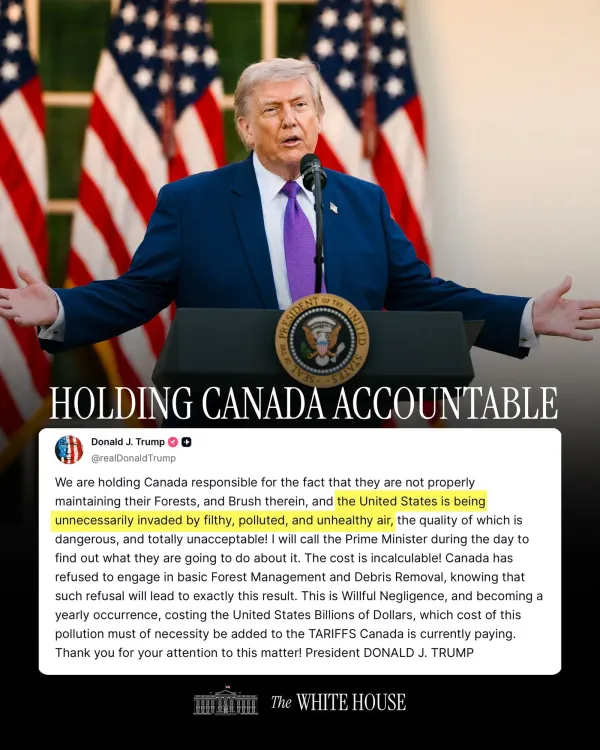
President Donald J. Trump, in a statement shared by the White House on 17 July 2026, publicly held Canada responsible for what he called 'filthy, polluted, and unhealthy air' crossing into the United States, describing the situation as dangerous and totally unacceptable.
Key Takeaways
President Trump publicly blamed Canada for cross-border air pollution in a White House statement dated 17 July 2026 .
He described the air as 'filthy, polluted, and unhealthy' and called the situation 'totally unacceptable.' The 1991 Canada-United States Air Quality Agreement is the existing bilateral framework for managing such transboundary pollution disputes.
The administration's language frames the issue as a matter of direct bilateral accountability rather than technical treaty cooperation.
Northern US border states and their residents are the populations most immediately exposed to cross-border air-quality events.
The statement raises the prospect of diplomatic or regulatory escalation between Washington DC and Ottawa .
Washington DC, 17 July 2026 — The White House on Friday quoted President Donald J. Trump holding Canada directly responsible for what he described as dangerous transboundary air pollution crossing into the United States, declaring the situation 'totally unacceptable.'
Context
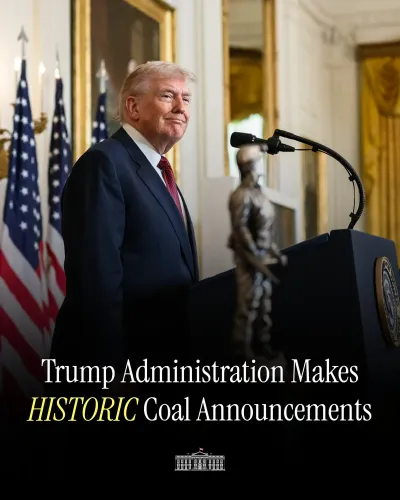
In the statement shared by the official White House account, President Trump said: 'We are holding Canada responsible... the United States is being unnecessarily invaded by filthy, polluted, and unhealthy air, the quality of which is dangerous, and totally unacceptable!' The post was accompanied by an image and directed attention to what the administration characterised as a cross-border environmental threat.
Transboundary air pollution between the two neighbours is not a new concern. Northern border states in the US have periodically recorded deteriorating air quality linked to sources originating in Canada, including industrial emissions and, in recent years, large-scale wildfire smoke events.
Policy Backdrop
The United States and Canada have governed shared air-quality concerns through the 1991 Canada-United States Air Quality Agreement, a bilateral treaty designed to reduce acid rain and other transboundary pollutants through cooperative technical mechanisms.
The Trump administration's framing — of Canada being 'held responsible' — signals a shift toward direct bilateral accountability rather than the technical, agency-led consultation process envisaged under that agreement. This approach is consistent with the broader pattern of the administration applying transactional, America First pressure to longstanding treaty relationships.
Stakeholders and Impact
Residents of US northern border states, including communities in New York, Michigan, Minnesota, and Washington state, are the most directly affected by episodes of poor air quality with cross-border origins. Environmental and public health agencies on both sides of the border monitor such events.
Canada, as a signatory to the 1991 Air Quality Agreement, has existing obligations to consult and cooperate with the US on transboundary pollution. A public presidential rebuke of this nature raises the political stakes for diplomatic and environmental agencies in Ottawa and Washington DC.
What's Next
Observers will watch for formal diplomatic communications between the two governments, any scheduled bilateral environmental consultations, and statements from the US Environmental Protection Agency on current air-quality conditions in northern states.
If the administration moves beyond rhetoric toward concrete trade or regulatory measures framed around air quality, it would mark a significant escalation in US-Canada relations — adding an environmental dimension to already strained bilateral ties. The episode underscores how environmental disputes, historically managed through technical channels, are increasingly entering the arena of high-stakes political confrontation.
Point of View
Already navigating tariff pressures and renegotiated trade terms, this adds an environmental accountability dimension that complicates an already strained relationship. The use of visceral, emotive language — 'filthy,' 'invaded' — also signals that this is as much a domestic political message to northern-state voters as it is a diplomatic one directed at Ottawa.
NationPress
18 Jul 2026
Frequently Asked Questions
Why is Trump blaming Canada for air pollution in the US?
President Trump stated that the United States is being 'invaded' by dangerous air originating from Canada , holding Ottawa directly responsible. Transboundary air pollution — including wildfire smoke and industrial emissions — has periodically affected northern US states , and the administration is framing this as a bilateral accountability issue.
What is the 1991 Canada-US Air Quality Agreement?
The 1991 Canada-United States Air Quality Agreement is a bilateral treaty that established a formal framework for both countries to cooperate in reducing transboundary air pollutants, including acid rain. It is the primary legal mechanism governing cross-border air-quality disputes between the two nations.
Which US states are most affected by Canadian air pollution?
Northern border states such as New York , Michigan , Minnesota , and Washington state are most vulnerable to air-quality deterioration linked to cross-border sources in Canada , including wildfire smoke and industrial emissions.
What could the US do to hold Canada responsible for air quality?
The US could pursue formal consultations under the 1991 Air Quality Agreement , raise the matter through diplomatic channels, or — in a more aggressive posture — link the issue to trade or regulatory negotiations. The Trump administration has not yet specified what concrete measures it intends to take.
How does this affect US-Canada relations?
The public rebuke adds an environmental dimension to an already strained US-Canada relationship, which has faced friction over tariffs and trade terms. Framing air quality as a matter of direct presidential accountability raises the diplomatic stakes significantly for Ottawa .