CM Fadnavis Receives Buddhist Monks at Ramgiri, Nagpur
Synopsis
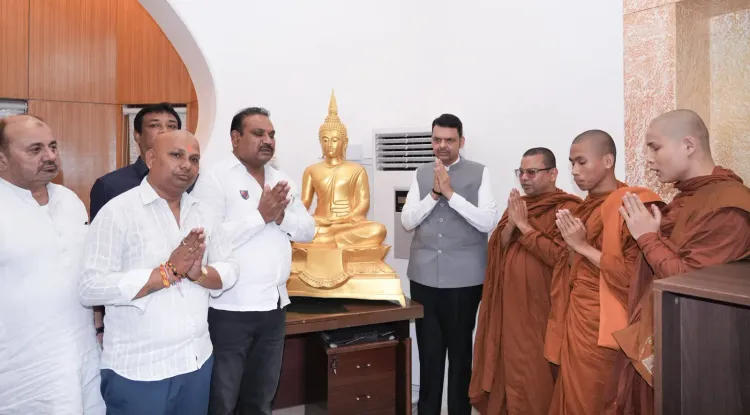
Chief Minister Devendra Fadnavis received a delegation of Buddhist monks from the Sanghakaya Foundation at his official Nagpur residence, Ramgiri Bungalow, on 26 July 2026. The meeting, held with reverence, reflects Maharashtra's sustained engagement with the state's significant Buddhist community rooted in Nagpur's Ambedkarite heritage.
Key Takeaways
A delegation of Buddhist monks from the Sanghakaya Foundation met CM Devendra Fadnavis at Ramgiri Bungalow , Nagpur, on 26 July 2026 at 11 a.m.
The Chief Minister accorded the delegation a warm and reverential welcome, as described in the official trilingual post.
Nagpur is the site of Dr.
Ambedkar's 1956 mass conversion to Buddhism, making it the symbolic heart of Ambedkarite Buddhism in India.
The meeting follows a long-standing pattern of Maharashtra governments engaging with Buddhist monastic and lay organisations in the state.
No specific policy outcomes or agenda details were disclosed in the official communication.
Any follow-up on Buddhist pilgrimage development or monastic welfare support may emerge during the Maharashtra legislature's winter session in Nagpur.
The Chief Minister's Office of Maharashtra announced on 26 July 2026 that a delegation of Buddhist monks from the Sanghakaya Foundation called on Chief Minister Devendra Fadnavis at his official residence, Ramgiri Bungalow, in Nagpur, at 11 a.m. The monks were accorded a warm, respectful welcome by the Chief Minister on the occasion.
Context
The meeting took place at Ramgiri, the official Nagpur residence of the Maharashtra Chief Minister, which serves as a regular venue for administrative and social engagements during the Chief Minister's visits to the city. The post, shared in English, Marathi, and Hindi, described the welcome as shraddhapoorvak — 'with reverence' — underscoring the ceremonial tone of the meeting. Nagpur holds singular significance for India's Buddhist community as the city where Dr. B.R. Ambedkar led a mass conversion to Buddhism on 14 October 1956, an event that transformed the social landscape of Maharashtra.
Policy Backdrop
Successive Maharashtra governments have maintained periodic engagement with Buddhist monastic and lay organisations since Ambedkar's historic conversion movement. Nagpur, as the winter capital of Maharashtra and the epicentre of Ambedkarite Buddhism, naturally draws such interactions to its administrative calendar. State-level leaders across India routinely hold courtesy meetings with religious delegations as a signal of administrative accessibility and a commitment to social harmony, and Maharashtra's large converted Buddhist population makes such engagements particularly resonant in this region.
Stakeholders and Impact
The Sanghakaya Foundation delegation's visit represents an interface between the state government and an organised Buddhist monastic body. For Nagpur's substantial Buddhist community — descendants of the Ambedkarite conversion movement — such direct access to the Chief Minister carries symbolic weight. CM Fadnavis, whose political base is rooted in Nagpur, has historically maintained outreach across the city's diverse religious and social communities. While the official post does not detail the agenda discussed, meetings of this nature often open channels for dialogue on pilgrimage infrastructure, monastic welfare, or cultural preservation.
What's Next
Observers will watch for any follow-up announcements linked to Buddhist pilgrimage development, heritage site conservation, or state support for monastic institutions — particularly ahead of the Maharashtra legislature's winter session, which is traditionally held in Nagpur. Nagpur's identity as a Buddhist pilgrimage hub, anchored by sites such as Deekshabhoomi, gives such meetings the potential to translate into tangible policy action if the government chooses to build on the goodwill generated by this engagement.
Point of View
A city where the Buddhist electorate carries demographic and symbolic weight tied to the Ambedkarite legacy. For a BJP Chief Minister whose home turf is Nagpur, maintaining visible and respectful outreach to Buddhist monastic bodies serves both a social-harmony signal and a local political calculus. Maharashtra's Buddhist community has historically been mobilised by parties across the spectrum, making such access meetings a low-cost, high-visibility investment in community relations. Whether this courtesy call translates into concrete policy — particularly around pilgrimage infrastructure at sites like Deekshabhoomi — will determine its lasting significance.
NationPress
25 Oct 2026
Frequently Asked Questions
Who met CM Devendra Fadnavis in Nagpur on 26 July 2026?
A delegation of Buddhist monks from the Sanghakaya Foundation met CM Devendra Fadnavis at his official Nagpur residence, Ramgiri Bungalow, on 26 July 2026.
Where is Ramgiri Bungalow located?
Ramgiri Bungalow is the official residence of the Maharashtra Chief Minister in Nagpur, the state's winter capital.
What is the Sanghakaya Foundation?
The Sanghakaya Foundation is a Buddhist monastic organisation whose delegation called on CM Fadnavis; specific details about the foundation's activities were not disclosed in the official communication.
Why is Nagpur significant for Buddhists in India?
Nagpur is where Dr. B.R. Ambedkar led a historic mass conversion to Buddhism on 14 October 1956, making it the symbolic and spiritual centre of Ambedkarite Buddhism in India.
What policy outcomes are expected from this meeting?
No specific policy outcomes were announced. Observers are watching for potential follow-up on Buddhist pilgrimage infrastructure or monastic welfare support, possibly during the Maharashtra legislature's winter session in Nagpur.