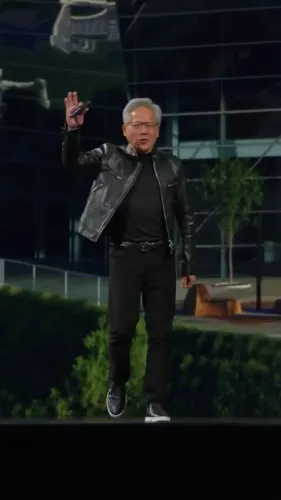
Nvidia's Jensen Huang Calls Europe an AI Economy in the Making

Synopsis
At GTC Berlin, Nvidia CEO Jensen Huang publicly urged Europe to harness its industrial and scientific heritage to build a homegrown AI economy, with Nvidia positioning its GPU infrastructure as the enabling layer for that ambition.
Key Takeaways
Jensen Huang addressed GTC Berlin with a direct call to 'build Europe's AI economy and put AI to work.' Nvidia argues Europe's generations of expertise in science, engineering, and manufacturing make it uniquely positioned for AI-led industrial transformation.
GTC Berlin is part of Nvidia's expanding GPU Technology Conference series, used strategically to court regional industries and governments.
The European Commission's AI strategy , launched in 2018 , and Europe's broader push for digital sovereignty provide a receptive policy backdrop for Nvidia's pitch.
Nvidia's move fits a wider pattern of US tech firms engaging European governments and manufacturers as global semiconductor and AI compute competition intensifies.
Generations of European scientific and industrial mastery — from precision engineering in Germany to semiconductor research across the continent — may be about to find a powerful new application. At GTC Berlin, Nvidia chief executive Jensen Huang made a direct pitch to Europe: the expertise is already there; now let AI put it to work.
What Huang Said at GTC Berlin
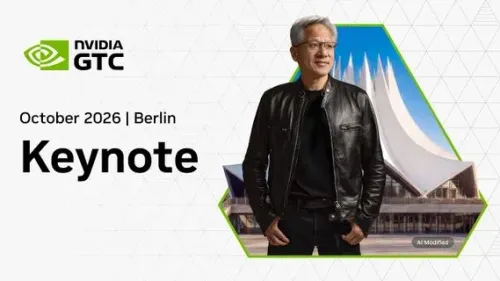
Nvidia's official account framed the moment with characteristic confidence: 'Europe has spent generations mastering science, engineering, and manufacturing. That knowledge and expertise can now power AI of its own.' The post carried a direct quote from Huang — 'Let's work together to build Europe's AI economy and put AI to work' — signalling that this was not a generic keynote aside but a deliberate, public invitation to European industry and governments.
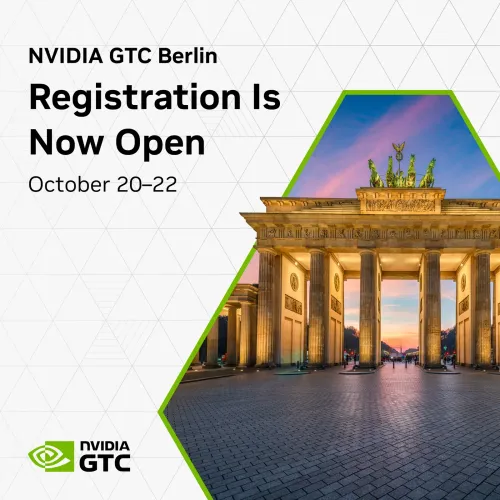
GTC Berlin is part of Nvidia's GPU Technology Conference series, regional editions of its flagship developer and industry event. Nvidia uses these gatherings to position its chips and AI infrastructure as the backbone of local digital economies — and Berlin, sitting at the heart of Europe's industrial belt, is a pointed choice of venue.
Why Europe Is the Target Now
Europe's case for AI is unusually strong on paper. The continent leads in precision manufacturing, chemicals, automotive engineering, and aerospace — all sectors where AI-driven optimisation and automation promise transformative gains. The argument Nvidia is making is essentially: you already have the industrial base; the missing layer is AI compute, and we supply that.
The European Commission laid the policy groundwork as far back as 2018, when it unveiled its AI strategy aimed at trustworthy AI development and boosting investment across member states. Since then, Europe's focus on digital sovereignty — the drive to reduce dependence on non-European technology stacks — has created a politically receptive environment for exactly this kind of partnership pitch. Nvidia is, in effect, meeting European ambition where it lives.
The Bigger Nvidia Playbook
This is not the first time Nvidia has used a regional GTC to plant a flag. The company has steadily expanded its conference footprint — from San Jose to Tokyo to now Berlin — as a way of telling local industries that AI infrastructure is not a distant Silicon Valley concern but something they can build on today. European manufacturers, AI developers, and tech policymakers are all squarely in the crosshairs of that message.
Global semiconductor and computing competition adds urgency to the moment. With the United States and China both accelerating AI investment at scale, Europe faces real pressure to move — and Nvidia's pitch lands at precisely the point where that pressure is most acutely felt in policy circles and boardrooms alike.
The question now is whether Huang's Berlin call-to-action translates into concrete partnership announcements with European research bodies or triggers fresh EU funding rounds for AI infrastructure. The invitation has been issued, loudly and publicly. Europe's answer will define the next chapter.
Point of View
Huang sidesteps the sovereignty debate and reframes Nvidia not as a foreign dependency but as an accelerant for indigenous capability. This mirrors a broader pattern where chip leaders court governments on the cusp of major digital-industrial policy decisions — the timing, with EU AI Act implementation underway and digital sovereignty budgets expanding, is anything but accidental. For Nvidia, locking in European industrial partnerships now could prove as strategically significant as its early dominance in data-centre AI compute.
NationPress
25 Oct 2026
Frequently Asked Questions
What is GTC Berlin and why did Nvidia hold it there?
GTC Berlin is a regional edition of Nvidia's GPU Technology Conference series, held in Berlin to engage European industries, AI developers, and policymakers. Berlin was chosen as a symbolic and practical hub given Germany's central role in European manufacturing and technology.
What did Jensen Huang say about Europe and AI at GTC Berlin?
Jensen Huang called on Europe to build its own AI economy, saying 'Let's work together to build Europe's AI economy and put AI to work.' He argued that Europe's deep heritage in science, engineering, and manufacturing positions it well to develop homegrown AI capabilities.
Why is Nvidia targeting Europe for AI expansion?
Europe combines strong industrial and scientific expertise with growing government investment in AI and digital sovereignty. Nvidia sees this as an opportunity to position its GPU infrastructure as the compute backbone for European AI development, especially as global semiconductor competition intensifies.
What is Europe's existing AI policy framework?
The European Commission launched its AI strategy in 2018 to promote trustworthy AI and boost investment across member states. Since then, Europe has also advanced digital sovereignty policies aimed at reducing dependence on non-European technology.
How does Nvidia's Europe push fit its global strategy?
Nvidia regularly uses regional GTC events to court local industries and governments, framing its chips and AI infrastructure as enablers of local digital economies. Europe is the latest and arguably most strategically significant target in that global expansion playbook.