CM Fadnavis orders withdrawal of agitation-related cases in Nagpur
Synopsis
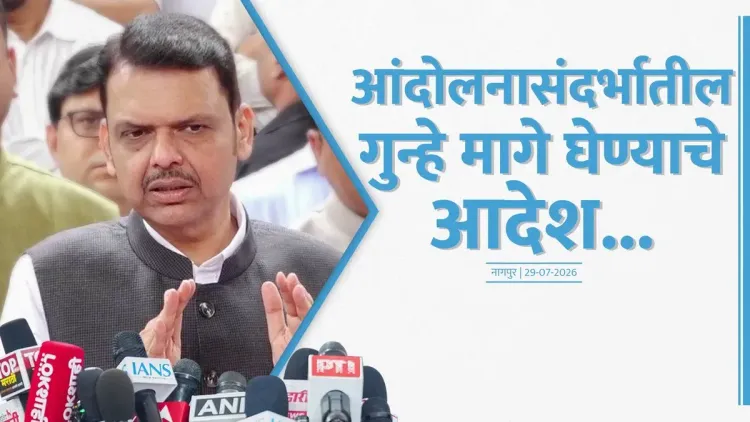
Maharashtra Chief Minister Devendra Fadnavis on 29 July 2026 announced orders to withdraw criminal cases registered during a public agitation in Nagpur, signalling a government move to de-escalate tensions through the Chief Minister's office.
Key Takeaways
CM Devendra Fadnavis issued orders on 29 July 2026 to withdraw criminal cases filed during a public agitation in Nagpur .
The announcement was made directly by the Chief Minister on X in both Marathi and Hindi , signalling a deliberate public communication of the decision.
Withdrawal of agitation FIRs is an established instrument used by Maharashtra governments to de-escalate post-protest tensions.
Each case withdrawal requires a court's formal consent via the public prosecutor — execution by Nagpur police is the next critical step.
The specific agitation and exact number of cases involved were not disclosed in the post.
A significant de-escalation move from Maharashtra Chief Minister Devendra Fadnavis on Wednesday, 29 July 2026: orders have been issued to withdraw criminal cases registered in connection with a public agitation in Nagpur, signalling the state government's intent to draw a line under the unrest.
Posting on X, CM Fadnavis stated in Marathi and Hindi: 'Aandolanasambandhit gunhe mage ghenyache aadesh denyat aale aahet' — 'Orders have been given to withdraw the cases registered in connection with the agitation.' The announcement was geo-tagged to Nagpur, the state's winter capital and a perennial nerve centre of Maharashtra's political life.
What case withdrawal means in practice
When a state government directs withdrawal of agitation-related FIRs, the order flows from the Chief Minister's office to the relevant district police and, ultimately, to the public prosecutor, who moves the court for withdrawal under Section 321 of the Code of Criminal Procedure. The process is not instantaneous — each case requires a court's formal consent — but the political signal is immediate: the government considers the dispute settled enough to stop pursuing protesters through the courts.
Maharashtra administrations have used this instrument before, typically after negotiations with agitating groups conclude or after a prolonged standoff risks hardening into a wider political grievance. The pattern is well-established: protests generate FIRs, FIRs become a bargaining chip, and withdrawal becomes the government's olive branch.
Nagpur as the flashpoint
Nagpur carries outsized political weight in Maharashtra. As the winter capital, it hosts the state legislature's winter session and is the organisational heartland of the RSS, making any unrest there — and any resolution — resonate far beyond the city's limits. A government announcement of case withdrawal from Nagpur, delivered personally by the Chief Minister, carries a deliberate message of authority and closure.
The specific agitation that prompted these FIRs has not been independently confirmed, and the exact number of cases to be withdrawn remains unspecified in the post. What is clear is that the withdrawal order has been issued at the highest level of the state executive.
The next test is execution: whether Nagpur police move swiftly through the courts and whether the affected protesters and any opposition parties accept the gesture as sufficient. Announcements are easy; case files take longer to close.
Point of View
Making the announcement personally and publicly on X frames the move as decisive leadership rather than a concession wrung out by agitators. The choice of Nagpur as the site matters: any governance signal from the winter capital carries amplified resonance across Maharashtra's political landscape. Watch whether opposition parties characterise this as a belated correction or whether affected groups treat it as a full settlement — that response will determine whether the episode stays contained or becomes a larger narrative about how the state handles dissent.
NationPress
13 Sept 2026
Frequently Asked Questions
What did CM Devendra Fadnavis announce on 29 July 2026?
CM Fadnavis announced that orders have been issued to withdraw criminal cases registered in connection with a public agitation in Nagpur, Maharashtra.
What does withdrawal of agitation cases mean for protesters?
It means the state government has directed the public prosecutor to approach courts to drop FIRs filed against individuals during the agitation, effectively ending their criminal exposure from those cases.
Which agitation in Nagpur is CM Fadnavis referring to?
The specific agitation has not been officially identified in the post. The announcement confirms cases exist and will be withdrawn, but does not name the protest movement.
How does the government withdraw agitation-related FIRs in Maharashtra?
The Chief Minister's office issues directions to district police and the public prosecutor, who then applies to the relevant court under Section 321 of the Code of Criminal Procedure for formal withdrawal consent.
Why is Nagpur significant in Maharashtra politics?
Nagpur is Maharashtra's winter capital, hosts the state legislature's winter session, and is the organisational base of the RSS, giving political developments there outsized statewide and national significance.