CM Fadnavis wishes Amit Shah on birthday, hails Naxal fight
Synopsis
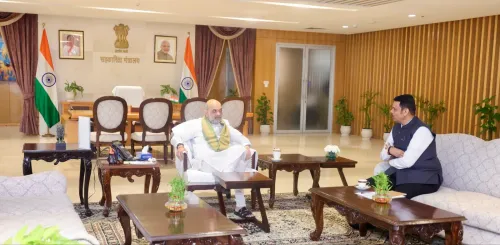
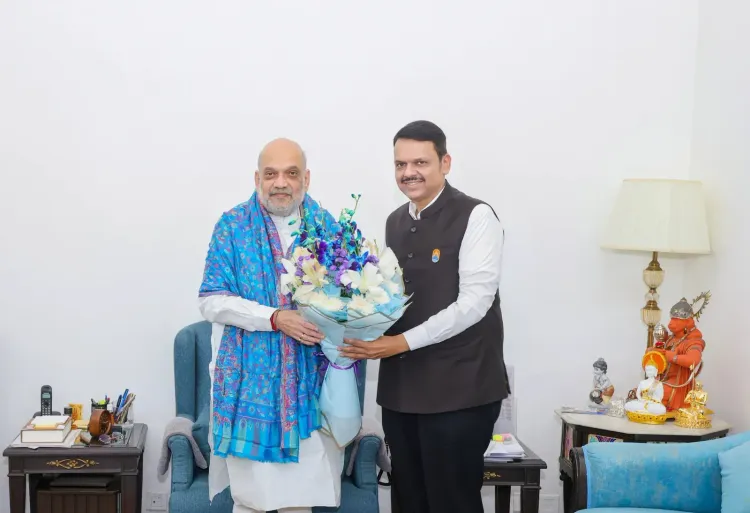
Maharashtra CM Devendra Fadnavis visited Union Home and Cooperation Minister Amit Shah in New Delhi on 21 October 2026 to extend birthday greetings, publicly praising Shah's leadership in anti-Naxal operations, Centre-State security coordination, and farmer-centric cooperative sector initiatives.
Key Takeaways
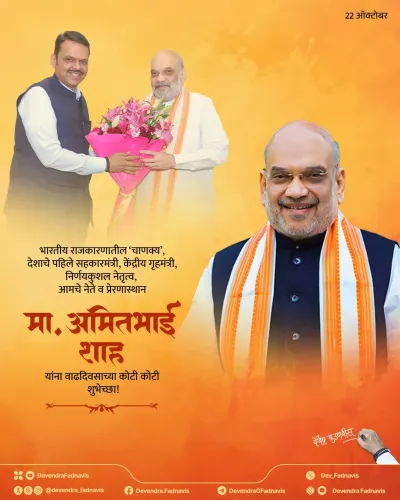
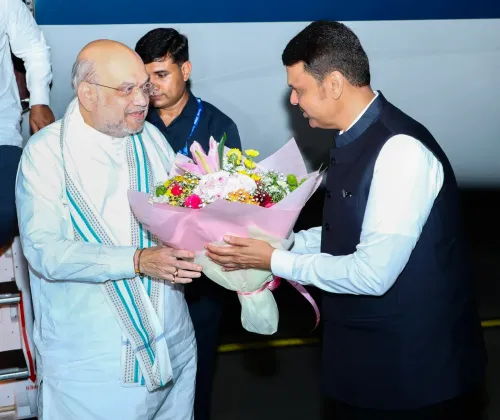
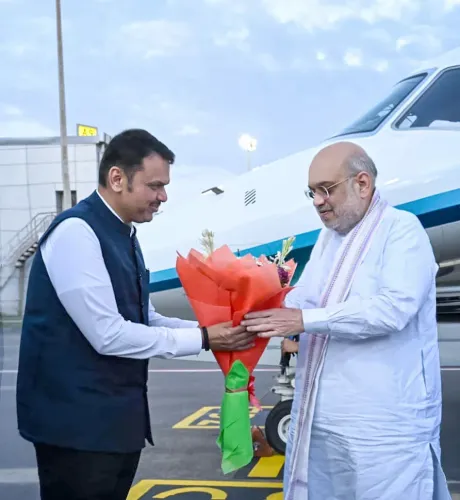
Maharashtra CM Devendra Fadnavis met Amit Shah in New Delhi on 21 October 2026 to convey birthday wishes on behalf of Maharashtra.
Fadnavis credited Shah's leadership with reinforcing internal security through curbing Naxalism and improving Centre-State coordination.
Shah has served as Union Home Minister since 2019 and has headed the Ministry of Cooperation since its creation in July 2021 .
The Ministry of Cooperation has linked cooperatives with schemes such as PM-KISAN and dairy development, targeting rural economic strengthening.
Maharashtra's Gadchiroli district remains among the more persistently Naxal-affected areas, giving the state a direct stake in the Centre's counter-insurgency outcomes.
The public tribute reflects a standard BJP federal framework of visible Centre-State alignment on both security and agrarian policy.
A birthday visit to New Delhi became an occasion for Maharashtra Chief Minister Devendra Fadnavis to publicly spotlight the Union government's twin priorities of internal security and rural cooperative development. On Thursday, 22 October 2026, Fadnavis announced that he had called on Union Home and Cooperation Minister Amit Shah in New Delhi the previous day to extend birthday greetings on behalf of the people of Maharashtra.
In his post, Fadnavis credited Shah's leadership with delivering measurable gains on two distinct policy fronts. 'His leadership in curbing Naxalism and Centre-State coordination have further reinforced internal security,' Fadnavis wrote, also praising Shah's 'visionary initiatives in the cooperative sector and farmer-centric decisions' for strengthening rural economies.
The Naxal front: a long campaign at a critical juncture
The reference to Naxalism is far from ceremonial filler. The Naxalite-Maoist insurgency, a left-wing extremist movement entrenched across central and eastern India for decades, has been a defining security challenge for successive governments. Since 2014, the Centre has pursued an accelerated, coordinated counter-insurgency effort — progressively shrinking the number of affected districts through joint operations involving central paramilitary forces and state police. Amit Shah, as Home Minister since 2019, has been the political face of this campaign, chairing regular review meetings and pushing Centre-State intelligence integration.
For Maharashtra, which shares a geographic and operational stake in the anti-Naxal effort through its Gadchiroli district — one of the more persistently affected areas — Fadnavis's acknowledgment carries specific resonance. It signals that the state's security apparatus sees itself as a co-investor in the campaign's outcomes.
Cooperatives as rural backbone: Shah's second mandate
Less discussed nationally but arguably as consequential in the long run, the Ministry of Cooperation — carved out as a standalone portfolio in July 2021 and handed to Shah — represents the government's bet that modernising India's sprawling cooperative network can unlock rural prosperity at scale. The ministry has worked to integrate cooperatives with flagship programmes, including linkages to PM-KISAN and dairy development initiatives, attempting to turn locally-rooted institutions into delivery pipelines for central welfare.
Maharashtra's cooperative sector is among the country's largest and most complex — encompassing sugar cooperatives, credit societies, and dairy federations — making Shah's decisions in this ministry a matter of direct economic consequence for the state Fadnavis governs.
Federalism in full view
Public acknowledgments like this one follow a recognisable grammar in Indian federal politics: a state chief minister from the same party publicly validates a central minister's record, reinforcing both institutional loyalty and the narrative of seamless Centre-State coordination. The visit also serves as a reminder that internal security and agricultural policy are never purely central or purely state concerns — they play out in the intersection, and the relationship between New Delhi and Mumbai matters in both domains.
Fadnavis closed with a warm note: 'Wished him good health, long life and continued success on behalf of the people of Maharashtra.' महाराष्ट्र की जनता की ओर से उनके उत्तम स्वास्थ्य, दीर्घायु एवं निरंतर सफलता की मंगलकामनाएँ व्यक्त कीं। [Conveyed wishes for his good health, long life, and continued success on behalf of the people of Maharashtra.]
As anti-Naxal operations move into their final contested districts and the cooperative ministry seeks to deepen rural credit and market linkages, the work Fadnavis is applauding is very much still in progress — and Maharashtra's stake in its success has never been greater.
Point of View
And the cooperative ministry is pushing for deeper penetration in rural credit and markets. By naming both portfolios explicitly, Fadnavis signals that Maharashtra sees itself as a partner and beneficiary of both campaigns, not merely a recipient. In a federal system where Centre-State friction is common, such public alignment doubles as a quiet message to New Delhi about Maharashtra's cooperative posture.
NationPress
22 Oct 2026
Frequently Asked Questions
Why did CM Devendra Fadnavis meet Amit Shah in New Delhi?
Fadnavis visited Amit Shah in New Delhi on 21 October 2026 to personally extend birthday wishes on behalf of the people of Maharashtra, also publicly acknowledging Shah's work on internal security and cooperative sector development.
What is Amit Shah's role in the anti-Naxal campaign?
As Union Home Minister since 2019, Amit Shah has been the political head of the Centre's counter-insurgency strategy against the Naxalite-Maoist insurgency, chairing security reviews and driving Centre-State coordination that has progressively reduced affected districts since 2014.
What is India's Ministry of Cooperation and why does it matter?
The Ministry of Cooperation was created in July 2021 and handed to Amit Shah to modernise India's cooperative sector, linking cooperative societies with central welfare schemes such as PM-KISAN to strengthen rural economies and farmer livelihoods.
What is Maharashtra's connection to the Naxal problem?
Maharashtra's Gadchiroli district has been one of the more persistently affected areas of the Naxalite insurgency, making the state a key partner in the Centre's counter-insurgency operations and giving Fadnavis a direct interest in their progress.
Is Devendra Fadnavis from the same party as Amit Shah?
Yes, both Devendra Fadnavis and Amit Shah are senior leaders of the Bharatiya Janata Party (BJP). Fadnavis leads the BJP-headed government in Maharashtra, while Shah is a senior cabinet minister in the BJP-led central government.