Goyal: Kullu's Sinduri Pomegranate Reaches Dubai Markets
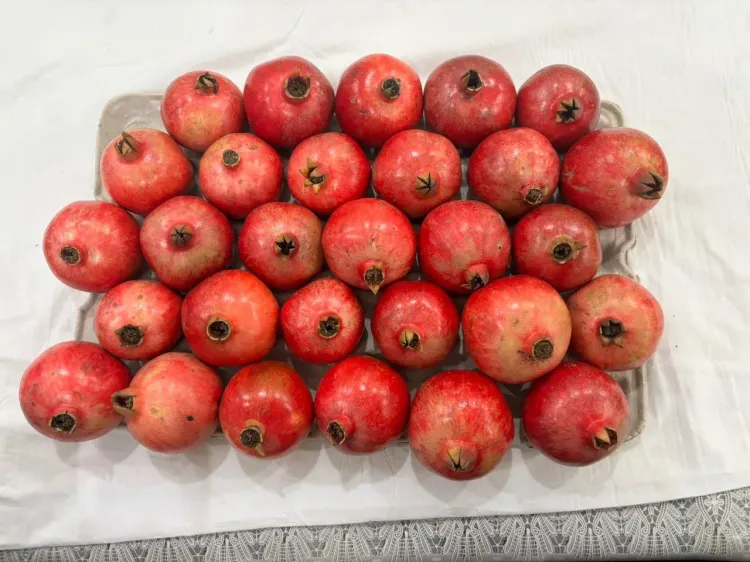
Synopsis
Union Commerce Minister Piyush Goyal announced the export of 1.3 metric tonnes of Kullu's premium Sinduri pomegranate to Dubai through APEDA, positioning it as a key step in raising Himachal Pradesh farmer incomes and advancing India's agricultural export ambitions in Gulf markets.
Key Takeaways
1.3 metric tonnes of Sinduri pomegranate exported from Kullu, Himachal Pradesh to Dubai .
Shipment facilitated by APEDA , the Commerce Ministry's agricultural export promotion body.
Union Minister Piyush Goyal described the move as a step toward raising farmer incomes and growing India's agri exports.
India's Agricultural Export Policy 2018 targets USD 60 billion in agri exports through market and product diversification.
Dubai serves as a key re-export hub for Indian produce into West Asia and Africa.
The push aligns with India's broader strategy of promoting GI-linked, high-value horticultural varieties over bulk commodity exports.
From the orchards of Kullu, Himachal Pradesh, to the shelves of Dubai — India's push to globalise its niche farm produce just wrote a new chapter. Union Commerce and Industry Minister Piyush Goyal on Thursday, October 22, 2026, announced that 1.3 metric tonnes of the prized Sinduri pomegranate variety had been exported from Kullu to Dubai, a milestone he attributed to the efforts of APEDA (Agricultural and Processed Food Products Export Development Authority).
Posting in Hindi, Goyal framed the shipment as a signal of things to come: 'Kullu ke Sinduri Anar ki Dubai tak pahunchi mithas!' ('The sweetness of Kullu's Sinduri pomegranate has reached all the way to Dubai!'). The minister described the export as a 'pivotal step' in linking local produce to global markets, raising farmer incomes, and carrying Indian agricultural exports to 'new heights.'
Why Sinduri Pomegranate and Why Now
The Sinduri variety — named for its deep vermillion skin — is among Himachal Pradesh's premium horticultural outputs, grown largely in the Kullu valley's temperate micro-climates. Unlike mass-commodity pomegranates shipped from Maharashtra's Nashik belt, Sinduri occupies a niche tier: smaller volumes, distinctive colour, and a flavour profile that commands a premium in West Asian markets.
APEDA, a statutory authority under the Commerce Ministry operating since the 1980s, has run cluster-development and quality-certification programmes designed precisely for this kind of high-value, geographically specific produce. The Kullu-to-Dubai corridor fits that template — a short, high-frequency Gulf route where Indian fresh produce competes on quality rather than price alone.
India's Agri-Export Pivot Toward the Gulf
The shipment lands against a policy backdrop that has been years in the making. India's Agricultural Export Policy of 2018 set an ambition to double agri exports to USD 60 billion through market diversification and value addition. Progress has been uneven, but Gulf destinations — with Dubai functioning as a critical re-export hub into West Asia and parts of Africa — have grown in strategic importance as India seeks to diversify away from traditional European and US market dependence.
APEDA's facilitation model covers logistics coordination, cold-chain support, and phytosanitary certification — the unglamorous but essential machinery that turns a single farmer's harvest into a compliant, marketable export consignment.
What Kullu's Farmers Stand to Gain
For smallholder growers in Kullu district, access to export channels represents a meaningful income lever. Domestic wholesale prices for horticultural produce are notoriously volatile and compress margins at the farm gate. Export premiums, even on modest volumes like this 1.3 metric tonne pilot, signal a price signal that can change cropping decisions over time — more acreage under Sinduri, more attention to grading and post-harvest handling, and potentially a push toward formal GI (Geographical Indication) registration that would protect the variety's identity in international markets.
Whether this first shipment grows into a sustained, scaled export stream will depend on the depth of APEDA's follow-through in Himachal — new cluster announcements, cold-storage linkages at source, and whether subsequent seasons see larger consignments moving along the same corridor.
A single crate of pomegranates making it to a Dubai market stall is a small thing. A systematic pipeline connecting Kullu's orchards to Gulf buyers, season after season, is something else entirely — and that is exactly the ambition Goyal is staking this announcement on.
Point of View
Not just headline trade figures. Goyal's social media framing, leading with the farmer rather than the freight volume, reflects a deliberate political register: agriculture is electorally sensitive terrain, and connecting Himachal's orchards to Gulf premiums is a potent narrative in a state that votes for its farmers. The deeper policy question is whether APEDA's facilitation model can replicate this at scale — turning pilot shipments into durable export clusters — or whether these announcements remain largely illustrative. The watch metric is not this crate, but next season's corridor.
NationPress
22 Oct 2026
Frequently Asked Questions
What is Sinduri pomegranate and where is it grown?
Sinduri is a premium pomegranate variety known for its deep red skin and sweet flavour, grown primarily in the Kullu valley of Himachal Pradesh in India's north.
How much Sinduri pomegranate was exported to Dubai?
According to Commerce Minister Piyush Goyal's announcement on October 22, 2026, 1.3 metric tonnes of Sinduri pomegranate were exported from Kullu to Dubai.
What is APEDA and what role did it play in this export?
APEDA (Agricultural and Processed Food Products Export Development Authority) is a statutory body under India's Commerce Ministry. It facilitated the Kullu-to-Dubai pomegranate shipment through logistics support and quality certification programmes.
Why is Dubai a key destination for Indian agricultural exports?
Dubai is a major re-export hub in the UAE, providing Indian agricultural produce with access to West Asian and African markets. Its well-developed logistics infrastructure makes it a gateway for fresh produce from India.
What is India's Agricultural Export Policy target?
India's Agricultural Export Policy of 2018 set a target to double agri exports to USD 60 billion through market diversification, value addition, and promotion of GI-linked and high-value produce.