Forest Rights Act: 25 lakh titles distributed, 11 lakh claims still pending
Synopsis
Two decades after the Forest Rights Act was passed, only 25 lakh of 54 lakh claims have resulted in titles — and over 18 lakh have been rejected outright. A high-level MoTA review in Kolkata is now pressing high-pendency states like Madhya Pradesh, Odisha, and Assam to clear their backlogs, but the scale of rejection remains the Act's most unresolved fault line.
Key Takeaways
25 lakh titles distributed out of 54 lakh claims filed nationally under the Forest Rights Act, 2006 as of 31 August 2026 .
Over 18 lakh claims have been rejected; 11 lakh remain pending at various stages.
Madhya Pradesh , Odisha , and Assam identified as states with the highest concentration of pending claims.
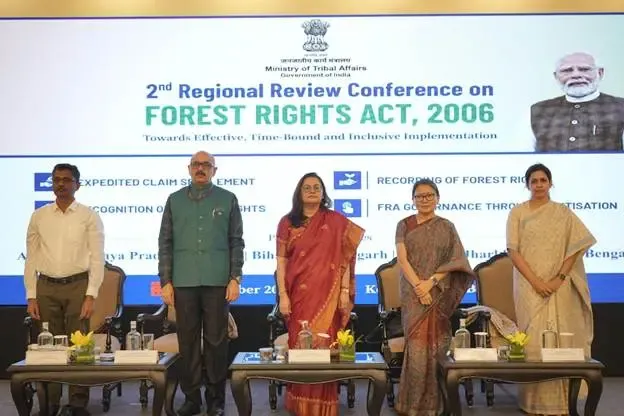
The Second Regional Review Conference held in Kolkata on 10 October 2026 covered eight states including West Bengal, Jharkhand, Bihar, and Chhattisgarh.
Andhra Pradesh was cited as a model for digitisation, record integration, and credit access for FRA titleholders.
MoTA's advisory of 24 June 2026 and Habitat Rights guidelines of 5 January 2026 were highlighted as key implementation benchmarks.
As many as 25 lakh titles have been distributed out of 54 lakh claims received nationally under the Scheduled Tribes and Other Traditional Forest Dwellers (Recognition of Forest Rights) Act, 2006 (FRA), a senior official of the Union Ministry of Tribal Affairs (MoTA) said on Saturday, 10 October 2026. The disclosure came at the Second Regional Review Conference on FRA Implementation held in Kolkata, bringing renewed scrutiny to the pace and quality of forest rights recognition across India.
Key Figures and Pending Claims
According to the Joint Secretary of MoTA, who addressed the conference, roughly 11 lakh claims remain pending at various stages of processing as of 31 August 2026. Additionally, over 18 lakh claims have been rejected — a figure that has drawn concern from tribal welfare advocates. Madhya Pradesh, Odisha, and Assam were specifically identified as states where pendency is concentrated in particular districts, according to official statements.
What the Conference Focused On
The two-day regional conference brought together senior functionaries from the Tribal Welfare, Revenue, and Forest Departments as well as Tribal Research Institutes from eight states: West Bengal, Assam, Tripura, Jharkhand, Odisha, Bihar, Madhya Pradesh, and Chhattisgarh. District-level officials — including Collectors, Sub-Collectors, and ITDP/ITDA Project Officers from high-pendency districts — also attended to deliberate on a coordinated way forward.
Key priorities identified at the conference included timely disposal of pending claims, review of rejected claims in line with the Act and its Rules, reconciliation of FRA data, digitisation of case records, incorporation of recognised rights into revenue and forest records, and acceleration of recognition of Community Forest Resource Rights and Habitat Rights for Particularly Vulnerable Tribal Groups (PVTGs).
Best Practices from Andhra Pradesh
Senior officials from Andhra Pradesh were specially invited to present the state's best practices, which include digitisation of FRA records, integration of titles into government records, convergence of livelihood schemes with FRA titleholders, and extension of credit facilities to rights holders. These initiatives are being held up as a model for other states grappling with implementation gaps.
What Senior MoTA Officials Said
The Secretary of MoTA underscored that the FRA places the rights, dignity, and aspirations of forest-dwelling communities at the centre of inclusive and sustainable development. She emphasised that recognised rights must be incorporated into Revenue and Forest records with accurate maps, and that convergence with programmes for productive land use, housing, and livelihoods must become a routine part of implementation, rather than an exception.
The Director, FRA, MoTA, separately presented a national overview, highlighting the importance of incorporating the Record of Forest Rights into revenue and forest records — in line with the Ministry's advisory of 24 June 2026 — as well as Habitat Rights recognition under guidelines issued on 5 January 2026.
Context and What Comes Next
This conference follows the First Regional Review Conference held in Bengaluru on 10 September 2026, which covered southern states. The back-to-back regional reviews signal a concerted push by MoTA to accelerate FRA implementation ahead of what critics argue has been two decades of uneven progress since the Act's passage in 2006. Notably, the rejection of over 18 lakh claims — nearly one-third of all claims filed — remains a contested issue, with tribal rights groups arguing that many rejections were procedurally flawed. With high-pendency districts now under direct scrutiny, the pressure on state governments to clear the backlog is expected to mount in the coming months.
Point of View
Fewer than half the claimants have received recognition. The concentration of pendency in Madhya Pradesh, Odisha, and Assam is not accidental — these states have some of India's densest forest-dwelling tribal populations and also the sharpest conflicts between forest bureaucracies and community rights. MoTA's regional review circuit is a necessary corrective, but without binding timelines and an independent grievance mechanism for rejected claims, it risks being an exercise in data reconciliation rather than genuine rights delivery.
NationPress
10 Oct 2026
Frequently Asked Questions
How many titles have been distributed under the Forest Rights Act so far?
As of 31 August 2026, 25 lakh titles have been distributed out of 54 lakh claims filed nationally under the Forest Rights Act, 2006. Over 18 lakh claims have been rejected and approximately 11 lakh remain pending.
Which states have the highest pendency of FRA claims?
Madhya Pradesh , Odisha , and Assam have been identified by MoTA as states with the largest concentration of pending FRA claims, with backlogs concentrated in specific districts within each state.
What was the purpose of the Kolkata regional conference on FRA?
The Second Regional Review Conference, held in Kolkata on 10 October 2026, was convened to review FRA implementation across eight eastern and central states. It focused on clearing pending claims, reviewing rejected claims, digitising records, and accelerating recognition of Community Forest Resource Rights and Habitat Rights for PVTGs.
Why are so many FRA claims being rejected?
MoTA's data shows over 18 lakh claims have been rejected, though the official statement did not detail the grounds for rejection. Tribal rights advocates have long argued that many rejections are procedurally flawed, citing inadequate evidence standards and lack of due process at the gram sabha level.
What role does Andhra Pradesh play in FRA implementation?
Andhra Pradesh was invited to the Kolkata conference to share best practices, including digitisation of FRA records, integration of titles into government databases, convergence of livelihood schemes with titleholders, and provision of credit facilities — steps other high-pendency states are being encouraged to replicate.