Did HM Shah Just Lay the Foundation for India's First State-Run BSL-4 Lab in Gandhinagar?

Synopsis
Union Home Minister Amit Shah has set the stage for a groundbreaking initiative in Gandhinagar by laying the foundation for India's first state-operated BSL-4 lab. This facility aims to enhance the nation's bio-safety and health security, positioning India as a global leader in biotechnology. Discover the transformative impact this lab will have on research and public health.
Key Takeaways
Foundation stone laid for Gujarat's first BSL-4 lab.
Investment of Rs 362 crore for the project.
Facility will enhance India's bio-safety systems.
Expected to accelerate vaccine development .
Strengthens the state's capacity to tackle global health challenges.
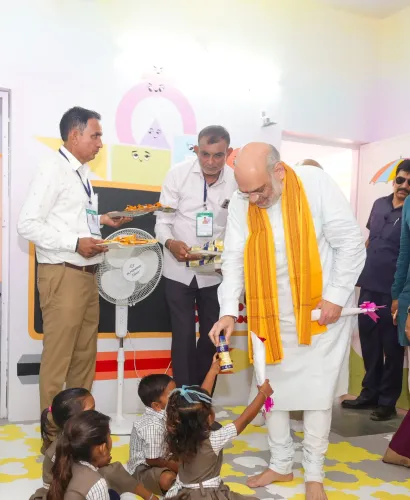
Gandhinagar, Jan 13 (NationPress) On Tuesday, Union Home Minister Amit Shah inaugurated the groundbreaking ceremony for Gujarat's premier state-operated Bio-Safety Level-4 (BSL-4) bio-containment laboratory and an Animal Bio-Safety facility located in his parliamentary constituency, Gandhinagar.
Attending the ceremony were Chief Minister Bhupendra Patel and State Science and Technology Minister Arjun Modhwadia.
This ambitious project, with an estimated budget of Rs 362 crore, will be the first of its kind BSL-4 laboratory managed by a state government in India, and only the second high-containment lab in the country, following Pune's.
During the event, the Union Department of Biotechnology presented a Letter of Intent to designate the forthcoming BSL-4 lab at the Gujarat Biotechnology Research Centre as the “National Centre for High Containment Pathogen Research Facility”, in line with the BioE3 policy.
Addressing the audience, Minister Shah stated that this initiative heralds a transformative era for India's health security and bio-safety systems, emerging from the heart of Gujarat.
He stated that the facility will act as India's “impenetrable shield” against lethal viruses and a critical element of the nation's biomedical infrastructure.
Furthermore, Shah expressed optimism that the new lab will create ample opportunities for globally competitive researchers and budding scientists, reinforcing Prime Minister Narendra Modi's One Health Mission to combat zoonotic diseases.
The Minister emphasized the rapid expansion of India's biotechnology sector over the last decade, pointing out that the bio-economy has surged from $10 billion in 2014 to over $166 billion in 2024.
“The number of biotech startups has skyrocketed from under 500 to more than 10,000, while incubators have grown from 6 to 95, and incubation space has expanded from 60,000 square feet to an impressive 9 lakh square feet,” he remarked.
Private sector investment, Shah added, has soared from Rs 10 crore to Rs 7,000 crore, with annual patent filings increasing from 125 to over 1,300.
He noted that this new facility will expedite vaccine development, diminish dependence on foreign testing for high-risk pathogens, and aid India's ambition to emerge as a global biotech leader.
Furthermore, he urged researchers to tackle the escalating threat of antimicrobial resistance, labeling it a “silent disaster”, and inspired students to contribute towards India's goal of becoming a developed nation by 2047.
Chief Minister Patel remarked that the BSL-4 lab represents a significant advancement in India's capability to confront future pandemics.
He characterized it as a crucial aspect of the Prime Minister's vision for “Healthcare for All” and the modernization of scientific infrastructure.
Patel emphasized that with this facility operational, Gujarat can conduct high-risk virus research locally, ensuring quicker diagnoses, timely actions, and a more resilient healthcare system.
He asserted that research outcomes here will directly impact diagnostics, treatment strategies, and public health policies, marking a pivotal step in fostering a healthy, secure, and self-sufficient India.
Minister Modhwadia stated that just as Mahatma Gandhi and Sardar Patel shaped India’s past, Prime Minister Modi and Home Minister Shah are redefining modern India and Gujarat through their visionary approach to science and technology.
He added that the new laboratory will fortify Gujarat's status as a biotechnology center and enhance the state's ability to tackle global health challenges.
The inauguration was attended by Gandhinagar Mayor Meera Patel, MPs Hasmukh Patel and Haribhai Patel, MLA Ritaben Patel, senior officials, and numerous citizens.
Point of View
The inauguration of this BSL-4 lab in Gandhinagar marks a pivotal moment for India's public health infrastructure. It demonstrates a commitment to advancing biotechnology and enhances our capability to respond to future health challenges. This initiative aligns with the government's vision of a self-reliant healthcare system and underscores the importance of scientific research in safeguarding our nation.
NationPress
17 Sept 2026
Frequently Asked Questions
What is a Bio-Safety Level-4 laboratory?
A Bio-Safety Level-4 (BSL-4) laboratory is a high-containment facility designed to study and handle dangerous pathogens that can cause severe or fatal diseases in humans. These labs have stringent safety protocols to prevent accidental exposure.
How will the BSL-4 lab impact public health in India?
The BSL-4 lab will enhance India's ability to conduct advanced research on high-risk pathogens, accelerate vaccine development, and strengthen bio-safety measures, ultimately improving public health responses to emerging infectious diseases.
What is the significance of this facility being state-run?
Having a state-run BSL-4 lab signifies a commitment from the Gujarat government to invest in advanced biomedical research, making it more accessible for local researchers and contributing to the national bio-economy.
What are the expected benefits for researchers?
Researchers will gain access to cutting-edge technology and resources for studying high-risk pathogens, fostering innovation and collaboration in the field of biotechnology.
How does this align with India's One Health Mission?
This facility supports the One Health Mission by addressing the interconnectedness of human, animal, and environmental health, enabling comprehensive approaches to managing zoonotic diseases.