Gadkari mourns Padma Vibhushan Teejan Bai's passing
Synopsis
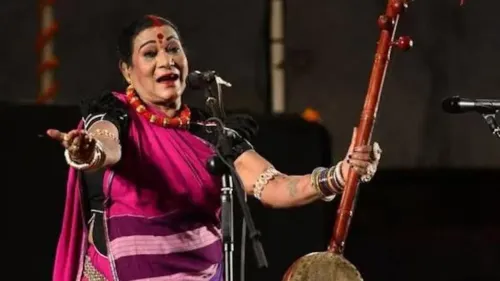
Union Minister Nitin Gadkari paid tribute to Padma Vibhushan Pandavani legend Teejan Bai on 5 July 2026, calling her passing an irreparable loss to India's cultural world. Teejan Bai, born in Chhattisgarh, had spent decades reviving the Mahabharata-based folk singing tradition and was one of India's most decorated folk artists.
Key Takeaways
Union Road Transport and Highways Minister Nitin Gadkari expressed condolences on 5 July 2026 over the passing of folk singer Teejan Bai .
Teejan Bai was a Padma Vibhushan awardee — India's second-highest civilian honour — recognised for her contribution to the Pandavani folk tradition.
Pandavani is a traditional oral performance form rooted in Chhattisgarh , drawing on episodes from the Mahabharata .
Gadkari described her death as an 'irreparable loss' to the country's art world and prayed for peace for her soul and strength for her family.
Her passing raises questions about institutional support for endangered folk forms and the continuation of the Pandavani tradition.
Union Road Transport and Highways Minister Nitin Gadkari on Sunday, 5 July 2026, expressed deep grief over the passing of Padma Vibhushan awardee and legendary Pandavani folk singer Teejan Bai, calling her death an irreparable loss to India's art world.
Context
Gadkari posted his condolences in Hindi on X, writing: 'प्रख्यात पंडवानी गायिका पद्म विभूषण तीजन बाई जी के निधन का समाचार अत्यंत दुःखद है' ('The news of the passing of renowned Pandavani singer Padma Vibhushan Teejan Bai is extremely saddening'). He offered his heartfelt tribute, saying she had given the Pandavani folk art form its identity through her voice. He concluded with a prayer: 'ईश्वर दिवंगत आत्मा को शांति प्रदान करे और परिजनों को संबल दे। ॐ शांति' ('May God grant peace to the departed soul and strength to her family. Om Shanti').
Gadkari described her departure as an 'irreparable loss' (अपूरणीय क्षति) to the country's cultural world — language that signals the gravity with which the Union government views her contribution to India's intangible heritage.
Policy Backdrop
Teejan Bai, born in Chhattisgarh, was one of the most celebrated exponents of Pandavani — a traditional oral performance tradition that draws on episodes from the Mahabharata and is deeply rooted in the folk culture of central India. She was honoured with the Padma Vibhushan, India's second-highest civilian award, in recognition of her decades-long contribution to reviving and popularising this endangered art form both within India and internationally.
Union ministers routinely issue formal public condolences on the passing of Padma awardees in classical and folk traditions, reflecting a long-standing practice of acknowledging custodians of regional oral epics and performing arts. Teejan Bai's recognition placed her among a rare cohort of folk artists to receive the Padma Vibhushan, underscoring the national stature she had attained.
Stakeholders and Impact
Teejan Bai's passing is a significant moment for the community of folk artists across Chhattisgarh and the broader Hindi-speaking heartland, where Pandavani has been a living tradition for generations. Her work brought the form to urban concert halls, international stages, and academic attention, helping ensure it was not confined to rural performance circuits.
Cultural organisations, folk music practitioners, and institutions engaged in the documentation of India's intangible heritage are expected to mark her passing. Her legacy also intersects with ongoing government efforts to preserve endangered folk forms under various cultural outreach programmes.
What's Next
Following the deaths of prominent Padma awardees, state and central governments have in the past announced memorials, archival projects, or schemes supporting the art forms they championed. The Chhattisgarh government and the Union Ministry of Culture may be expected to consider similar steps to honour Teejan Bai's legacy and support the continuation of Pandavani as a living tradition.
Her passing renews focus on the need for sustained institutional support for folk performers who, like Teejan Bai, carry entire oral traditions on their shoulders — and on what happens to those traditions when such singular voices are lost.
Point of View
Calling her death an 'irreparable loss' to the nation's art world, elevates the condolence beyond routine courtesy and implicitly invites policy follow-through. Teejan Bai's career arc — from rural Chhattisgarh to international stages — represents exactly the kind of intangible-heritage success story that cultural policy frameworks cite as a model. Her passing will test whether those frameworks translate into concrete archival and support measures for Pandavani's next generation of practitioners.
NationPress
3 Oct 2026
Frequently Asked Questions
What did Nitin Gadkari say about Teejan Bai?
Gadkari called her passing 'extremely saddening' and described it as an irreparable loss to India's art world, adding that she had given Pandavani its identity through her voice. He prayed for peace for her soul and strength for her family.
What is the Padma Vibhushan award?
The Padma Vibhushan is India's second-highest civilian honour, awarded for exceptional and distinguished service to the nation across fields including arts, literature, science, and public affairs.
What happens to folk art traditions after the passing of a key exponent?
The loss of a singular artist like Teejan Bai often prompts calls for government-backed archival projects, memorials, and schemes to support younger practitioners of endangered folk forms such as Pandavani.