Gadkari remembers Bharat Ratna Aruna Asaf Ali on death anniversary
Synopsis
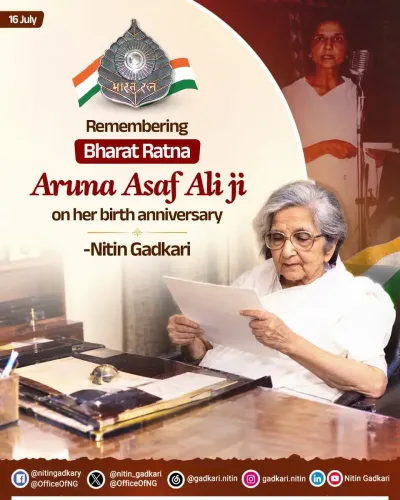
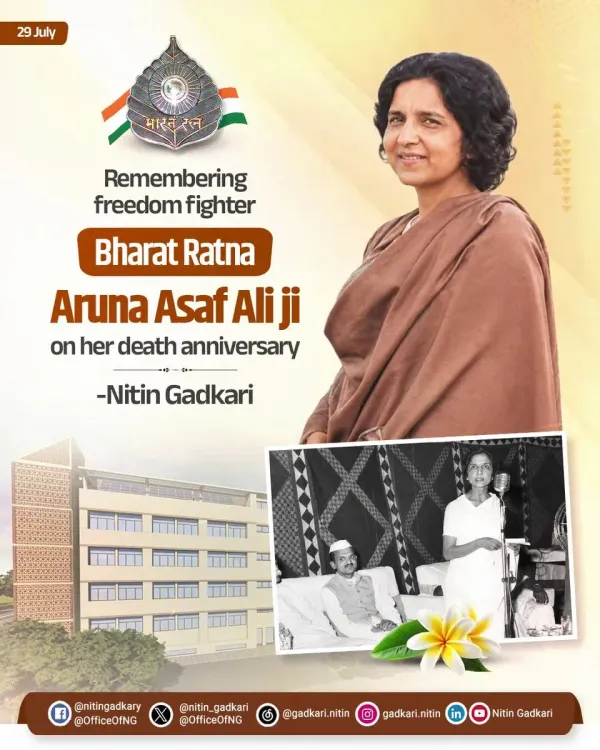
Union Minister Nitin Gadkari remembered Bharat Ratna Aruna Asaf Ali on her death anniversary, 29 July. Ali is celebrated for hoisting the national flag at Gowalia Tank Maidan during the 1942 Quit India Movement and was awarded the Bharat Ratna posthumously in 1997.
Key Takeaways
Union Minister Nitin Gadkari posted a tribute to Aruna Asaf Ali on her death anniversary, 29 July .
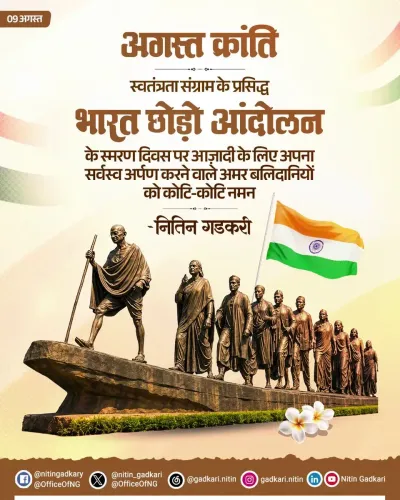
Aruna Asaf Ali hoisted the Indian national flag at Gowalia Tank Maidan, Bombay on 9 August 1942 , a defining act of the Quit India Movement.
She was born on 16 July 1909 and passed away on 29 July 1996 .
The Government of India awarded her the Bharat Ratna posthumously in 1997 .
She served as the first Mayor of Delhi in 1958 , reflecting a public life that extended well beyond the independence struggle.
She hoisted the tricolour when the British tried to silence an entire nation. On her death anniversary, Union Road Transport and Highways Minister Nitin Gadkari paid tribute to Bharat Ratna Aruna Asaf Ali, the freedom fighter whose defiance at Gowalia Tank Maidan in 1942 became one of the most iconic moments of the Quit India Movement.
The flag that refused to come down
On 9 August 1942, as British authorities cracked down on Congress leaders across India, a 33-year-old Aruna Asaf Ali stepped forward and unfurled the Indian national flag at Gowalia Tank Maidan, Bombay — the same ground where Mahatma Gandhi had launched the Quit India Movement. The act was brazen, deliberate, and instantly symbolic. Colonial authorities declared her a proclaimed offender and placed a reward on her head. She went underground rather than surrender, continuing to organise resistance.A life beyond one defining moment
Born 16 July 1909, Aruna Asaf Ali's contribution to Indian public life extended well past independence. She became the first Mayor of Delhi in 1958 and remained a committed voice for progressive causes through decades of post-independence politics. She passed away on 29 July 1996. The following year, the Government of India awarded her the Bharat Ratna posthumously — the nation's highest civilian honour — recognising a life spent in service of the republic she helped birth. India also honoured her memory with a postage stamp, and New Delhi named a road after her — small markers of a legacy the capital still carries. Across parties and ideological lines, Indian political leaders mark the anniversaries of independence-era figures through social media tributes. Gadkari's post joins a long tradition of public commemoration that keeps the freedom movement visible in everyday political discourse — a reminder that the republic's founding generation is never far from the national conversation.Point of View
Honouring figures like Aruna Asaf Ali — associated with the Congress-era independence movement — signals an inclusive reading of the freedom struggle that transcends party lineage. Such commemorations carry no direct policy weight but serve as soft-power moments that keep the founding generation anchored in public memory. The ritual consistency of these tributes, year after year, reflects how deeply the independence narrative remains woven into India's political fabric.
NationPress
28 Oct 2026
Frequently Asked Questions
Who was Aruna Asaf Ali?
Aruna Asaf Ali (1909-1996) was an Indian independence activist best known for hoisting the national flag at Gowalia Tank Maidan in Bombay during the Quit India Movement on 9 August 1942. She was later awarded the Bharat Ratna posthumously in 1997.
When did Aruna Asaf Ali die?
Aruna Asaf Ali passed away on 29 July 1996. Her death anniversary is observed annually on this date.
Why is Aruna Asaf Ali famous?
She is most celebrated for her act of defiance on 9 August 1942, when she unfurled the Indian tricolour at Gowalia Tank Maidan, Bombay, in the face of a British crackdown on the Quit India Movement. She also served as the first Mayor of Delhi in 1958.
What is the Bharat Ratna awarded to Aruna Asaf Ali for?
The Bharat Ratna, India's highest civilian honour, was awarded to Aruna Asaf Ali posthumously in 1997 in recognition of her lifelong contribution to India's independence struggle and public service.
Why did Nitin Gadkari post about Aruna Asaf Ali?
Union Minister Nitin Gadkari posted a tribute on the occasion of Aruna Asaf Ali's death anniversary, 29 July, as part of the broader tradition among Indian political leaders of publicly commemorating freedom fighters on significant dates.