Gadkari pays tribute on Azad Hind Fauj Foundation Day
Synopsis
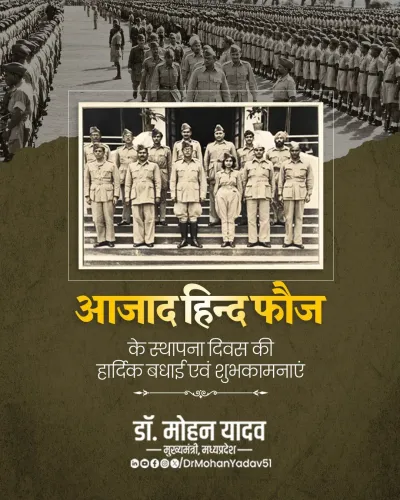
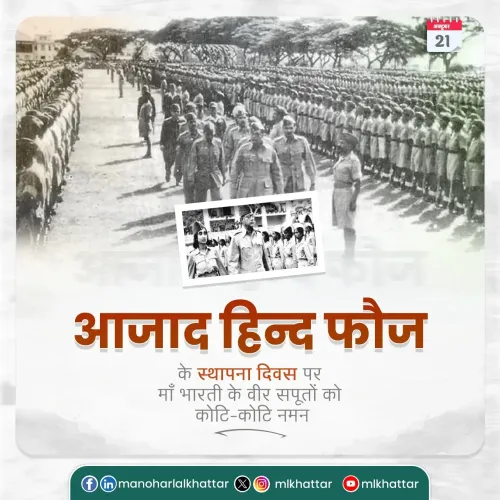
Union Minister Nitin Gadkari marked the 83rd Foundation Day of the Azad Hind Fauj on 21 October 2026, saluting the immortal martyrs of Subhas Chandra Bose's Indian National Army that fought British rule from Singapore in 1943.
Key Takeaways
Union Minister Nitin Gadkari posted a tribute on 21 October 2026 marking the Azad Hind Fauj Foundation Day .
The Azad Hind Fauj (Indian National Army) was formally established on 21 October 1943 in Singapore by Subhas Chandra Bose .
Bose simultaneously proclaimed the Provisional Government of Free India , the first structured armed push for Indian independence.
The INA fought through Burma and Manipur , reaching the gates of India before Allied forces reversed their advance at Kohima and Imphal in 1944 .
Annual tributes on 21 October span political parties, reflecting a broad national consensus on honouring the INA's martial contribution to independence.
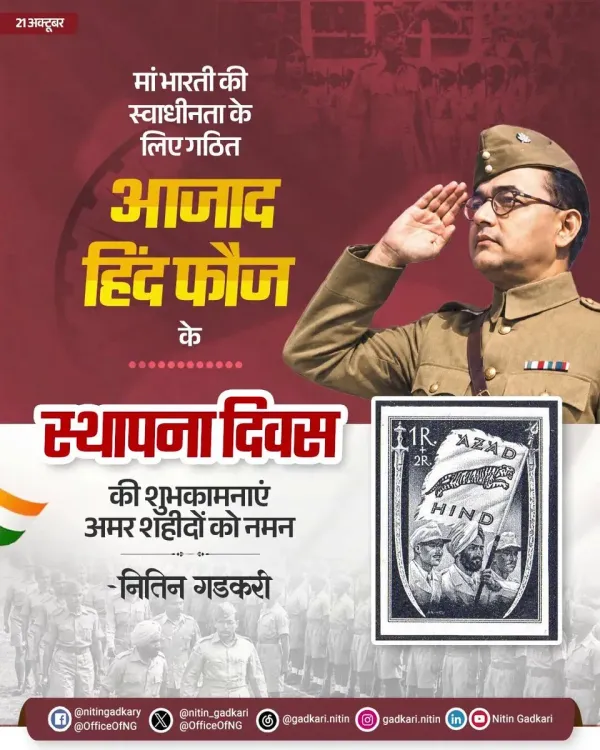
Eighty-three years after Subhas Chandra Bose proclaimed a government-in-exile and raised a fighting force to drive the British out of India, the flame of the Azad Hind Fauj still commands salutes from the highest offices in the land. On Wednesday, 21 October 2026, Union Road Transport and Highways Minister Nitin Gadkari marked the Foundation Day of the Indian National Army (INA) with a tribute on X, bowing to its immortal martyrs.
Posting in Hindi, Gadkari wrote: 'Maa Bharati ki swaadheenataa ke liye gathit Azad Hind Fauj ke sthaapanaa divas kii shubhakaamnaayein. Amar shaheedon ko naman.' — 'Best wishes on the Foundation Day of the Azad Hind Fauj, formed for the freedom of Mother India. Salutations to the immortal martyrs.'The day that changed the idea of India's freedom struggle
On 21 October 1943, in Singapore, Bose proclaimed the Provisional Government of Azad Hind and formally reorganised the Indian National Army under his command. It was a seismic act: for the first time, a structured Indian military force stood ready to liberate the subcontinent by armed combat, offering a martial counterpoint to the non-violent movement led simultaneously on home soil.
The INA drew its ranks from Indian prisoners of war captured by Japan and from the Indian diaspora across Southeast Asia. Its soldiers fought through Burma and Manipur, reaching the gates of India before the Allied reversal at Kohima and Imphal in 1944 ended their advance. Thousands died; many more were captured. Their trials in the Red Fort in Delhi after the war became a flashpoint that shook British confidence in the loyalty of its Indian armed forces.
Why Bose's legacy draws tributes across party lines
Each year on 21 October, political figures across India's spectrum pause to honour the INA — a rare moment of near-universal consensus in an otherwise divided public square. The gesture reflects a deliberate effort to weave the military dimension of the independence struggle into national memory alongside the Gandhian narrative. For the BJP, invoking Bose carries particular resonance: the party has consistently championed his legacy through declassification of files, the installation of his hologram statue at India Gate in 2022, and the permanent granite statue that replaced it.
Gadkari, a senior BJP leader and former national president of the party, has made such tributes a regular feature of his public communication, underlining the INA's place in the broader nationalist imagination that the ruling party seeks to foreground.
The Azad Hind Fauj's foundation anniversary is not merely ceremonial history — it is a live argument about which forms of resistance built the nation. That argument, eighty-three years on, is still being made.
Point of View
Long-running BJP project to elevate Subhas Chandra Bose and the INA's armed resistance as co-equal pillars of India's independence story alongside the Gandhian non-violent movement. Marking the 1943 Singapore proclamation each year reinforces a nationalist historiography that the party has backed with concrete gestures — file declassification, the India Gate statue — not just social-media posts. Across parties, however, 21 October functions as a rare common ground: the INA's sacrifice is too broadly revered to be monopolised by any single political tradition, which is precisely what makes these annual tributes both sincere and strategically resonant.
NationPress
21 Oct 2026
Frequently Asked Questions
When was the Azad Hind Fauj established?
The Azad Hind Fauj (Indian National Army) was formally established on 21 October 1943 in Singapore , when Subhas Chandra Bose proclaimed the Provisional Government of Free India and took command of the force.
Why does India observe 21 October as Azad Hind Fauj Foundation Day?
21 October 1943 is the date Bose officially constituted the Provisional Government of Azad Hind and reorganised the INA, marking the formal launch of an armed Indian military campaign against British rule — hence it is commemorated annually as the Foundation Day.
Who was the leader of the Azad Hind Fauj?
Subhas Chandra Bose , also known as Netaji, led the Azad Hind Fauj as its Supreme Commander and simultaneously headed the Provisional Government of Free India from 1943 until the end of World War II.
What did Nitin Gadkari say on Azad Hind Fauj Foundation Day 2026?
Gadkari posted a Hindi tribute on X wishing the nation on the Foundation Day of the Azad Hind Fauj and offering 'salutations to the immortal martyrs' who sacrificed their lives for India's freedom.
What was the significance of the INA trials at Red Fort?
After World War II, the British tried INA officers at the Red Fort in Delhi , but the proceedings backfired — they galvanised Indian public sentiment and raised serious doubts about the loyalty of Indian soldiers within the British Indian Army, accelerating the path to independence.