Gadkari pays tribute to G. D. Madgulkar on birth anniversary
Synopsis
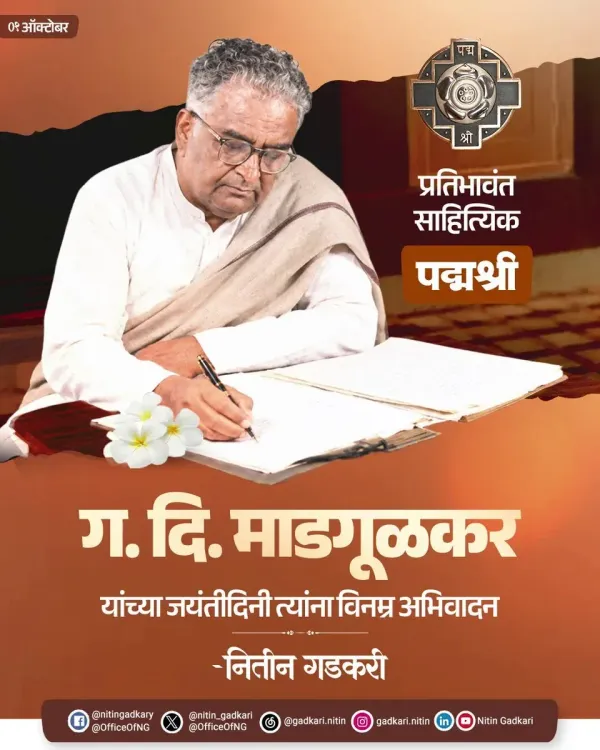
Union Minister Nitin Gadkari paid homage to celebrated Padma Shri Marathi poet, screenwriter, and lyricist G. D. Madgulkar on his birth anniversary on October 1, 2026, honouring the creator of the iconic 'Geet Ramayan'.
Key Takeaways
Union Minister Nitin Gadkari posted a tribute to Marathi literary icon G.
Madgulkar on his birth anniversary, October 1, 2026 .
Madgulkar was born on October 1, 1919 , and was honoured with the Padma Shri for his contributions to Marathi literature and cinema.
He is best known for Geet Ramayan , a cycle of 56 devotional songs composed with musician Sudhir Phadke in 1955–56 .
Madgulkar was a multi-faceted artist — poet, screenwriter, dialogue writer, and lyricist — who shaped both Marathi literature and cinema.
He passed away on December 14, 1977 , but his work remains a cornerstone of Maharashtra's cultural identity.
On the birth anniversary of Padma Shri-decorated Marathi poet, screenwriter, dialogue writer, and lyricist G. D. Madgulkar, Union Road Transport and Highways Minister Nitin Gadkari offered a humble salute to the literary legend on Thursday, October 1, 2026 — honouring a figure whose verses helped define the soul of modern Marathi culture.
Gadkari posted in Marathi, paying tribute to Padmashri Puraskarane Sanmanit Vikhyat Marathi kavi, patkatha-samvad lekhak va geetkar — 'the distinguished Marathi poet, screenwriter-dialogue writer, and lyricist honoured with the Padma Shri' — using the hashtags #ग_दि_माडगूळकर and #GDMadgulkar.
Who was G. D. Madgulkar?
Ga. Di. Madgulkar (full name Gajanan Digambar Madgulkar) was one of Maharashtra's most celebrated literary figures of the twentieth century. Born on October 1, 1919, he earned an enduring place in Marathi literature as the author of Geet Ramayan — a monumental cycle of 56 devotional songs narrating the story of Lord Ram, composed in collaboration with music composer Sudhir Phadke in 1955–56. The work is considered a crown jewel of Marathi lyric poetry and continues to be sung and performed across Maharashtra and beyond.
Beyond poetry, Madgulkar was a prolific screenwriter and dialogue writer for Marathi and Hindi cinema, shaping the golden era of regional film. The Government of India recognised his contributions with the Padma Shri, one of the country's highest civilian honours. He passed away on December 14, 1977, but his literary legacy remains very much alive.
Why Gadkari's tribute carries weight
As a senior BJP leader from Maharashtra's Nagpur, Gadkari's tribute reflects both personal and political pride in the state's rich cultural heritage. Madgulkar's Geet Ramayan holds particular resonance in Maharashtra's cultural and spiritual identity — a resonance that cuts across political lines. Paying homage on the birth anniversary is a tradition observed widely by Maharashtra's public life, and a minister of Gadkari's stature joining that tribute underscores how deeply Madgulkar's work is woven into the region's collective memory.
More than four decades after his passing, G. D. Madgulkar's words still fill temples, concert halls, and family gatherings every Ramnavami — proof that the truest monuments are built not in stone, but in song.
Point of View
Which frequently invokes Maharashtra's literary and spiritual heritage to deepen regional bonds. For a Nagpur-based leader, honouring the creator of 'Geet Ramayan' — a work steeped in Ramabhakti — also carries implicit ideological alignment. Yet the tribute transcends partisanship: Madgulkar is claimed by all of Maharashtra, and marking his birth anniversary is as much a civic act as a political one. It signals how cultural commemoration continues to serve as soft diplomacy within the state's complex political landscape.
NationPress
1 Oct 2026
Frequently Asked Questions
Who is G. D. Madgulkar?
G. D. Madgulkar (Gajanan Digambar Madgulkar) was a celebrated Marathi poet, screenwriter, dialogue writer, and lyricist born on October 1, 1919. He is best known for composing 'Geet Ramayan', a series of 56 devotional songs, and was honoured with the Padma Shri by the Government of India.
What is 'Geet Ramayan'?
'Geet Ramayan' is a landmark work in Marathi literature — a collection of 56 songs narrating the life of Lord Ram, composed by G. D. Madgulkar with music by Sudhir Phadke between 1955 and 1956. It is considered a masterpiece of Marathi lyric poetry and remains widely performed today.
Why did Nitin Gadkari post about G. D. Madgulkar?
Union Minister Nitin Gadkari posted a tribute to G. D. Madgulkar on his birth anniversary, October 1, 2026, to honour the Padma Shri-awarded poet's legacy and his lasting contribution to Marathi literature and culture.
When was G. D. Madgulkar born and when did he pass away?
G. D. Madgulkar was born on October 1, 1919, and passed away on December 14, 1977. His literary works, especially 'Geet Ramayan', continue to be celebrated across Maharashtra.
What award did G. D. Madgulkar receive from the Government of India?
G. D. Madgulkar was awarded the Padma Shri, one of India's highest civilian honours, in recognition of his distinguished contributions to Marathi literature, poetry, and cinema.