Gadkari pays tribute to revolutionary Damodar Hari Chapekar
Synopsis
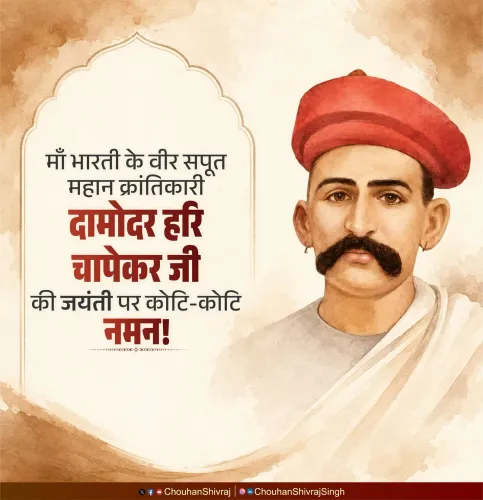
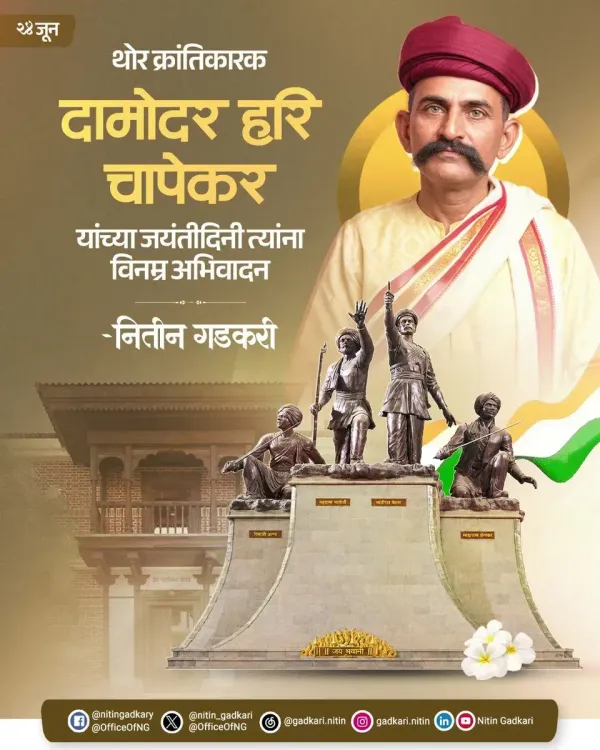
Union Minister Nitin Gadkari on 25 June 2026 paid homage to revolutionary Damodar Hari Chapekar on his birth anniversary, calling him a 'great revolutionary' in a Marathi post on X. Chapekar is remembered for the 1897 assassination of British plague commissioner W.C. Rand, one of the earliest acts of armed resistance in India's freedom struggle.
Key Takeaways
Nitin Gadkari , Union Minister of Road Transport and Highways, posted a tribute to Damodar Hari Chapekar on his birth anniversary on 25 June 2026 .
Gadkari described Chapekar as a 'thor krantikarak' (great revolutionary) in his Marathi-language post on X.
Damodar Hari Chapekar was one of the Chapekar brothers from Pune who assassinated British plague commissioner W.C.
The assassination is considered one of the earliest acts of organised revolutionary violence in India's independence movement.
BJP leaders regularly commemorate pre-Gandhian revolutionary figures from Maharashtra to highlight armed resistance narratives in the freedom struggle.
The tribute was accompanied by a video and hashtagged in both Marathi and English, broadening its digital reach.
Union Road Transport and Highways Minister Nitin Gadkari on Wednesday, 25 June 2026, paid homage to revolutionary freedom fighter Damodar Hari Chapekar on his birth anniversary, posting a salute on X in Marathi and calling him a 'thor krantikarak' — a great revolutionary.
Context
Gadkari's post, written in Marathi, reads: 'थोर क्रांतिकारक दामोदर हरि चापेकर यांच्या जयंतीदिनी त्यांना विनम्र अभिवादन' — 'Humble salutations to the great revolutionary Damodar Hari Chapekar on his birth anniversary.' The tribute, accompanied by a video, was shared with the hashtags #दामोदर_हरि_चापेकर and #DamodarHariChapekar, signalling a deliberate effort to amplify the commemoration across both Marathi and English-speaking audiences on the platform.
Policy Backdrop
Damodar Hari Chapekar was one of three brothers from Pune, Maharashtra, who carried out the 1897 assassination of W.C. Rand, the British plague commissioner, in one of the earliest acts of organised revolutionary violence in the Indian independence struggle. The Chapekar brothers are regarded as pioneers of armed resistance against colonial rule, predating the Gandhian era of non-violent protest by more than two decades. Their story remains deeply embedded in Maharashtra's nationalist consciousness and is taught as part of the state's historical memory of the freedom movement.
Leaders of the BJP and affiliated organisations have consistently marked the anniversaries of late-19th-century revolutionary figures from Maharashtra — including the Chapekars and Vinayak Damodar Savarkar — to foreground narratives of armed resistance alongside the dominant Congress-led account of the independence movement. These commemorations serve to reinforce ideological continuity with pre-Gandhian militant nationalism and underscore the party's claim to a distinct strand of the freedom struggle's legacy.
Stakeholders and Impact
The tribute resonates particularly with Maharashtrian nationalist communities, historians of the Indian independence movement, and BJP's political base in Maharashtra, where the Chapekar legacy carries strong regional pride. Gadkari, himself a senior BJP leader and former national president of the party, hails from Nagpur, Maharashtra, and regularly posts public tributes to historical figures on their birth and death anniversaries — a practice that keeps such figures in mainstream public discourse. The commemoration also draws attention from researchers and academics focused on the pre-Gandhian revolutionary phase of Indian nationalism.
What's Next
Parallel statements from Maharashtra state BJP leaders or visits to the Chapekar Wada memorial in Pune around this anniversary period are worth watching, as the party typically coordinates commemorative outreach across multiple levels of leadership. As Maharashtra continues to be a key electoral battleground, such tributes also serve to reinforce the BJP's cultural connect with the state's historical heroes. Gadkari's post adds to a growing pattern of social-media-led commemoration of revolutionary figures that shapes how younger generations engage with India's pre-independence history.
Point of View
The senior Maharashtra leader simultaneously addresses a regional audience steeped in Chapekar lore and a national audience less familiar with the 1897 Pune episode. In a state as electorally significant as Maharashtra, these commemorations function as soft cultural signalling, reinforcing the party's roots in the region's militant nationalist history. The consistency of such tributes across BJP's leadership ladder suggests a coordinated effort to embed revolutionary iconography into the party's everyday political identity.
NationPress
22 Sept 2026
Frequently Asked Questions
Who was Damodar Hari Chapekar?
Damodar Hari Chapekar was a revolutionary from Pune, Maharashtra, and one of the three Chapekar brothers who assassinated British plague commissioner W.C. Rand in 1897, in one of the earliest acts of organised armed resistance against colonial rule in India.
Why did Nitin Gadkari pay tribute to Damodar Hari Chapekar?
Nitin Gadkari paid tribute to Damodar Hari Chapekar on his birth anniversary, calling him a great revolutionary. As a senior BJP leader from Maharashtra, Gadkari regularly commemorates historical freedom fighters on their birth and death anniversaries.
What did the Chapekar brothers do in 1897?
The Chapekar brothers assassinated W.C. Rand, the British plague commissioner in Pune, in 1897. The act is considered one of the first instances of organised revolutionary violence in India's independence movement, predating the Gandhian era by over two decades.
Why does the BJP commemorate pre-Gandhian revolutionaries like the Chapekars?
The BJP and affiliated organisations commemorate pre-Gandhian revolutionaries to highlight the armed resistance strand of India's freedom struggle, presenting an alternative narrative to the dominant Congress-led account centred on non-violent protest.
Where is the Chapekar memorial located?
The Chapekar Wada, a memorial dedicated to the Chapekar brothers, is located in Pune, Maharashtra, and is a site of commemoration for those honouring their role in India's revolutionary independence movement.