Are Gen Z Engineers, Coders, and Scientists Leading Innovation in the Space Sector?
Synopsis
Discover how Gen Z is revolutionizing the space sector! Union Minister Jitendra Singh reveals that young talents are leading research and development, driving innovation, and reshaping India's position in the global space economy. Learn about the government's reforms and international collaborations that are boosting the nation's space endeavors.
Key Takeaways
Gen Z is leading innovation in the Indian space sector.
2020 reforms have modernized space governance.
Up to 100% FDI is now permitted.
382 startups are registered in space technology .
India collaborates with multiple countries for space projects.
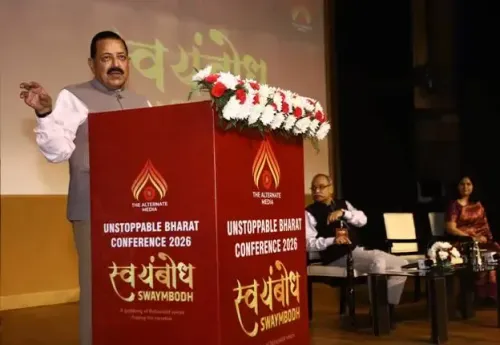
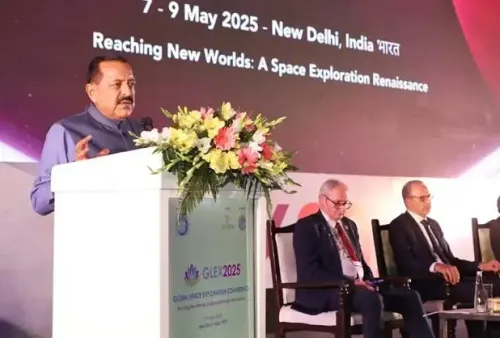
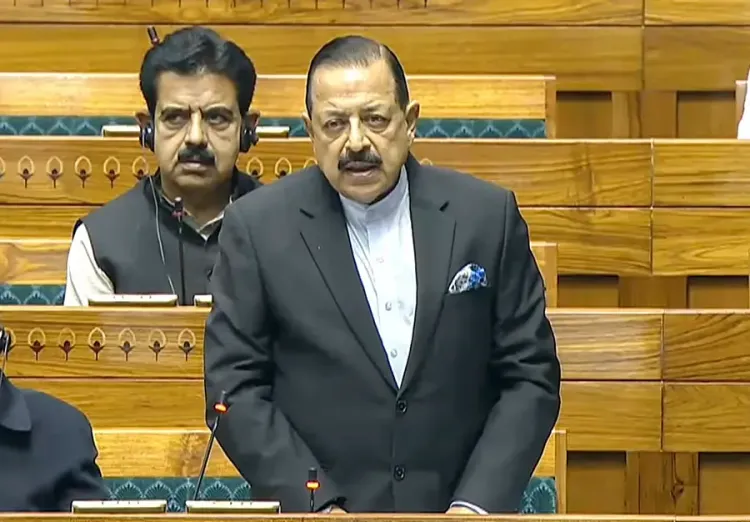
New Delhi, Dec 18 (NationPress) Generation Z engineers, designers, coders, and scientists are at the forefront of research and development and innovation within the space sector, as stated by Jitendra Singh, the Union Minister of State for the Department of Space, during a parliamentary session on Thursday.
In a written communication to the Rajya Sabha, Singh praised the space sector reforms introduced in 2020. These reforms modernized India's space legislation and governance structure, facilitating a more innovation-driven ecosystem and swift advancements in the sector.
“Gen Z engineers, designers, coders, and scientists are propelling research and development and innovation in the space realm, crafting new solutions through fresh perspectives, advanced skills, and a keen focus on digital transformation,” Singh remarked.
He further noted that the reforms declared by the Indian government in June 2020 have substantially enhanced the landscape for the nation’s space startups, leading to rapid growth over the past four years.
The Minister emphasized that the government views India’s space sector as a burgeoning hub for global investors.
To expand India’s footprint in the global space economy, initiatives have been implemented to liberalize the sector, allowing both domestic and international players to engage in comprehensive space activities.
A revised FDI policy was unveiled in February 2024, aimed at promoting international investments, technology transfers, and collaborative research opportunities within the space sector, Singh added.
“According to the updated FDI policy, up to 100% FDI is permitted in the space industry, featuring sectoral caps along with provisions for automatic and administrative routes. Currently, there are 382 startups in space technology registered with the DPIIT on the Startups India portal,” he stated.
In response to another inquiry, Singh provided insights into India’s collaborations with foreign governments and agencies in the space field.
“Over the past three years, India has formalized cooperative agreements with several foreign governments and agencies, including Australia, Brunei, Europe, France, Indonesia, Japan, Mauritius, Netherlands, Philippines, Republic of Korea, Saudi Arabia, Sweden, and the US. These partnerships aim to explore peaceful uses of outer space through joint satellites, projects, data exchange, ground stations, human spaceflight, and academic collaboration,” the Minister elaborated.
Moreover, NewSpace India Limited (NSIL), a Central Public Sector Enterprise under the Department of Space, has been collaborating with the European Space Agency, the Government of Singapore, Brazil, UK, and Nepal for satellite launches using ISRO’s operational vehicles, and has worked with France for launch service cooperation, he concluded.
Point of View
It is essential to recognize that the advancements in India's space sector, driven by Gen Z talents, reflect a broader trend of youth engagement in technology and innovation. The government's proactive reforms and international collaborations suggest a promising trajectory for India's role in the global space economy. This development should be viewed as a significant step towards enhancing India's capabilities and attracting global investments.
NationPress
19 Sept 2026
Frequently Asked Questions
What are the key reforms in the Indian space sector?
The key reforms in the Indian space sector include modernizing space legislation and governance through initiatives introduced in 2020, facilitating a more innovation-driven ecosystem.
How much FDI is allowed in the Indian space sector?
According to the amended FDI policy, up to 100% FDI is permitted in the Indian space sector with provisions for automatic and administrative routes.
What is the significance of Gen Z in the space sector?
Gen Z engineers, designers, coders, and scientists are crucial in driving research, development, and innovation, contributing fresh ideas and advanced skills to the space sector.
Which countries has India signed cooperative agreements with in space?
India has signed cooperative agreements with countries such as Australia, France, Japan, the US, and many others to explore peaceful uses of outer space.
What is NewSpace India Limited (NSIL)?
NewSpace India Limited (NSIL) is a Central Public Sector Enterprise under the Department of Space that collaborates with various countries for satellite launches and other space-related services.