Will Over 42% of Government Welfare Benefits Go to North Karnataka?
Click to start listening
Synopsis
In a significant move, Karnataka Chief Minister Siddaramaiah announced plans to allocate 42% of government benefits to North Karnataka to combat regional disparities. This decision aligns with the region’s population and area, aiming to uplift its socioeconomic conditions. Will this initiative truly bridge the gap in development?
Key Takeaways
- Karnataka's initiative to allocate 42% of benefits to North Karnataka.
- Focus on regional development to combat disparities.
- Importance of Prof. R. Govinda Rao's report in shaping future allocations.
- Investment in education and health sectors is crucial for progress.
- Need for continued support to ensure equitable growth across regions.
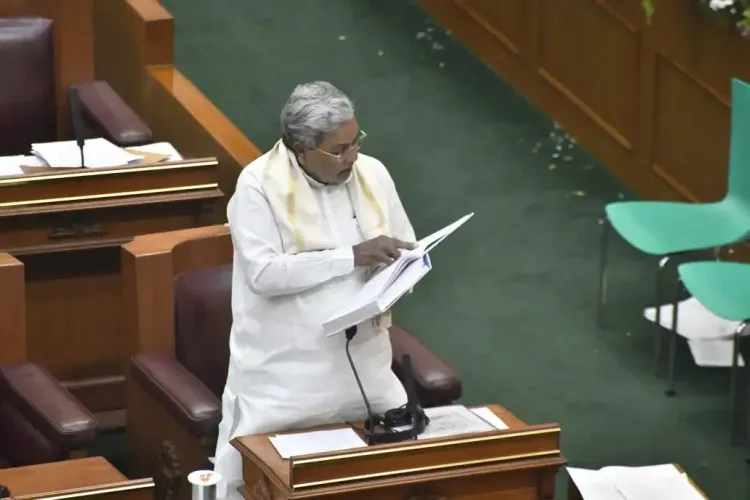
Belagavi, Dec 19 (NationPress) The Chief Minister of Karnataka, Siddaramaiah, announced on Friday that his administration plans to dedicate a minimum of 42 to 43 percent of government scheme benefits to the North Karnataka region. This allocation is aimed at addressing the existing regional disparities based on geographical area and population.
During a special discussion in the Assembly, the Chief Minister elaborated, "Currently, Karnataka has an estimated population of approximately 6.95 crore. Out of this, 2,96,28,767 individuals reside in the 14 districts of North Karnataka, representing nearly 42 percent of the state's population. The total geographical expanse of Karnataka is 1,91,791 square kilometres, with North Karnataka covering 1,01,708 square kilometres. Thus, about 53 percent of the state's land is situated in this region. In terms of population density, North Karnataka has 292 people per square kilometre, while the density in South Karnataka stands at 443 people per square kilometre. Moreover, out of the 224 Assembly constituencies in the state, 97 constituencies belong to the North Karnataka districts, making up around 43 percent of the total seats. Consequently, we aim to ensure that at least 42 to 43 percent of government scheme benefits are allocated to this region as well."
He further mentioned that the tenure of a former member of the 14th Finance Commission, Prof. R. Govinda Rao, has been extended for an additional two months and his report is anticipated by January 2026. The government is committed to implementing the recommendations from this report to mitigate the regional imbalance in North Karnataka.
"The expected report, due in January 2026, will be crucial for our plans. Prof. Govinda Rao, an economist from North Karnataka, will provide insights that we will act upon," the Chief Minister stated.
He also highlighted a request for Rs 500 crore to be allocated for the development of Kittur, which will be reviewed after receiving the Govinda Rao report. A committee has been established specifically to tackle the regional disparity.
Since the region is recognized as backward, a committee led by D.M. Nanjundappa was formed in 2001. After thorough studies and visits to various districts, the committee submitted its report in 2002, identifying 39 taluks as extremely backward, 40 taluks as very backward, and 35 taluks as backward, summing up to 114 backward taluks.
The committee recommended an expenditure of Rs 31,000 crore over an eight-year period. Of this amount, Rs 15,000 crore was to be provided through regular allocations, while an additional Rs 16,000 crore was to be spent over the same duration. Currently, CM Siddaramaiah stated that more than Rs 31,000 crore has already been utilized.
Following the implementation of the Nanjundappa report, dairy production has seen a significant rise, with the Karnataka Milk Federation now producing one lakh litres of milk daily. However, disparities remain, as the Old Mysuru region produces one crore litres of milk daily, compared to just over 10 lakh litres from North Karnataka. In the Bidar, Kalaburagi, and Yadgir milk unions, daily production is at 67,000 litres, he noted.
The Chief Minister stated the government has increased the milk subsidy per litre twice, firstly by Rs 3 and then by Rs 4, with the entire amount going directly to farmers. Furthermore, the current government has settled Rs 600 crore that was left unpaid by the previous BJP-led administration. As fodder prices have escalated, the Chief Minister assured an incentive of Rs 7 per litre will be provided within the current term, as pledged in the manifesto.
In response to opposition criticism, the CM remarked, "The special status under Article 371J for this region was granted when Congress was in power at the Centre, despite opposition from BJP leader and former Deputy Prime Minister L.K. Advani. Thus, the opposition lacks the moral authority to comment on this matter."
An allocation of Rs 3,000 crore was made in 2023, with an additional Rs 5,000 crore earmarked for 2025–26, he added.
For the advancement of North Karnataka, 300 Karnataka Public Schools (KPS) are being established. This year alone, Rs 1,800 crore has been allocated, with directions to ensure a total of Rs 5,000 crore is spent within the year. Despite these expenditures, the region still struggles in education, nutrition, and health sectors. To enhance attention on education and health, a committee led by Prof. Chhaya Devadgaonkar was formed, and its findings will be reviewed and implemented by the government to boost literacy rates.
There is a renewed focus on health, with directives to increase the number of hospitals, he stated.
“Since this government took office, Rs 3,000 crore has been spent on a special development program. Nevertheless, regional imbalance persists. Out of the 39 extremely backward taluks, 27 are situated in the Kalyana Karnataka region. Despite spending over Rs 31,000 crore, the disparity remains,” he acknowledged.
The Chief Minister highlighted that Karnataka holds the top position in the country regarding per capita income. He noted that while opposition leaders have been discussing per capita income since the announcement of the guarantee schemes, Karnataka has secured the number one spot nationally after implementing these schemes.
"True equality can only be achieved when all districts progress uniformly. The caste system has hindered equal opportunities for all," he stated.
Referencing Dr B.R. Ambedkar’s address on November 25, 1949, the Chief Minister remarked that political democracy cannot thrive without social and economic democracy.
Point of View
It is crucial to recognize the Karnataka government's initiative to allocate significant welfare benefits to North Karnataka. This decision could potentially address long-standing regional imbalances, enhancing opportunities for development and growth. Observations must focus on the actual implementation and genuine impact on the lives of the people in the region.
NationPress
19/12/2025
Frequently Asked Questions
What percentage of government benefits will be allocated to North Karnataka?
The Karnataka government plans to allocate at least 42 to 43 percent of government benefits to the North Karnataka region.
What is the purpose of this allocation?
This allocation aims to address the regional backwardness of North Karnataka, ensuring that the benefits are proportional to its population and geographical area.
When is the report from Prof. R. Govinda Rao expected?
The report from Prof. R. Govinda Rao is anticipated by January 2026.
How much has been spent on the special development program?
Since the government came to power, Rs 3,000 crore has been spent under a special development program.
What are some key issues identified in North Karnataka?
Key issues include backwardness in education, nutrition, and health sectors, as identified by various committees studying the region.