Giriraj Singh invokes 1990 kar sevak firing ahead of polls
Synopsis
Union Textiles Minister Giriraj Singh has attacked opposition leaders visiting the Ram Mandir as electoral theatrics, invoking the 1990 Ayodhya police firing on kar sevaks as a historic stain no temple visit can erase.
Key Takeaways
Giriraj Singh posted on X on 9 November 2026 attacking opposition visits to the Ram Mandir as election-driven hypocrisy.
He invoked the 1990 police firing on kar sevaks in Ayodhya, ordered by the Mulayam Singh Yadav-led UP government , as an indelible stain.
The post does not name a specific individual, but is widely read as targeting opposition leaders making recent Ayodhya visits.
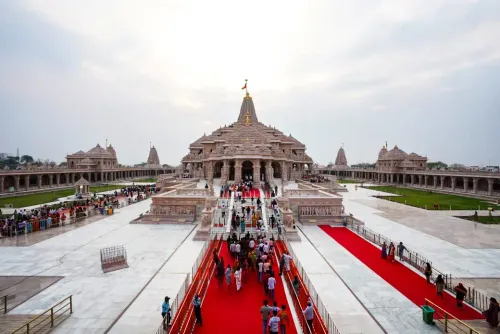
The Ram Mandir was consecrated in January 2024 following the Supreme Court's 2019 verdict clearing the way for construction.
BJP has repeatedly deployed references to the 1990 firings to contrast its temple advocacy with past opposition actions.
The post signals that Ayodhya and Hindu sentiment will remain central fault lines in the upcoming election campaign.
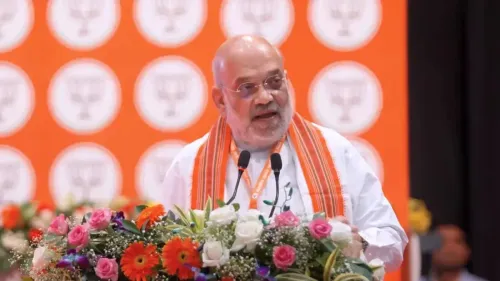
A political flashpoint that is more than three decades old is burning bright again. Union Textiles Minister Giriraj Singh on Monday, 9 November 2026, took direct aim at opponents who have recently visited the Ram Mandir in Ayodhya, calling the gesture a sham timed to election season and invoking the 1990 police firing on kar sevaks as a stain no temple visit can wash away.
Posting on X in Hindi, the senior BJP leader and Lok Sabha MP from Begusarai, Bihar, wrote: 'Karsevkon par goliyaan chalwane ka daag Ram Mandir jaane ke dhong se nahin dhulne wala.' — 'The stain of ordering bullets to be fired on kar sevaks will not be erased by the pretence of visiting the Ram Mandir.' He added: 'The truth behind this drama of faith, awakened in election season, is hidden from no one.'
The 1990 firing that never left the political memory
The incident at the heart of Singh's attack is one of the most charged episodes in modern Indian political history. In October–November 1990, during the peak of the Ram Janmabhoomi movement and L.K. Advani's Rath Yatra, kar sevaks — volunteers committed to constructing a temple at the disputed Ayodhya site — converged on the town in large numbers. The Mulayam Singh Yadav-led Uttar Pradesh government ordered police to open fire to prevent the demolition of the Babri Masjid structure. Several kar sevaks were killed. The episode became foundational to BJP's political identity and a wound the party has kept open in every subsequent election cycle.
That identity crystallised further after the Supreme Court's 2019 verdict cleared the way for temple construction, and Prime Minister Narendra Modi consecrated the Ram Mandir in January 2024. For the BJP, that moment was both a civilisational milestone and a political trophy — but it also raised the stakes for any opposition leader who now seeks to claim proximity to the temple.
Electoral season, a sudden surge in temple visits
Singh's post does not name an individual — and the specific target of his November 2026 broadside cannot be independently verified — but the message lands with precision: opposition leaders visiting Ayodhya now, with elections on the horizon, are guilty of opportunism at best and hypocrisy at worst. The phrase 'chunavi mausam mein jaage is aastha ke natak' — 'this drama of faith that awakens only in election season' — frames the visit as a performance, not a conviction.
The BJP has deployed this argument consistently since the late 1980s. References to the 1990 firings resurface reliably whenever an opposition leader attempts to soften their image on Hindu cultural issues or seeks to associate themselves with the Ayodhya temple. The underlying logic is simple and durable: you cannot shed a past action with a photo opportunity.
What Singh's post signals about the coming campaign
Giriraj Singh is one of the BJP's most combative voices, and his posts on X frequently set the tone for how the party frames cultural and religious fault lines ahead of polling. The timing — November 2026 — places this squarely in a pre-election window where Ayodhya, Hindu sentiment, and the memory of past state violence are live ammunition.
Watch for opposition responses: whether the targeted party engages, stays silent, or attempts to pivot will shape the next leg of the debate. If recent temple visits were meant to defuse a cultural vulnerability, Singh's post suggests the BJP has no intention of letting that strategy succeed quietly.
Point of View
The BJP frames any opposition attempt to claim Ram Mandir proximity as illegitimate from the outset. The strategy has worked before — the 1990 episode helped consolidate Hindu voter sentiment around the BJP for a generation — and invoking it now signals the party intends to hold that high ground aggressively. The challenge for opposition parties is structural: engaging the charge keeps the 1990 memory alive in the news cycle, while ignoring it risks letting the narrative set without rebuttal. What makes this moment distinct is that the Ram Mandir is now built and consecrated, raising the political temperature around who 'owns' the achievement.
NationPress
9 Nov 2026
Frequently Asked Questions
What did Giriraj Singh say about Ram Mandir visits?
Giriraj Singh said that the stain of ordering police to fire on kar sevaks in 1990 cannot be erased by the pretence of visiting the Ram Mandir, calling such visits an election-season drama.
What was the 1990 Ayodhya kar sevak firing?
In 1990, the Mulayam Singh Yadav-led Uttar Pradesh government ordered police to fire on kar sevaks — volunteers supporting the Ram Janmabhoomi movement — who had gathered at Ayodhya. Several kar sevaks were killed, and the incident became a defining episode in BJP political rhetoric.
Who is Giriraj Singh?
Giriraj Singh is a senior BJP leader, Union Minister of Textiles in the Government of India, and Lok Sabha MP from Begusarai, Bihar. He is known for his outspoken positions on cultural and political issues.
When was the Ram Mandir at Ayodhya consecrated?
The Ram Mandir at Ayodhya was consecrated in January 2024, following the Supreme Court's 2019 verdict that cleared the way for temple construction on the disputed site.
Why does the BJP frequently raise the 1990 Ayodhya firing before elections?
The BJP uses references to the 1990 firing to contrast its long advocacy for the Ram Temple with what it portrays as the opposition's historic hostility to the movement, framing opponents' current temple visits as opportunistic and hypocritical.