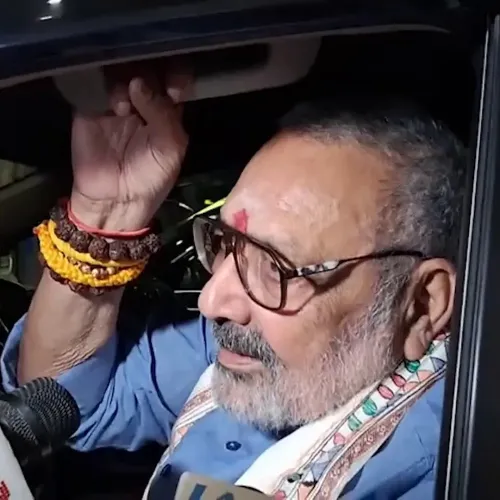
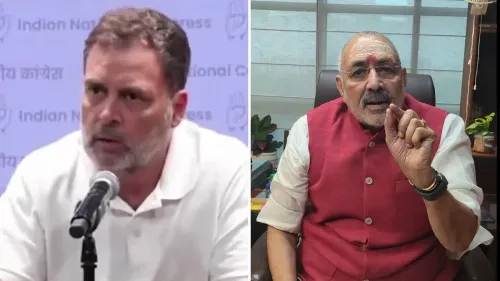
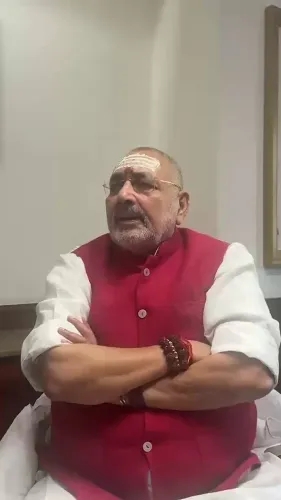
Giriraj Singh accuses Opposition of using youth to spread unrest
Synopsis
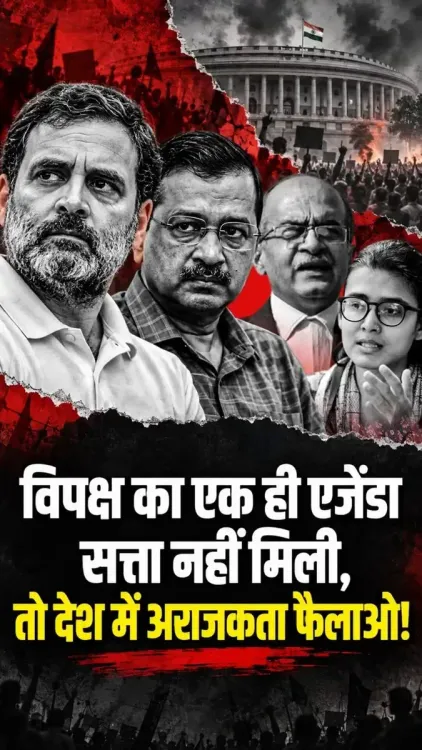
Union Textiles Minister Giriraj Singh accused the Opposition on October 16 of weaponising youth to spread violence and anarchy, framing it as a bid to destabilise India driven by lust for power — a statement that fits the BJP's decade-long 'development versus disruption' political narrative.
Key Takeaways
Giriraj Singh , Union Textiles Minister and BJP MP from Begusarai, Bihar , posted a sharp political attack on the Opposition on October 16, 2026 .
He alleged the Opposition is 'blinded by the lust for power' and is using youth as 'shields' to spread violence and anarchy in India.
Singh credited the BJP government with 'unprecedented development' that he said the Opposition finds threatening.
He declared that the 'vile intentions' to destabilise India will 'never be fulfilled.' The statement extends a BJP pattern since 2014 of contrasting its governance record with opposition-linked protests framed as destabilisation attempts.
Opposition responses in Parliament and on social media are anticipated, particularly with state elections on the horizon.
The Opposition's alleged design to destabilise India by using young people as foot-soldiers in a campaign of 'violence and anarchy' — that is the charge Union Textiles Minister Giriraj Singh levelled on Friday, October 16, 2026, in a pointed post on X that sharpened the BJP's long-running political offensive against rival parties.
The accusation in Giriraj Singh's own words
Posting in Hindi, the senior BJP leader wrote: 'BJP sarkar mein hua desh ka abhutpurv vikas vipaksh ki aankhon mein khatkta hai' — 'The unprecedented development that has taken place under the BJP government is a thorn in the eye of the Opposition.' He went further, alleging that 'blinded by the lust for power,' opposition parties are 'making youth their shield and spreading violence and anarchy across the country.' His closing line was a direct warning: 'Their vile intentions to destabilise India and sacrifice the country to violence will never be fulfilled.'
BJP's 'development versus disruption' frame — a decade in the making
The statement is not an isolated broadside. Since 2014, the Bharatiya Janata Party under Narendra Modi has consistently paired its governance record — infrastructure, welfare schemes, economic growth — against a counter-narrative that frames Opposition-backed protests as orchestrated destabilisation rather than legitimate dissent. Giriraj Singh, who represents Begusarai in Bihar, is one of the party's most vocal proponents of this framing. His political identity is built on blunt, confrontational messaging that rarely leaves room for ambiguity.
The invocation of 'youth as shields' is a loaded phrase: it implies that protesting young Indians are being manipulated by political actors rather than acting on genuine grievances. That argument cuts to the heart of a recurring dispute in Indian democracy — where the line sits between mobilising citizens and exploiting them.
What comes next in this political exchange
With state assembly elections periodically reshaping India's political calendar, rhetoric of this intensity rarely stays confined to social media. Opposition parties will likely respond — in Parliament, at press conferences, or on their own social feeds — contesting both the 'unprecedented development' claim and the allegation of fomenting unrest. How sharply that exchange escalates will tell the story of where Indian politics stands heading into the next electoral cycle.
Giriraj Singh's message ends with a confident assertion, not a question: the intentions of those trying to destabilise India 'will never be fulfilled.' That is less a policy statement and more a campaign declaration — combative, assured, and aimed squarely at a base that equates stability with the BJP's continued grip on power.
Point of View
' he forces a binary that is difficult for the Opposition to argue against without appearing to defend disorder. The 'youth as shield' framing is particularly calculated: it attempts to detach young protesters from their own agency and reattribute their actions to elite political manipulation. As assembly elections loom, statements like this serve as both a warning to opponents and a mobilisation signal to the party faithful.
NationPress
16 Oct 2026
Frequently Asked Questions
What did Giriraj Singh say about the Opposition on October 16, 2026?
Giriraj Singh accused the Opposition of using youth as 'shields' to spread violence and anarchy in India, alleging their motive is lust for power and a desire to destabilise the country.
What is the BJP's 'unprecedented development' claim?
Since 2014, the BJP under Narendra Modi has highlighted infrastructure expansion, welfare programmes, and economic growth as markers of 'unprecedented development,' using this record as a counterpoint to Opposition criticism.
Who is Giriraj Singh?
Giriraj Singh is India's Union Textiles Minister, a senior BJP leader, and the Lok Sabha MP representing Begusarai in Bihar, known for combative political statements.
Why does the BJP accuse the Opposition of fomenting unrest?
The BJP has repeatedly framed Opposition-backed protests as orchestrated destabilisation rather than legitimate dissent, arguing that rivals resort to disruption when they cannot counter the government's development record at the ballot box.
What could follow Giriraj Singh's statement politically?
Opposition parties are expected to respond in Parliament or on social media contesting the development claims and the allegation of inciting violence, with the exchange likely to intensify ahead of upcoming state assembly elections.