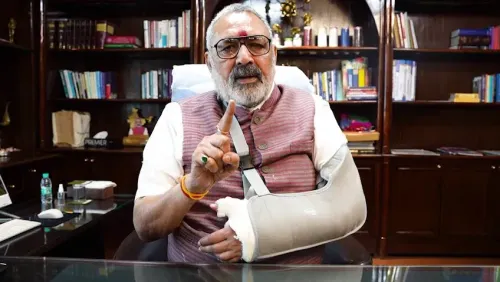
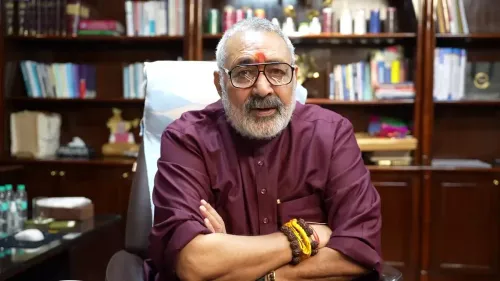
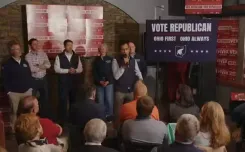
Giriraj Singh: Crowds Don't Win Elections, Voters Do
Synopsis
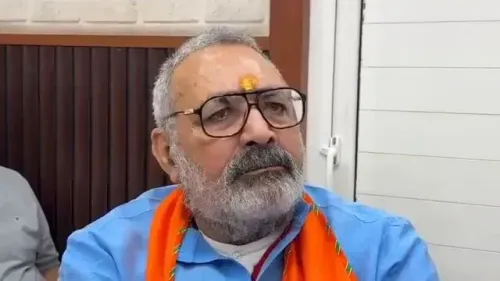
Union Textiles Minister Giriraj Singh on October 26 challenged the opposition's crowd-mobilisation strategy, arguing that in a democracy only election results — not district-wise bussed-in rallies — reflect true public support.
Key Takeaways
Union Textiles Minister Giriraj Singh posted a sharp political message on X on October 26, 2026 .
He argued that bussing supporters from districts to inflate rally numbers does not equal genuine public backing.
His core contention: 'In a democracy, the final verdict is delivered by the people at the election.' He asserted directly that public support is 'not with them' — referring to the opposition.
The post included a video, suggesting it was tied to a specific rally or mobilisation event.
The statement fits a recurring BJP pattern of framing electoral contests as the only legitimate test of public sentiment over street protests.
No matter how large the rally, the ballot box has the final word. That, in essence, is the pointed message Union Textiles Minister Giriraj Singh fired off on X on Monday, October 26, 2026, targeting opposition efforts to project street strength as a measure of political legitimacy.
In Hindi, the BJP veteran wrote: 'जिलों से लोगों को लाकर चाहे जितनी भीड़ जुटा ली जाए, लेकिन लोकतंत्र में अंतिम फैसला चुनाव में जनता ही करती है।' — 'No matter how many people are bussed in from districts to swell a crowd, in a democracy the final verdict is delivered by the people at the election.' He concluded with a sharp dismissal: 'And the truth is, public support is not with them.'
The Crowd-vs-Ballot Argument at the Heart of Indian Politics
The contrast Giriraj Singh draws is one of the oldest rhetorical weapons in Indian electoral politics. Ruling party leaders routinely point to election results as the only legitimate measure of public backing, while opposition groups position mass mobilisation — rallies, marches, sit-ins — as proof of ground-level discontent. Both readings are, technically, democratic; they simply measure different things at different moments.
What makes Singh's post particularly pointed is the specific charge of 'bussing in' supporters from districts — implying that the crowd is manufactured rather than organic. That accusation, too, is a familiar one across party lines in India. It shifts the debate from 'how many turned up' to 'who actually came on their own.'
Begusarai's Voice in a Broader National Pattern
Singh, the Lok Sabha MP from Begusarai, Bihar, is among the BJP's most combative communicators. His post carries weight beyond a single rally or event — it frames the stakes of any upcoming electoral contest as a referendum on whether street energy translates into vote share. Bihar, with its complex coalition arithmetic and high political temperature, is perennially a bellwether for how these competing claims play out.
The post includes a video, suggesting it may be tied to specific visuals of a rally or mobilisation — though the precise event is not identified in the post itself.
The fundamental question Singh poses is direct: when the votes are counted, will the crowds have mattered? In Indian electoral history, the answer has swung both ways — sometimes overwhelming rallies have preceded landslide victories, sometimes they have preceded stunning defeats. That unpredictability is precisely what makes the ballot the ultimate arbiter.
Point of View
The BJP seeks to anchor the public narrative firmly on vote share rather than rally optics. It signals that an electoral contest is either imminent or politically salient enough to warrant the framing war now. The 'bussed-in crowds' charge is a deliberate provocation designed to force the opposition to defend the authenticity of its own mobilisation rather than its policy positions. Whether this framing lands will depend entirely on how the ballots fall — which, as Singh himself acknowledges, is the only verdict that counts.
NationPress
26 Oct 2026
Frequently Asked Questions
What did Giriraj Singh say about opposition rallies?
Giriraj Singh said that no matter how many people are bussed in from districts to swell a crowd, the final verdict in a democracy is delivered by voters at elections, and that public support is not with the opposition.
Why is Giriraj Singh criticising crowd mobilisation?
Singh argues that large rallies assembled by transporting people from different districts do not reflect genuine public support, contrasting manufactured crowd size with actual vote share at elections.
Who is Giriraj Singh?
Giriraj Singh is the Union Minister of Textiles in the Indian government, a senior BJP leader, and the Lok Sabha MP from Begusarai in Bihar.
What is the BJP's argument against opposition rallies in India?
The BJP frequently contends that street mobilisation and large protests are not a true measure of electoral support, and that only election results reveal where the public actually stands.
What elections is Giriraj Singh referring to?
The post does not name a specific election, but the statement is framed as a general principle ahead of any upcoming state assembly elections or bypolls where competing claims of public support will face an electoral test.