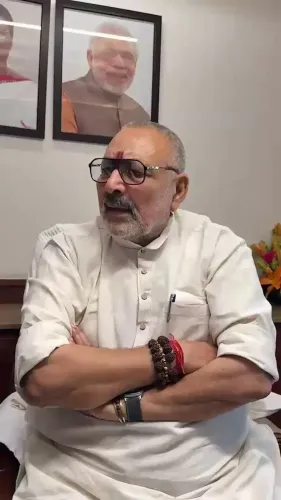
Giriraj Singh contrasts empty opposition seats with Shah rally crowd

Synopsis
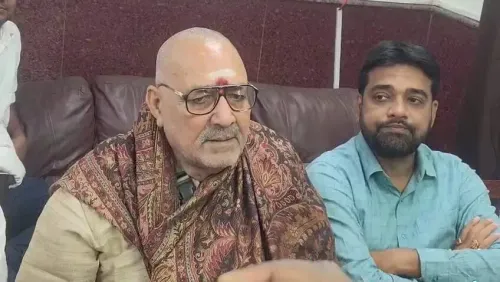
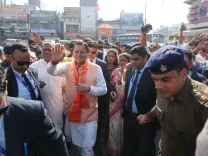
Union Textiles Minister Giriraj Singh posted a video on November 3 contrasting opposition 'empty chairs' with a massive crowd at a Home Minister Amit Shah event, asserting that the nation stands firmly with strong leadership — a familiar BJP counter-move to opposition boycotts.
Key Takeaways
Giriraj Singh posted on November 3, 2026 drawing a contrast between opposition empty seats and a large crowd at an Amit Shah event.
He called the crowd a 'jan-sailaab' (flood of people) and described it as 'direct proof' the nation backs strong leadership.
The post included a video and was framed as a rebuttal to the opposition's visible absence at the event.
BJP has consistently used public rally turnout as a counter-argument to opposition walk-outs and boycotts, a pattern stretching back to 2014 .
Amit Shah , as Union Home Minister and senior BJP leader, is a central figure in the party's political mobilisation strategy.
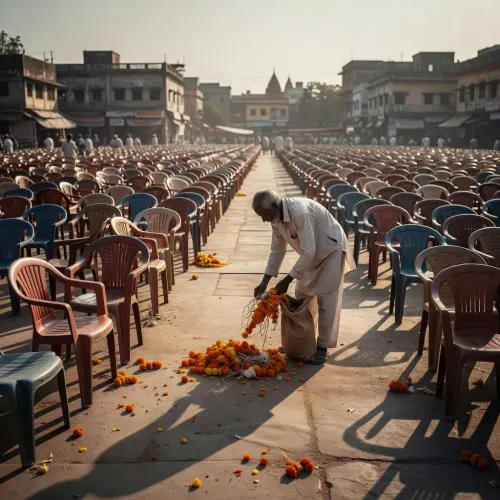
An ocean of supporters on one side, empty chairs on the other — Union Textiles Minister Giriraj Singh drew that sharp contrast on Tuesday, November 3, 2026, posting a video alongside a pointed observation about the opposition's absence at a public event where Union Home Minister Amit Shah drew a massive crowd.
Posting in Hindi, Singh wrote: 'एक तरफ विपक्ष की खाली कुर्सियां और दूसरी तरफ माननीय गृह मंत्री श्री अमित शाह जी के साथ कदम मिलाता यह विशाल जन-सैलाब प्रत्यक्ष प्रमाण है कि देश सशक्त नेतृत्व के साथ मजबूती से खड़ा है।' — 'On one side, the empty chairs of the opposition; on the other, this massive wave of people marching in step with Home Minister Shri Amit Shah ji — direct proof that the nation stands firmly with strong leadership.'
The 'empty chairs' jab and what it signals
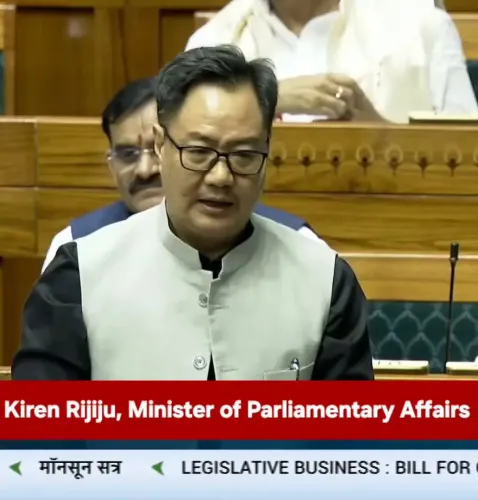
The imagery Singh reaches for is deliberate. Opposition walk-outs and seat boycotts have been a recurring feature of Indian parliamentary and public political life since 2014, deployed by various parties as a protest tool. The BJP has consistently countered that tactic by pointing to packed public venues as evidence of popular legitimacy — a visual argument that bypasses the floor of the house entirely.
Singh, a senior BJP leader and Lok Sabha MP from Begusarai, Bihar, has long been one of the party's most vocal amplifiers on such messaging. His post frames the contrast not just as a numbers game, but as a verdict — the public filling space the opposition has vacated.
Amit Shah's crowd as a BJP proof-of-strength moment
Amit Shah, as Union Home Minister and one of the BJP's foremost organisational minds, routinely draws large gatherings at rallies and public programmes. The ruling party has made 'jan-samanth' — public density — a visible metric of political health, particularly in response to opposition criticism about governance. Singh's invocation of a 'jan-sailaab' ('flood of people') is squarely in that tradition.
The BJP's messaging pattern here is consistent: when the opposition leaves the room, literally or symbolically, the party answers with images of the street. Whether the opposition responds formally — in the next parliamentary sitting or through a counter-rally — will determine how far this particular exchange travels.
Point of View
The party answers with images of mass public support. The move shifts the debate from institutional participation to popular legitimacy, a framing the BJP has refined over more than a decade in power. Amit Shah's continued ability to draw large public gatherings remains a core organisational asset the party projects as a confidence signal. The opposition, by staying absent, hands the ruling party an easy visual victory — a dynamic that both sides understand and, at this point, seem to have accepted as structural.
NationPress
3 Nov 2026
Frequently Asked Questions
What did Giriraj Singh post about Amit Shah on November 3 2026?
Giriraj Singh posted a video contrasting empty opposition seats with a massive public crowd at an event featuring Home Minister Amit Shah, calling the turnout direct proof that India supports strong leadership.
Why does the BJP highlight opposition empty chairs?
The BJP uses the imagery of opposition walk-outs or empty seats to argue that the ruling party has genuine public backing, pivoting from floor-of-the-house criticism to visible crowd support at rallies.
Who is Giriraj Singh?
Giriraj Singh is a senior BJP leader, Union Minister of Textiles, and Lok Sabha MP from Begusarai, Bihar, known for his outspoken political messaging.
What does 'jan-sailaab' mean in Indian political context?
'Jan-sailaab' literally means 'flood of people' and is commonly used in Indian political discourse to describe an overwhelmingly large public gathering at a rally or event.
How has the BJP responded to opposition walk-outs historically?
Since 2014, the BJP has repeatedly countered opposition boycotts and walk-outs by pointing to large public rallies and mass gatherings as evidence of popular support, framing street turnout as a democratic mandate.