Giriraj Singh Flags BCG Report on India's Rise as AI Hub

Synopsis
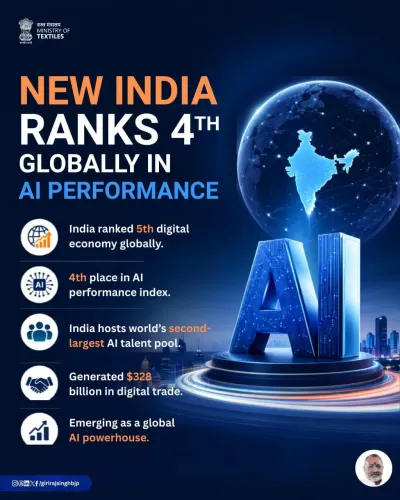
Union Textiles Minister Giriraj Singh amplified a BCG report on 17 June 2026 stating India is becoming the world's top AI hub as global skilled-professional mobility fell sharply in 2025, reinforcing the government's IndiaAI Mission narrative.
Key Takeaways
Union Textiles Minister Giriraj Singh shared a BCG report on 17 June 2026 via the NaMo App citing India's rise as a global AI hub.
The BCG report notes that global movement of skilled professionals fell sharply in 2025 , which the government frames as an opportunity for India.
The Union Cabinet approved the IndiaAI Mission in March 2024 with a ₹10,372 crore outlay to build a 10,000-GPU AI compute facility .
India's AI policy lineage dates to June 2018 when NITI Aayog released the #AIforAll National Strategy for Artificial Intelligence.
Key beneficiaries include India's AI startups and tech professionals who may increasingly choose to stay or return amid tightening global immigration conditions.
Implementation milestones for the IndiaAI Mission and potential new AI skilling provisions in the next Union Budget are the immediate policy markers to watch.
Union Textiles Minister Giriraj Singh on Wednesday, 17 June 2026 shared a report citing Boston Consulting Group (BCG) findings that position India as an emerging global AI hub, noting that the worldwide movement of skilled professionals has fallen sharply in 2025. The minister shared the report via the NaMo App, highlighting what he described as a structural shift in global talent flows that could benefit India's technology ecosystem.
Context
The post references a BCG report titled 'Global Movement of Skilled Professionals Falls Sharply in 2025', framing the decline in cross-border talent mobility as an opportunity for India. Singh's post, in Hindi, reads: 'India is becoming the world's top AI hub, global talent shift sees a decline: BCG Report.' The minister's amplification of the report signals the ruling dispensation's intent to link reduced global skilled-worker mobility to India's domestic AI ambitions.
While the specific statistics cited in the BCG report could not be independently verified, the broader trend of tightening immigration policies in major destination economies — particularly the United States and Europe — has been widely documented as a factor reshaping where skilled professionals choose to work and settle.
Policy Backdrop
India's AI policy architecture has been built steadily over nearly a decade. NITI Aayog released the National Strategy for Artificial Intelligence — branded #AIforAll — in June 2018, outlining seven focus areas including skilling, data governance, and research. The strategy was the first formal articulation of India's ambition to be a global AI player.
The most significant financial commitment followed in March 2024, when the Union Cabinet approved the IndiaAI Mission with an outlay of ₹10,372 crore. The mission aims to establish a 10,000-GPU AI compute facility, build curated datasets, and expand talent pipelines to reduce dependence on foreign infrastructure and retain homegrown expertise.
Since 2018, successive government reports have framed a potential reverse brain-drain — driven by geopolitical friction and immigration tightening abroad — as a strategic window for India to consolidate AI talent within its own digital ecosystem.
Stakeholders and Impact
The primary beneficiaries of this narrative shift are India's AI startups and the country's large pool of tech professionals, many of whom have historically emigrated to the United States, United Kingdom, and Canada. A slowdown in global talent mobility, if sustained, could mean more high-skilled engineers and researchers remain in or return to India, deepening the domestic talent pool available to both startups and large technology firms.
For the government, the BCG findings — as amplified by a senior Union Minister — serve as external validation for the IndiaAI Mission's core premise: that India can build world-class AI capacity at home rather than rely on diaspora expertise abroad. Investors and multinational corporations scouting AI talent globally are also watching India's infrastructure build-out closely.
What's Next
Parliamentary updates on the IndiaAI Mission's implementation timeline — particularly the operationalisation of the 10,000-GPU compute facility — will be closely tracked as a measure of whether policy intent is translating into on-ground capacity. The next Union Budget may also introduce new provisions for AI talent visas or skilling incentives to capitalise on the window that reduced global mobility is seen to have opened.
If the trend of falling cross-border skilled-worker movement persists through 2026, India's ability to convert that demographic dividend into AI leadership will depend on the pace of execution on infrastructure, regulation, and industry partnerships — making the months ahead a critical test of the government's AI strategy.
Point of View
External validation from a firm like BCG lends credibility to claims that have so far rested largely on policy intent. The broader pattern here is the government's consistent effort since 2018 to reframe brain-drain anxiety into a reverse-migration opportunity narrative. Whether the BCG data fully supports the causal link drawn in the post remains to be seen, but the political utility of the framing — India as the destination of choice for global AI talent — is unmistakable.
NationPress
16 Sept 2026
Frequently Asked Questions
What did the BCG report say about India and AI in 2025?
The BCG report, as cited in the post shared by Minister Giriraj Singh, states that global movement of skilled professionals fell sharply in 2025 and positions India as an emerging top AI hub. The specific statistics from the report could not be independently verified.
What is the IndiaAI Mission?
The IndiaAI Mission is a Central government programme approved by the Union Cabinet in March 2024 with an outlay of ₹10,372 crore. It aims to build a 10,000-GPU AI compute facility, develop curated datasets, and expand India's AI talent pipeline.
Why is global talent mobility declining in 2025?
The decline in cross-border skilled-professional movement is broadly attributed to tightening immigration policies in major destination economies such as the United States and Europe, as well as geopolitical frictions reshaping where professionals choose to work.
What is Giriraj Singh's role and why is he commenting on AI?
Giriraj Singh is the Union Minister of Textiles and a senior BJP leader. As a Cabinet minister, he frequently amplifies government policy narratives on the NaMo App, and his post reflects the ruling party's broader messaging around India's technology and AI ambitions.
When did India first announce a national AI strategy?
NITI Aayog released India's National Strategy for Artificial Intelligence, branded #AIforAll, in June 2018. It outlined seven focus areas including skilling, data governance, and research, marking India's first formal commitment to becoming a global AI player.