Giriraj Singh Hails India as Rising Hub for Retail GCCs
Synopsis
Union Textiles Minister Giriraj Singh has spotlighted India's rapid rise as a global retail GCC hub, citing 180 centres, large-scale employment, and increasing AI integration as markers of the country's growing appeal to multinational corporations and its alignment with the Viksit Bharat 2047 vision.
Key Takeaways
Union Textiles Minister Giriraj Singh posted on 20 July 2026 highlighting India's emergence as a major retail GCC destination.
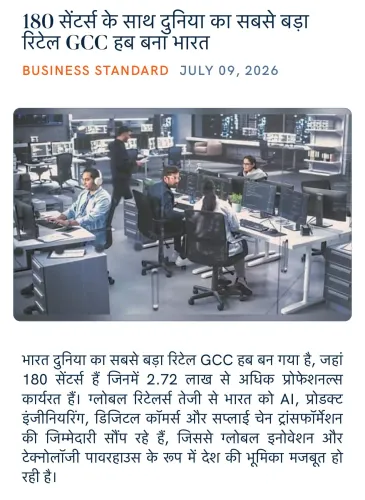
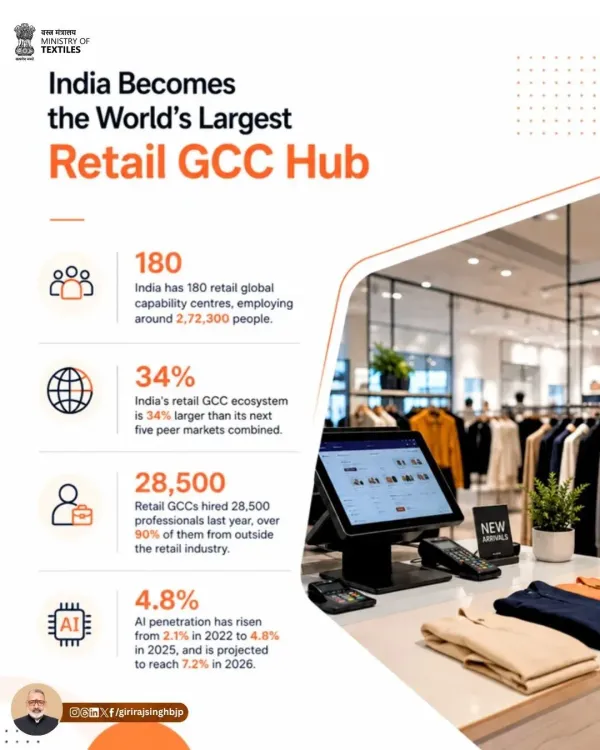
The post cited 180 retail GCCs operating in India, along with large-scale employment generation for Indian professionals.
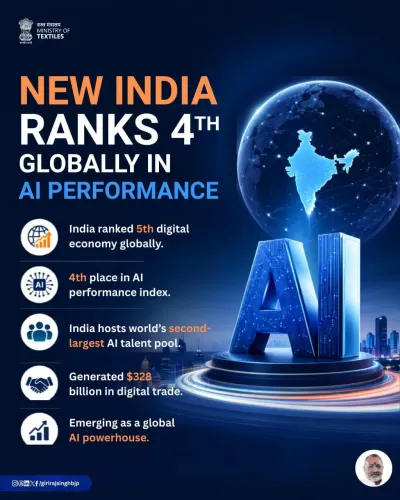
Rising AI adoption within these centres was flagged as a sign that India is moving toward higher-value global business functions.
The development was framed within the Viksit Bharat 2047 vision and the Digital India programme's digital-infrastructure push.
Policy groundwork including Make in India (2014) and Digital India (2015) has been central to making India an attractive GCC location.
Future policy signals to watch include retail and AI-specific incentives in the next Union Budget and updates to services investment policy.
Union Textiles Minister Giriraj Singh on Monday, 20 July 2026 highlighted India's growing stature as a major global destination for retail Global Capability Centres (GCCs), pointing to expanding employment, rising artificial intelligence adoption, and increasing confidence among multinational corporations in India's business environment.
Posting on X, the Minister wrote — 'भारत आज वैश्विक रिटेल GCC का बड़ा केंद्र बनकर नई पहचान बना रहा है' ('India is today carving out a new identity by emerging as a major hub for global retail GCCs') — and cited the presence of 180 retail GCCs, large-scale job creation, growing AI integration, and rising trust from global companies as evidence of India's talent, innovation capacity, and favourable business climate.
Context
Global Capability Centres are offshore delivery hubs established by multinational firms to handle functions such as IT services, data analytics, research and development, and business operations. India has long been a preferred destination for such centres owing to its large English-speaking workforce, cost competitiveness, and progressive liberalisation of foreign direct investment norms.
The retail segment represents one of the newer and faster-growing verticals within the broader GCC ecosystem, reflecting a shift by global retail corporations toward centralising digital, supply-chain, and analytics functions in India.
Policy Backdrop
India's emergence as a GCC powerhouse is closely linked to a series of policy initiatives pursued since the mid-2010s. The Digital India programme, launched in July 2015, aimed to build robust digital infrastructure, promote e-governance, and create an enabling environment for technology-driven businesses — conditions that directly benefit GCC operations.
The Make in India initiative, announced in September 2014, complemented this by improving ease of doing business and attracting foreign investment into both manufacturing and services. Together, these programmes helped shift India's pitch to global investors from cost arbitrage alone toward a broader value proposition encompassing talent quality, digital readiness, and innovation. Minister Singh's post invokes the Viksit Bharat 2047 vision — the government's long-term roadmap to transform India into a fully developed economy by the centenary of independence — framing GCC growth as integral to that national ambition.
Stakeholders and Impact
The primary beneficiaries of retail GCC expansion are Indian tech and analytics professionals, who gain access to high-quality employment in global corporate environments without relocating abroad. For global retail firms, India-based GCCs offer a combination of skilled talent and operational cost efficiency that is difficult to replicate elsewhere.
The Minister's reference to AI adoption signals that these centres are moving up the value chain — from back-office processing toward higher-order functions such as demand forecasting, personalisation engines, and supply-chain optimisation. This trajectory aligns with the government's stated objective of positioning India as a node in high-value global business functions rather than only in traditional outsourcing roles.
What's Next
Observers will watch for data from industry bodies and the central bank on GCC headcount and investment flows to substantiate the scale of growth the Minister described. Any retail-sector or AI-specific incentives in the next Union Budget, or updates to textiles and services policy, could further accelerate the trend.
As global retail corporations continue to deepen their India footprints, the policy environment — spanning digital infrastructure, skilling, and investment facilitation — will be a key determinant of whether India consolidates or merely sustains its current lead in this segment.
Point of View
Signalling that the government views GCC growth as a cross-sectoral economic story rather than a purely technology-sector narrative. By invoking Viksit Bharat 2047 and Digital India alongside AI, the communication deliberately ties routine economic momentum to the ruling party's long-horizon development branding. The emphasis on 'trust' from global companies is also a soft diplomatic signal, reassuring foreign investors about India's policy stability at a time when geopolitical supply-chain realignments are prompting multinationals to diversify their global footprints. Taken together, the post reflects a broader government strategy of using social-media ministerial voices to aggregate positive economic data points into a coherent national-competitiveness narrative.
NationPress
20 Oct 2026
Frequently Asked Questions
What is a retail Global Capability Centre in India?
A retail Global Capability Centre (GCC) is an offshore hub set up by a global retail corporation in India to handle functions such as data analytics, supply-chain management, AI development, and digital operations, leveraging India's skilled workforce and cost advantages.
How many retail GCCs are there in India?
Union Textiles Minister Giriraj Singh cited 180 retail GCCs operating in India in his post on 20 July 2026, though this figure has not been independently verified from established public records.
What is Viksit Bharat 2047?
Viksit Bharat 2047 is the Indian government's long-term national vision to transform India into a fully developed economy by 2047, the centenary of independence, encompassing goals across digital infrastructure, manufacturing, and services.
Why is India a preferred destination for GCCs?
India's large English-speaking and technically skilled workforce, competitive operating costs, progressive FDI liberalisation, and government programmes such as Digital India and Make in India make it one of the most attractive locations globally for multinational GCC operations.
What role does AI play in India's retail GCCs?
Artificial intelligence is increasingly being integrated into retail GCC functions in India, including demand forecasting, customer personalisation, and supply-chain optimisation, enabling these centres to move beyond traditional back-office roles toward higher-value analytical and strategic work.