Giriraj Singh: BharatTex 2026 draws 130+ nations, Rs 14,300 cr bids
Synopsis
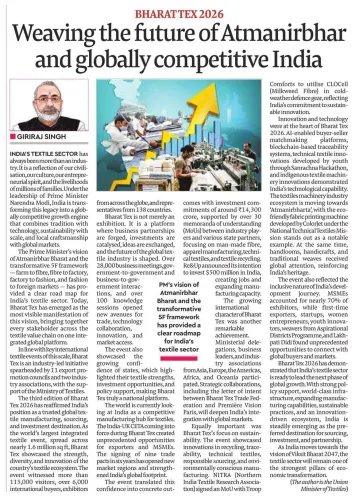
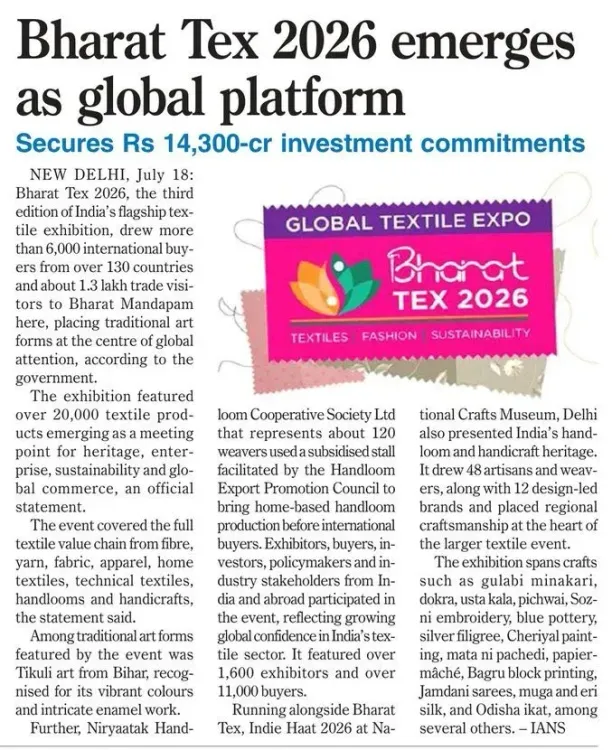
Union Textiles Minister Giriraj Singh has highlighted BharatTex 2026's outcomes: participation from over 130 countries, more than 6,000 international buyers, 20,000-plus products showcased, and investment proposals totalling Rs 14,300 crore — positioning India as an emerging global textile hub under the Viksit Bharat 2047 vision.
Key Takeaways
BharatTex 2026 attracted participation from more than 130 countries .
Over 6,000 international buyers attended the trade fair.
More than 20,000 products were displayed across textiles, handloom, handicrafts, and technical textiles.
Investment proposals worth Rs 14,300 crore were received at the event.
The fair is anchored in the Make in India and Viksit Bharat 2047 policy frameworks.
The PLI scheme for textiles (notified 2021) forms part of the broader incentive architecture supporting such initiatives.
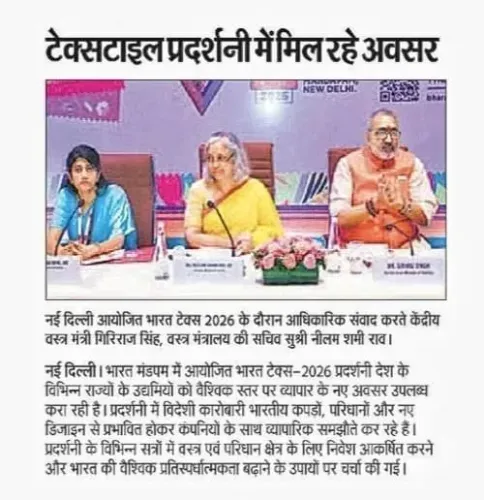
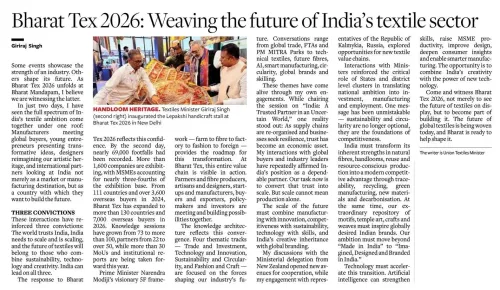
Union Textiles Minister Giriraj Singh on Sunday, 19 July 2026 highlighted the scale of BharatTex 2026, citing participation from more than 130 countries, over 6,000 international buyers, more than 20,000 products on display, and investment proposals worth Rs 14,300 crore as evidence of growing global confidence in Indian textiles.
Posting on X, Singh wrote — 'भारत टेक्स 2026 ने भारतीय वस्त्र उद्योग की बढ़ती वैश्विक पहचान को और सशक्त किया' — 'BharatTex 2026 has further strengthened the growing global recognition of India's textile industry.' He attributed the momentum to the leadership of Prime Minister Narendra Modi and described India as moving rapidly towards becoming a global textile hub.
Context
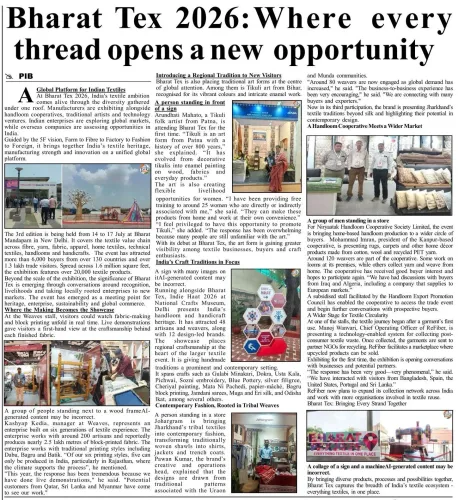
BharatTex is India's flagship international textile trade fair, designed to showcase the full breadth of the country's textile ecosystem — from traditional handloom and handicraft segments to modern technical textiles. The 2026 edition, by the figures cited by the Minister, represents a significant gathering of buyers, exhibitors, and investors from across the world. Singh's post underscores the event's role as a diplomatic and commercial platform, not merely a domestic industry showcase.
Policy Backdrop
The fair sits within a broader policy architecture built over the past decade. The Make in India programme, launched in September 2014, set the template for attracting manufacturing investment across sectors, with textiles identified as a priority. The Production Linked Incentive (PLI) scheme for textiles, notified in 2021, added financial incentives to expand capacity and boost exports, particularly in man-made fibres and technical textiles.
The Viksit Bharat 2047 vision — India's long-term goal of becoming a developed economy by the centenary of Independence — provides the overarching framework within which events such as BharatTex are positioned. Textiles, as one of India's largest employment-generating sectors, is central to that ambition. Singh's post explicitly invokes both #MakeInIndia and #ViksitBharat2047 as the ideological anchors of the event's significance.
Stakeholders and Impact
The sectors on display at BharatTex 2026 — apparel, handloom, handicrafts, and technical textiles — span a wide stakeholder base. MSME exporters and handloom artisans, who form the backbone of India's decentralised textile economy, stand to benefit most directly from international buyer engagement at such a platform. Investment proposals of Rs 14,300 crore, if converted into actual commitments, could translate into capacity additions and employment across producing states.
The emphasis on technical textiles alongside traditional segments reflects a deliberate diversification strategy. Several major economies have been realigning supply chains since 2020, and India has positioned itself as an alternative sourcing destination — a narrative that trade fairs of this scale are designed to reinforce.
What's Next
The critical test will be the conversion of investment proposals into on-ground commitments. Follow-up realisation reports from the textiles PLI scheme will indicate how much of the announced interest translates into factory floors and export orders. Any new policy measures in the next Union Budget targeting textile infrastructure, logistics, or export incentives will signal whether the government intends to sustain this momentum. For now, BharatTex 2026 has set a high benchmark for India's ambitions in global textile trade.
Point of View
Linking a trade fair's headline numbers directly to the Prime Minister's policy legacy. The invocation of both Make in India and Viksit Bharat 2047 signals that the Ministry is consciously embedding sectoral milestones within the larger national narrative ahead of the 2047 deadline. The emphasis on technical textiles alongside handloom and handicrafts reflects a structural pivot — moving India's textile identity beyond low-cost apparel into higher-value, future-facing segments. The real measure of success, however, will be investment realisation rates, which historically lag well behind the figures announced at trade events.
NationPress
18 Oct 2026
Frequently Asked Questions
What is BharatTex 2026?
BharatTex 2026 is India's flagship international textile trade fair, showcasing apparel, handloom, handicrafts, and technical textiles to global buyers and investors.
How many countries participated in BharatTex 2026?
According to Union Textiles Minister Giriraj Singh, more than 130 countries participated in BharatTex 2026.
What were the investment proposals at BharatTex 2026?
Investment proposals worth Rs 14,300 crore were received at BharatTex 2026, as cited by Minister Giriraj Singh on X.
What is India's PLI scheme for textiles?
The Production Linked Incentive scheme for textiles was notified in 2021 to expand manufacturing capacity and boost exports, particularly in man-made fibres and technical textiles.
What is Viksit Bharat 2047?
Viksit Bharat 2047 is India's long-term national vision to become a developed economy by 2047 , the centenary of Independence, with textiles identified as a key contributing sector.